It gets increasingly difficult to manage a fast-growing business if important data remains all over the place. Customer data is stored in spreadsheets, and sales information in other systems.
Thus, people have to spend many hours gathering, cleaning and verifying data. This process not only reduces productivity but also causes expensive errors in various operations.
And outdated data may lead to the loss of lucrative deals before people react. Data as a Service (DaaS) provides a more pragmatic solution to that problem. This is the possibility for enterprises to get reliable data without any infrastructure management.
People have the opportunity to gather, process, organize and access information through various services. This helps entrepreneurs to make decisions quickly and manage operational complexity efficiently.
However, to use this technology properly, people should understand it better. They should know what it is, where it brings value and where it is applicable. This comprehensive guide provides answers to these questions.
What Is Data as a Service?
Data as a Service provides businesses with information on demand via cloud services. Rather than creating expensive systems, businesses get access to data via centralized, scalable systems.
In essence, DaaS allows businesses to have an external team for data processing without hiring one. A DaaS vendor accumulates data from various sources and prepares it for consumption by the business.
The sources of data may include customer information, market trends, financial data or product information. Access to the data is provided via different means such as dashboards, databases, APIs, etc.
For instance, a retail store online monitors the prices of its competitors on many products. Such development will require heavy investments in the technological solution and its maintenance. A DaaS vendor can take care of all these tasks, providing structured data on demand.

How Does DaaS Work for Modern Businesses?
DaaS typically follows a straightforward process from collection through final data delivery. First, providers collect information from databases, websites, applications, sensors or external sources.
Next, they clean and organize that information to improve consistency and usability. The processed data then moves into cloud environments for secure storage and management.
Businesses access information through APIs, dashboards, analytics platforms, or direct integrations. Providers can also update information continuously, depending on business requirements and service capabilities.
This creates a flexible model where companies consume data without managing everything internally. For growing businesses, that flexibility becomes especially valuable during rapid expansion.
A company entering five new markets may suddenly need thousands of additional data points. DaaS can provide those resources without requiring an equally large infrastructure investment.
Businesses handling larger datasets can also benefit from data warehousing solutions. A centralized warehouse helps consolidate information from different systems for analysis.
Why is DaaS Important for Entrepreneurs?
Entrepreneurs frequently require accurate information to make important decisions. However, the collection of such information may take up time and resources on the inside.
DaaS helps entrepreneurs save time by providing instant information using various services. This way, it enables rapid experimentation without having to invest in technologies upfront.
For instance, if a startup needs to experiment in new markets, they will be able to obtain demographic information instantly.
Then, they will be able to make a comparison and allocate their budget for marketing only after that. Therefore, DaaS is especially helpful for companies that are looking for agility and decision-making.
In addition, it paves the way for developing analytics, automation, and artificial intelligence.
How Does DaaS Function for Modern Enterprises?
Data as a Service is based on several interconnected steps that make accessing data easier.
Knowing how DaaS functions will help business owners decide if DaaS is suitable for their businesses.
- Data Collection and Integration: Data providers start collecting data from multiple internal and external sources in the first step. Sources may include databases, applications, websites, APIs, sensors, and external platforms. Integration is connecting all those sources together and building a single ecosystem for business data.For instance, retailers can integrate customer, inventory, sales, and marketing data. It is not necessary for employees to manually collect any data. Moreover, businesses can automate this process with the help of API integration services. Through API integrations, various applications can exchange data automatically.
- Data Storage and Accessibility: After processing, information needs a secure and scalable storage infrastructure. Cloud-based environments allow businesses to access information without maintaining physical infrastructure.Teams can retrieve information through dashboards, APIs, databases, or connected applications. This accessibility becomes increasingly important as companies expand their data volumes. Modern cloud application development services can support scalable systems around these environments. Businesses can also centralize information through data warehousing services. This creates a more consistent foundation for reporting, analytics, and decision-making.
- Information Storage and Accessibility: After processing, there is a need for secure and scalable data storage systems. Cloud systems provide organizations with a means of accessing information without having any physical systems.
Information can be accessed from dashboards, APIs, databases, and applications linked to the system. The importance of this is evident as organizations increase their volume of information.
Modern cloud application development services can be used for creating scalable systems based on such environments. It is possible to centralize information using data warehousing services. - Data Delivery and Regular Updation: The last phase comprises the delivery of data based on certain business criteria. While some businesses require regular updates, others may need information instantly. Instant information delivery gains importance in areas such as finance, retail, logistics, and customer-facing operations.
An e-commerce enterprise, for instance, may receive real-time data on inventory levels by tracking orders. Similarly, the sales team can have instant access to customer information without the need for reports. Thus, the decision-making environment becomes more dynamic and operates in near-real-time.
A Simple Process of DaaS
A complete understanding of the whole process is available through the following simple model.
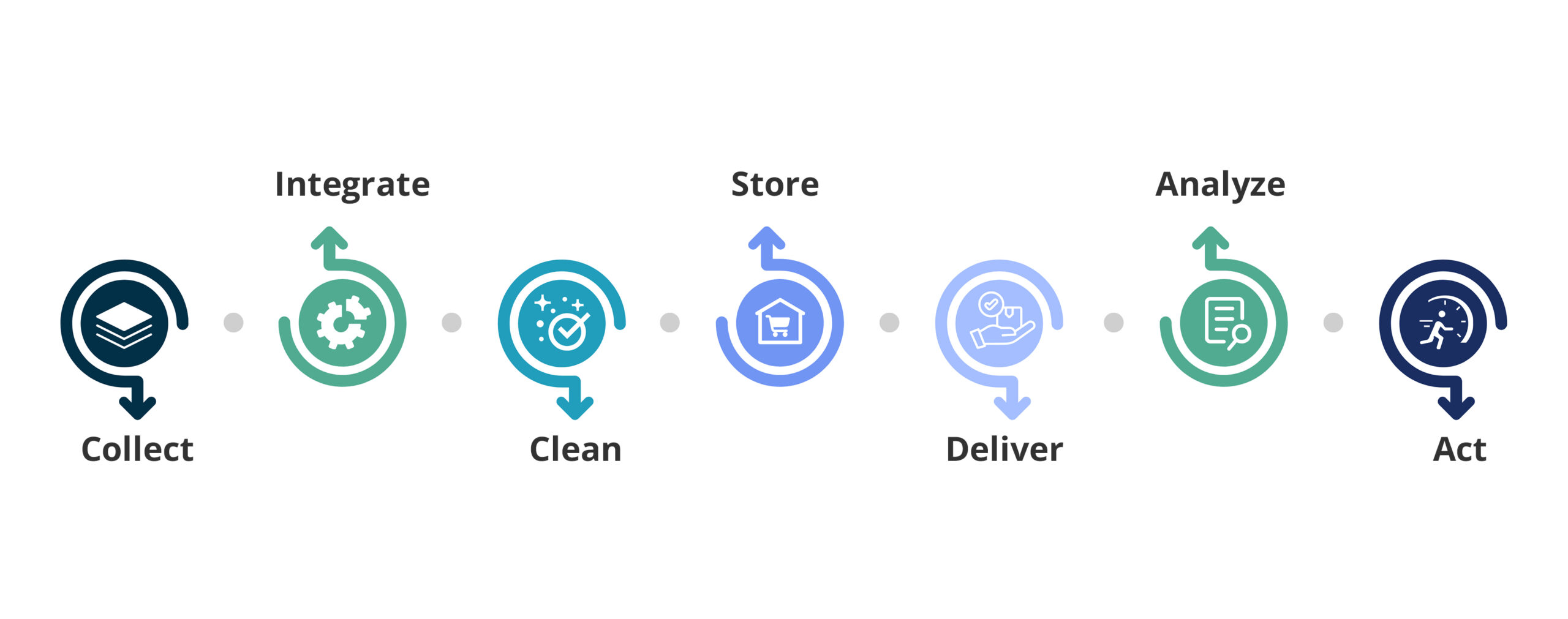
Every phase helps to make business information more accessible and useful. The actual benefit arises from integrating all phases in one process.
Thus, when information is processed seamlessly, management will have less time spent on manual data management. Instead, they can interpret information and take necessary action on that basis.
What Problem Does a DaaS Architecture Solve?
Your company is unlikely to have a shortage of data; you have a problem accessing it. Customer data exists in your CRM, sales data elsewhere, and reporting data arrives late.
In effect, your staff spends time looking for data rather than using it. A good DaaS architecture resolves this issue through the creation of a single reliable data stream.
It brings together multiple sources of data, processes the data and provides the data at the right time.
Does DaaS Solve the Problem of Connecting Data Held in Various Business Applications?
Growing companies tend to have many applications because their needs grow. There is one platform for marketing and another for sales, while finance runs elsewhere.
The problem is that these applications generate useful data, but not necessarily exchangeable data. DaaS architecture bridges the gap between these data silos.
A typical e-commerce company could integrate customer data, orders, inventory, and advertising metrics. This way, management gets a clearer picture of the company’s performance.
Data integration service solutions can be used to integrate these disparate applications.
This way, there will be fewer spreadsheets, exports and reconciliations.
How Can Firms Prevent Themselves from Making Mistaken Decisions Based on Stale Data?
Lagging information can render a report that was valid yesterday obsolete already. Think of the surprise when you realize that your most popular product is now out of stock.
You can keep running your marketing campaign with the wrong product. But with a proper DaaS framework, you can enable automation and real-time data delivery.
Data gets transferred from the source systems to the processing environments without human intervention. People will be able to consume their information using dashboards, applications, or APIs.
What If Business Data Is Inconsistent?
Multiple systems refer to one and the same client or product using various terms. One system may use “United States,” whereas the other one may use “USA.” These little inconsistencies often cause major reporting issues.
Data processing makes data consistent prior to the decision-making process. It helps to detect duplicates, correct formats, validate data entries and find gaps.
This way, an absolutely trustworthy basis is created for analytics and reporting. A business may improve such a basis by means of data engineering services.
What Ensures that Increasing Data Will Not Become an Infrastructure Issue for DaaS?
Data needs are unlikely to remain static during company growth. For instance, a startup may have thousands of data points at its current stage but millions in just a few years.
Creating infrastructure based only on present needs will result in costly mistakes in the future. With scalable cloud infrastructure, the system can scale along with increasing business needs.
That is to say that entrepreneurs would be able to increase their data activities without having to restructure their technological environment every time.
Why Are APIs Important In a DaaS Setting?
There is no requirement for companies to use all the available information simultaneously. There is a need for the right kind of information to be available in the application that will make the decision. APIs enable this by giving the systems the ability to demand certain information automatically.
Take the example of a lending application checking the client information during an application process. It can access relevant information automatically without any manual effort being made.
API development services enable companies to establish secure connectivity between their data and applications.
How Does DaaS Help AI and Business Intelligence?
The usefulness of DaaS increases when companies begin treating information not as storage but as an asset.
AI, analysis and automation all require information that is reliable, easily available and constantly updated.
- Better analytics: Information stored in one place enables teams to have cleaner datasets for dashboards, reporting, forecasting and analysis.
- Faster AI implementation: Properly organized information saves time on data pre-processing before companies implement machine learning and generative AI.
- Forecasting: Both historical and current information might be helpful in finding patterns in demand, customers’ behavior, and operations.
- More personalized experience: Customer information will allow businesses to deliver more tailored recommendations and services.
- Automated decisions: APIs and pipelines can automate processes when certain patterns emerge in business operations.
- Better operational transparency: The management of companies can analyze performance using information from different departments without having to create reports manually.
- Reliable AI results: Reliable datasets decrease the chances of receiving unreliable results due to inconsistent and poor information.
DaaS Use Cases in Various Industries
DaaS is used by organizations where accurate and timely information impacts key decision-making processes.
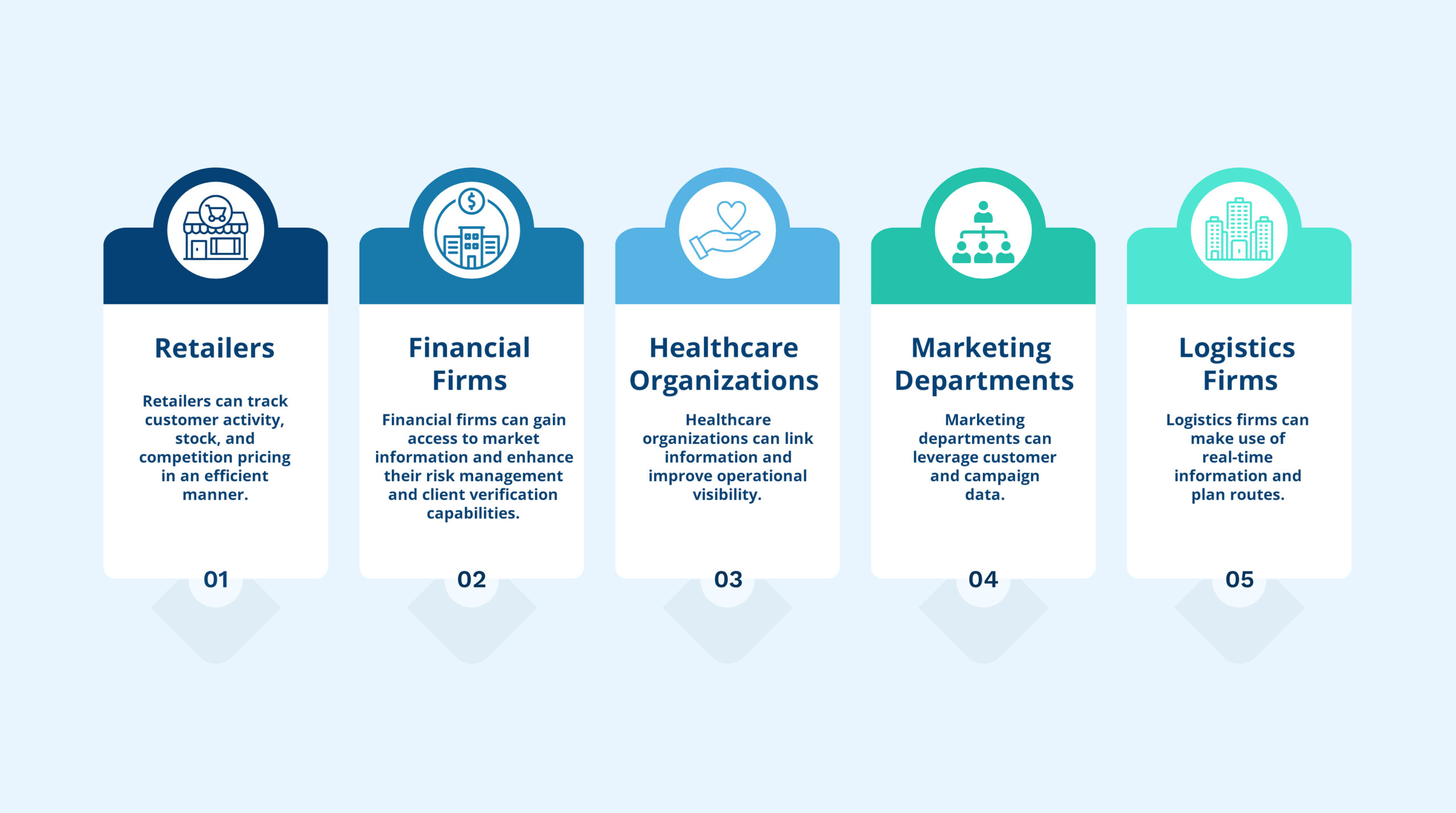
- Retailers can track customer activity, stock, and competitive pricing in an efficient manner.
- Financial firms can gain access to market information and enhance their risk management and client verification capabilities.
- Healthcare organizations can link information and improve operational visibility.
- Marketing departments can leverage customer and campaign data.
- Logistics firms can make use of real-time information and plan routes.
The underlying principle is straightforward: DaaS facilitates gaining access to valuable information.
What Are the Key Benefits of Data as a Service to Businesses?
For entrepreneurs, the importance of data-as-a-service lies in their ability to make better decisions while keeping operations simple. The following are the advantages that may count the most:
1. Cut Down on the Cost of Poor Quality Data:
Poor data quality is not just an IT problem. This problem might lead to monetary losses. According to Gartner, poor data quality costs businesses an estimated minimum of $12.9 million every year. DaaS allows firms to develop cleaner and more accessible data. It avoids any problems of duplication of records, inconsistency in reporting, and unreliable insight of business.
Better quality of data will protect start-ups from making costly mistakes based on poor information.
2. Make Decisions Quicker
A delay in receiving a report for even a few days could prove to be very costly, especially during changing markets. DaaS makes the information available quicker to the team from the connected business systems.
As per McKinsey, effective use of data and analytics would give measurable improvement in decision-making and performance. This means that the entrepreneur would be able to spot any changes in the customers’ behavior.
They would be able to change their pricing, marketing, inventory or sales strategy accordingly.
3. Minimize Manual Data Efforts
Managers should not be required to spend several hours downloading spreadsheets and combining data manually. Automated pipelines allow for repetitive collection, transformation, and delivery.
This means that employees will have more time for analysis, customer interactions, and income generation. The benefit is evident: there is no need to waste time on data management and analysis.
4. Scale Without Needing to Rework the Entire Infrastructure
The growth of a company brings more customers, more transactions, new apps, and additional data. A solution like DaaS provides scalable infrastructure that can grow along with changing needs.
Thus, entrepreneurs do not need to change the entire data management system each time they want to scale their business.
5. Build One Single Business Information Source
Each department tends to store the same data in its own way. For example, sales can state one revenue number while the finance department states another. DaaS helps in building a consistent data environment with consolidated data.

How Can Businesses Keep DaaS Data Secure?
DaaS makes business information more accessible, but that accessibility requires stronger controls around privacy, permissions, and infrastructure.
- Integrate security into architecture: Safeguard information from collection to delivery through encryption, authentication, monitoring, and restricted access.
- Grant access depending on job roles: Limit access rights to the extent that employees, applications, and business partners can have only access to the information needed by them to perform specific jobs.
- Make secure integrations and APIs: Secure integrations and APIs by authenticating connections, encrypting data transmissions, and monitoring APIs for unauthorized access.
- Focus on data quality and governance: Develop ownership, validation, retention, and utilization policies to avoid risks caused by inaccurate or poorly handled information.
- Protect cloud computing infrastructure: Constantly evaluate configuration, storage access, network control, and authentication settings to avoid unnecessary cloud security issues.
- Plan for AI-related threats: Ensure proper controls for any information that may go into the AI applications and develop policies for the use of models.
- Perform continuous monitoring: Detect possible threats by observing unusual access, failed authentication attempts, data transmission, and configuration changes.
- Develop a response and recovery strategy: Identify responsibilities and procedures for recovery before the actual incidents happen.
What Are the Greatest Challenges for Entrepreneurs Using DaaS?
DaaS helps make data management easier, but it doesn’t take away any risks for the business.
The correct strategy here is to determine these risks and protect the business against them in advance.
Below are the challenges entrepreneurs must keep in mind while considering implementing DaaS.
- Poor Data Quality May Ruin Everything: A DaaS provider will not be able to draw valuable insights from low-quality data. Issues such as duplicate entries, missing data, outdated data, and formatting problems may affect decision-making in the company negatively. Poor data quality costs an organization approximately $12.9 million every year, according to Gartner. It is important, thus, to check data quality first, not the dashboards provided by the DaaS service.
- Security Becomes More Important as Data Becomes Accessible: Making information easier to access also increases the importance of controlling that access. Weak permissions can expose sensitive customer, financial, or operational information. IBM’s 2026 research puts the financial risk into perspective. The global average data breach cost reached $4.99 million in 2026. Businesses should prioritize encryption, identity controls, monitoring, and secure data transfer. Solutions such as cloud security services can strengthen protection across connected environments.
- Integration Issues May Cause More Information Silos: Just because you have added another layer doesn’t necessarily mean you have solved the problem of disconnected systems. Integration issues can cause another silo to emerge that you need to deal with. Check the capabilities of your chosen provider and whether or not they have any integration possibilities. Check connections for your CRM, ERP, analytics software, and customer-facing solutions. Otherwise, your DaaS platform may turn into another siloed system.
- You Need to Be Ready for Compliance Complexities: Companies processing personal information need to know where the data comes from and how it is transferred. Different regions can have different requirements in relation to privacy and retention of data. The provider needs to be clear about the storage location, access, retention policy, and compliance features. It is especially relevant when the data crosses geographic and compliance borders.
How Can You Choose the Right DaaS Provider?
Choosing a DaaS provider should begin with your business requirements, not an impressive list of technical features.
Use this quick evaluation framework before signing any long-term agreement:
- Data accuracy: Verify source quality, update frequency, validation processes and historical accuracy before depending on provider information.
- Integration capabilities: Check whether APIs, connectors, and existing integrations can work smoothly with your current technology stack.
- Scalability: Choose infrastructure capable of handling increasing data volumes without creating expensive migrations or performance bottlenecks.
- Security standards: Review encryption, authentication, access controls, monitoring, compliance certifications, and incident-response procedures before sharing sensitive information.
- Data freshness: Confirm how frequently information gets refreshed, especially when your decisions depend on changing market conditions.
- Pricing structure: Understand subscription fees, API usage charges, storage costs, additional users, and potential overage expenses beforehand.
- Service reliability: Examine uptime commitments, support availability, recovery procedures, and service-level agreements protecting critical business operations.
- Data portability: Confirm that your information can be exported easily if your business eventually changes providers.
What Is the Future of Data as a Service?
DaaS is moving beyond simple data access as businesses demand faster, smarter, and more connected information.
Several developments are reshaping how companies will collect, manage, and use data:
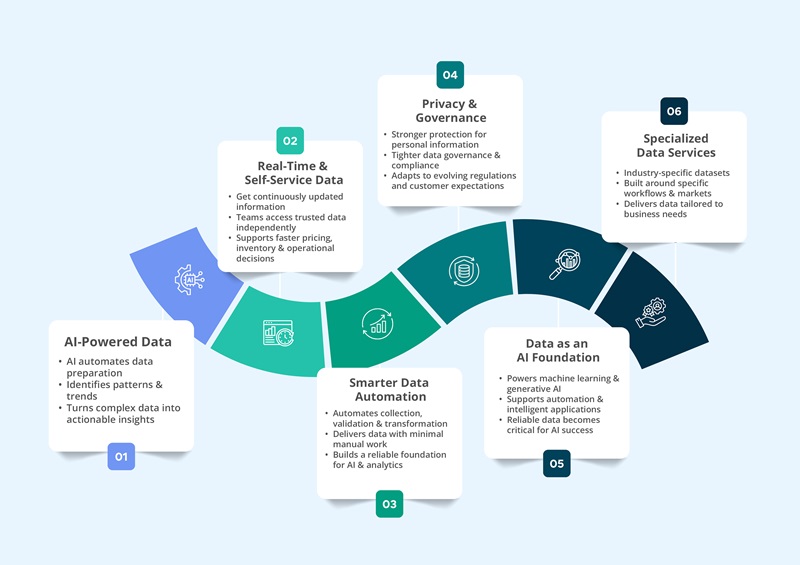
- AI-powered data services: Artificial intelligence will increasingly automate data preparation, identify patterns, and generate actionable insights from complex datasets.
- Real-time information delivery: Businesses will increasingly expect continuously updated information for pricing, inventory, fraud detection, personalization, and operational decisions.
- Self-service data access: More teams will access trusted information independently, reducing their dependence on technical teams for everyday reporting.
- Greater data automation: Automated pipelines will handle collection, validation, transformation, and delivery with minimal manual intervention.
- Stronger privacy expectations: Businesses will need tighter governance as regulations and customer expectations around personal information continue evolving.
- Data becoming an AI foundation: Reliable DaaS infrastructure will increasingly support machine learning, generative AI, automation, and intelligent business applications.
- More specialized data services: Providers will increasingly offer industry-specific datasets designed around particular workflows, markets, and decision-making requirements.
The opportunity is significant because global data creation continues expanding rapidly.
IDC has projected that the global datasphere could reach 291 zettabytes by 2027, highlighting the scale of information businesses must manage.
For entrepreneurs, the lesson is straightforward: building reliable data capabilities today creates greater flexibility for tomorrow.
What Do Organizations Need to Do Right Now?
- Perform a data audit: To know where your valuable information resides and where it is lacking so that decisions are not slowed down.
- Focus on workflows that have value: Start with information flows that can make money or save costs through improved efficiency and customer experience.
- Create scalable infrastructure: Pick an architecture that will support future analytics, automation, integrations, and artificial intelligence implementations.
- Measure the results of your business: Time savings, efficiency savings, decision speed, accuracy of information, and increased revenue.

Conclusion
DaaS is gaining importance as companies face more complex data needs. It enables firms to use quality data without being bogged down with the associated infrastructure and maintenance needs.
Moreover, DaaS links the data with speedier decision-making, efficient processes, and opportunities with AI.
Nevertheless, several considerations have to be planned for successfully adopting DaaS – security, integration, quality, scalability, and measurable benefits.
Entrepreneurs should start with one concrete problem and proceed from there. In fact, with the right strategy, data can fuel a company’s growth.
SoftProdigy helps businesses design scalable data solutions for analytics, automation, integrations, and digital growth. It is time to take advantage of this opportunity.