Customers drop off when experiences feel disconnected. They face delays and irrelevant messages. Therefore, businesses lose revenue quietly every week.
A promising lead fills out a form on Tuesday. No reply comes from the business until Thursday. By then they head towards a competitor. No one notices and revenue walks away. These are not random failures. They are expensive automation failures happening every week.
But can all this be solved? Wondering how? Customer journey automation fixes them. It delivers the right message at the right time across every stage. Smart systems nurture leads, onboard users and retain buyers without adding headcount.
Want to learn all about it? Let us begin by understanding customer journey automation.
What Is Customer Journey Automation?
Customer journey automation is the practice of using software to trigger the right action at the right moment across every stage of the buyer lifecycle. Instead of relying on manual follow-ups, it uses data, behavioral triggers and automated workflows to keep customers moving forward.
That sounds simple. But the implication is significant.
Most businesses have a customer journey. What they do not have is a system for delivering it consistently. The journey exists in the heads of their best salespeople, in informal onboarding habits and in the institutional knowledge of whoever handles customer success that week.
When that person is busy, the journey simply does not happen. As the team scales, those gaps multiply and when customers come in faster than the team can manage, the experience starts to degrade.
Automation does not replace judgment. It makes the judgment systematic. It captures what your best people do naturally and runs it at scale, every time, for every customer. That is the goal of every custom software system we build in this space.
The other thing it solves is timing. Human teams respond when they are available. Automation responds when the customer is ready. Those are almost never the same moment.
A customer researching your pricing page at 9 PM on a Thursday is at a specific decision point. Forrester Research found that companies using automated lead nurturing generate 50% more sales-ready leads at 33% lower cost. The gap is not marketing spend. It is response timing.
Customer journey automation closes the timing gap. It closes the consistency gap, the post-purchase gap and the retention gap. All at the same time.
The 6 Stages of the Customer Journey And What to Automate at Each Stage
Every customer moves through six stages before and after they buy. Most businesses only automate one or two of them. That is where revenue leaks happen.
Here is what should be automated at each stage.
|
|
How Does the Automation Engine Actually Work?
You do not need to understand the code. But understanding the architecture makes better decisions possible. Customer journey automation runs on five interconnected layers.
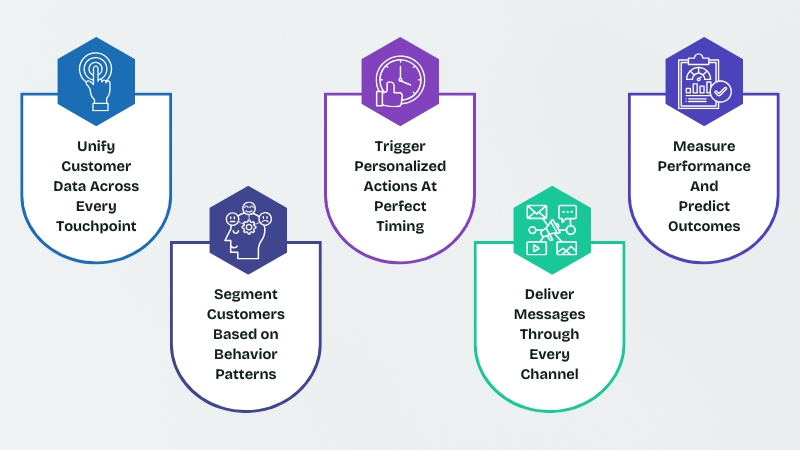
- The data layer:
Every automation system starts with signals. A page visit. A form submission. A purchase. An email was opened but not acted on. A login that did not happen for 14 days. These signals exist in multiple places: your website analytics, your CRM, your email platform and your product database. The data engineering team pulls them into one unified customer record that updates in real time.
This layer is the one most businesses underinvest in. When data is fragmented or stale, every automation layer above it produces wrong outputs. The right message goes to the wrong person. The right person gets nothing. - The segmentation layer
Once you have clean data, the system groups customers by behavior, lifecycle stage, and intent level. Rule-based segmentation works from simple conditions. AI-driven segmentation goes further. It scores each customer’s likelihood to buy, churn, or upgrade using patterns across your entire customer base. Nucleus Research found that marketing automation improves sales productivity by 14.5%. Segmentation is the mechanism. - The workflow layer
This is the logic itself. Triggers fire based on what customers actually do, not what you assumed they would do. Branching logic means no two customers have to follow identical paths. The system adapts to real behavior. This is the layer where most DIY automation falls apart. It is also where custom software development delivers the most value: building logic that matches your actual customer behavior, not a template. - The delivery layer
The system sends across every channel the customer uses. Email, SMS, push notification, in-app message, WhatsApp, ad retargeting. Chatbot development layer adds conversational touchpoints where live interaction increases conversion. A customer who does not respond to email may respond immediately to a well-timed chat prompt. - The analytics layer
Every action feeds a performance dashboard. Which workflows generate revenue? Which stages leak. Which channels work for which segments? Predictive analytics services add a forecasting layer on top of this, identifying which customers are most likely to convert, churn, or upgrade before the obvious signals appear.
Platform or Custom Build: An Honest Decision Framework
Wondering which would work for you? Let us walk you through it.
When is a platform the right call?
Your journey is linear and relatively simple. Your team is small. You need something working within weeks. Tools like HubSpot, Klaviyo, and ActiveCampaign are well-built for these situations. However, if you are on this path and want a rapid deployment, low-code and no-code development services can get a solid platform implementation live quickly.
When does a custom build make more economic sense?
Your journey has conditional complexity that no single platform handles cleanly. You have multiple products, multiple customer types, or multi-brand operations. You are in healthcare, fintech or another sector where data handling is not negotiable.
Or you have reached the point where platform workarounds exceed the cost of a better system. Enterprise software development teams handle this level of complexity end to end.
Gartner projects that by 2026, 75% of organizations will have moved toward composable or custom marketing technology stacks. But the move should be made for the right reasons, not because custom sounds more impressive.
Customer Journey Automation Patterns Across Seven Industries
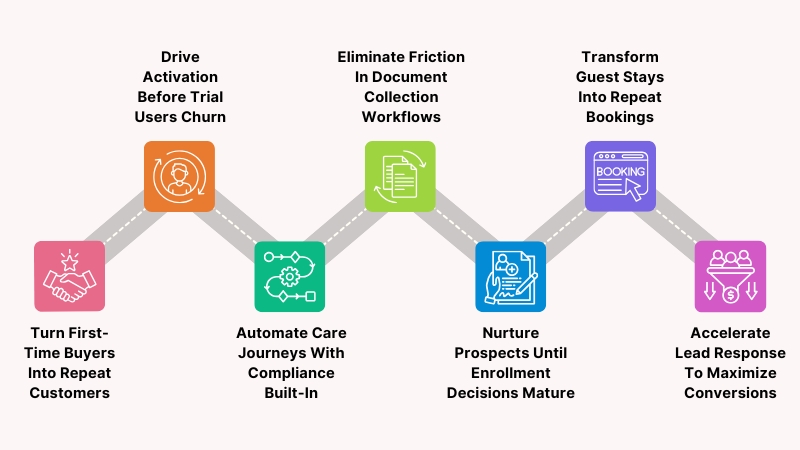
The mechanics of customer journey automation are the same across sectors. What changes is which stage has the biggest leak, which channel the customer actually responds to, and what the specific trigger looks like.
- E-commerce:
The cart abandonment sequence is well understood. What most e-commerce brands miss is the post-first-purchase journey. A customer who buys once and never hears from you again has a low probability of buying twice. A customer who receives a personalized product guide within 24 hours, a recommendation based on what they bought, and a loyalty milestone at 30 days has a meaningfully higher one. - SaaS:
The onboarding stage is the revenue-critical one. A trial user who does not activate the core feature in the first seven days is almost certainly going to churn. Product engineering team builds the event-tracking infrastructure that makes behavioral trigger automation possible inside a SaaS product. Knowing exactly which feature a user has not touched, and triggering the right sequence at exactly the right moment. - Healthcare:
Pre-visit automation reduces missed appointment rates by around 30% in the implementations we have seen. The post-visit journey is underused. For any healthcare implementation, the compliance architecture is non-negotiable.
See how we approach this in our EHR software development guide for more context on how we think about compliance in regulated sectors. - FinTech:
Document collection is where most fintech journeys stall. An automation system that tracks exactly which documents have been submitted and follows up only on the missing ones reduces time-to-completion by over 50% in most cases we have built. Compliance automation for consent management and audit trail logging runs alongside the customer-facing journey, not separately from it. - Education:
The decision window for prospective students is longer than most admissions teams realize. A nurture sequence that runs over 21 days, with messages timed to specific decision milestones, converts significantly better than a three-email blast. The internal signal that matters most is when a prospect opens a fees or scholarship email more than twice. That is the moment to escalate to a human conversation. - Hospitality
Pre-stay automation has become standard. Post-stay automation has not. A review request 24 hours after checkout, combined with a personalized rebooking offer tailored to what the guest paid for, creates a compounding effect on both reviews and repeat bookings. - B2B services
Speed from demo request to first conversation is a bigger conversion factor than most B2B teams realize. The agentic AI routing we build for B2B clients handles this assignment logic, connecting deal size, territory, and rep availability in real time. A prospect who receives a calendar link within 10 minutes of submitting a form converts at a higher rate than one who waits until the next morning.
How Do We Build Bespoke Customer Journey Automation?
- Journey Audit We map every current touchpoint and identify every gap. Where do customers drop off? Where do they stall? Where do they move fast? This produces a journey map with annotated problems, not just a diagram. It takes one to two weeks. Skipping it is the most expensive shortcut a business can take.
- Data Architecture Review We audit every data source. CRM records, website event data, email history, purchase data, support logs. Our data engineering team identifies the gaps, the duplication, and the disconnects. Clean unified data is the foundation everything else depends on.
- Segmentation Design We design the segmentation model from the ground up. Behavioral segments, intent scoring rules, lifecycle stage definitions. We decide which logic is rule-based and which calls for an AI/ML model based on your data volume and customer base complexity.
- Workflow Architecture We design every workflow on paper before writing code. Triggers, branches, time delays, escalation logic. We pressure-test each one against real customer behavior patterns. The logic has to hold up against edge cases before it runs on real customers.
- Channel and CRM Integration We connect every channel into one orchestration layer. Email, SMS, push, in-app, WhatsApp, and ad platforms. We build bidirectional CRM integrations using custom software development capability, with real-time sync. No nightly data jobs. No manual updates.
- AI and Predictive Layer For clients with the data volume to support it, we add predictive analytics, churn scoring, next-best-action recommendations, and LLM-powered personalisation that generates unique content at individual customer level. This is the layer that separates a system that learns from one that does not.
- Compliance and Testing Every workflow runs against edge cases before launch. For regulated sectors, we validate GDPR consent management, suppression logic, and data retention against specific regulatory requirements. Our specialized testing team handles this validation systematically.
- Phased Launch and Iteration We deploy in phases. Analytics run from the first day. We establish monthly review cycles before handing over. A customer journey automation system is not a project with an end date. It is a system with an owner and an improvement cycle. We make sure both exist before we finish.

Case Study: What We Built for Vendome
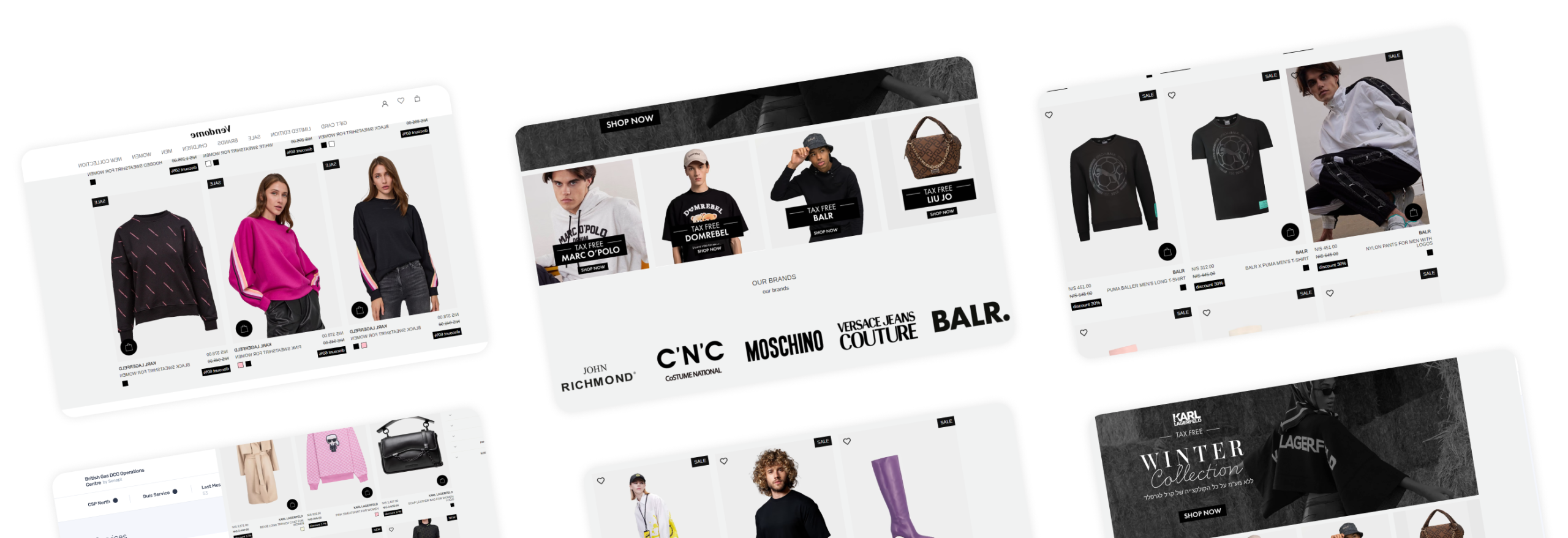
Vendome had traffic. They had premium brands. They had a Shopify store that was technically functional. What they did not have was any automation layer between the moment a visitor arrived and the moment they either bought or left.
Visitors browsed and left. Carts were abandoned and stayed abandoned. First-time buyers received no follow-up. There was no re-engagement mechanism for customers who had gone quiet. The entire post-visit and post-purchase experience depended on the customer choosing to come back on their own.
The journey audit showed three major drop-off points: the product page, the cart, and the checkout. Each had a different cause. The product page had friction in the browsing experience. The cart had no recovery mechanism. The checkout had too many steps for a premium customer experience.
What did we build?
- Complete digital experience rebuild on Shopify, addressing the product page friction and removing checkout steps that were creating abandonment
- Behavioral trigger sequences for product page abandonment and cart abandonment, personalised to the specific items each customer had viewed
- Post-purchase sequence for first-time buyers: day 1 confirmation with a styling guide specific to their purchase, day 7 check-in, day 30 loyalty acknowledgement
- Product recommendation engine using machine learning on browsing history and purchase data to surface relevant items on return visits
- Re-engagement sequence for customers who had made one purchase but not returned in 60 days, with sentiment-based escalation logic to identify disengaging customers early
What were the results within 2 months?
- NPS up 37%. The sharpest driver was the post-purchase experience. Customers who received the styled follow-up sequence rated their experience significantly higher.
- Bounce rate down 35%. Product page and checkout improvements reduced the friction that was causing early exits.
- Daily sessions at 800. Improving the on-page experience had a secondary SEO effect. Better engagement signals lifted organic visibility. Triggered emails brought returning visitors back.
- 22 to 30 orders per day. For the first time in the store’s history, daily order volume was predictable. Abandoned cart recovery alone accounted for a consistent share of this.
The wider lesson
Vendome did not have a traffic problem or a product problem. They had a journey problem. The customer arrived with intent, found something they wanted, and then encountered no system designed to bring them across the line or bring them back.
The automation we built did not create demand. It captured demand that already existed but was being lost to friction and silence.
That is almost always the case. The businesses with the most to gain from customer journey automation are not the ones with weak products. They are the ones whose products are strong but whose post-visit and post-purchase systems have not kept up.
Wrapping Up
Many businesses focus heavily on attracting customers and closing sales, but the customer journey does not end at the point of purchase.
After a customer buys, there are often missed opportunities to provide support, answer questions, encourage repeat purchases, or strengthen the relationship. Over time, these gaps can affect customer satisfaction, retention, and long-term growth.
Customer journey automation helps address these challenges by ensuring customers receive the right communication and support at the right stage of their journey. Whether it is onboarding, follow-up emails, personalised recommendations, or re-engagement campaigns, automation creates a more consistent experience without relying on manual effort.
The goal is not to replace human interaction. It is to make sure important touchpoints are not overlooked as a business grows. When implemented thoughtfully, customer journey automation can help businesses create smoother experiences, build stronger customer relationships, and improve retention over time.