Do you know your website doesn’t need an audit at the end of the quarter to experience problems? Customers leave forms blank, pages become slower, product descriptions go out-of-date and conversion rates change daily.
And what’s even worse? Your team might find out about the problems long after the traffic and leads have been lost. But site optimization with agentic AI solves that problem in a few seconds.
Additionally, AI agents could monitor website performance, identify patterns, suggest measures, and even implement changes when appropriate as part of the workflow. From finding out from customers what they really want to automatic SEO audits and conversion optimization, there is plenty of room to automate things.
In this article, we’ll discuss how agentic AI can help you and what can and cannot be automated yet.
Why Is Site Optimization with Agentic AI Becoming Necessary?
Agentic site optimization is becoming increasingly relevant since websites tend to be dynamic, and manual optimization is periodic. However, in this case, AI agents will be able to track the behavior of a website, detect problems, combine signals received from various tools and propose or even conduct an optimization.
It is much quicker than humans can. Furthermore, it will help businesses to react to problems right away instead of finding out about them weeks later. Consider what can happen when you have a drop in conversions at a certain landing page. While your analytics can show it, someone needs to notice it, determine the reason, make a decision on changes to be made, implement changes, and evaluate their impact.
It may take several days to do so. But an agentic workflow may help to connect data from analytics, search tools, customer interactions, CRM, heat maps and website performance systems to get closer to all of the mentioned steps.
For example, your agent may see that:
There has been an increase in organic traffic, but there is a decrease in qualified leads.
- Mobile users are leaving the webpage more often than desktop users.
- Users are consistently asking questions that are not covered on the service webpage.
- A very highly trafficked landing page shows unusually low engagement with the CTA.
- Website updates were recently made, and there is a noticeable decline in the performance of the page.
Any of these individually may not be considered important enough, but collectively, they point to customer loss.

How AI Agents Used to Optimize Websites Can Help Mitigate the Action Gap?
The point here is not just to obtain another AI-generated analysis. It is about closing the gap between problem identification and its mitigation.
Here is how an optimal agent-led process can be structured:
Detect → Investigate → Prioritize → Recommend → Implement → Validate
For example, if the mobile conversion rate drops after the website redesign, the agent will be able to analyze how much the performance changed, which particular pages were impacted, and what kind of issues were faced by users. Then, it would create the suggested changes to present to developers and marketers.
Why is the final step so crucial?
Not all optimizations can be done automatically. Sometimes changes connected with pricing strategies, payment processes, SEO pages, legal disclosures or branding will have to be approved by a human. This way, businesses can use automation while not giving agents full control over the site.
AI-Powered Website Optimization Requires Defined Objectives
However, there is another practical difference between ordering an AI agent to optimize the website and setting a concrete task for it. The particular agent might be responsible for:
- Conversion optimization: Spotting landing pages where users express their purchase intent but don’t convert.
- Content: Detecting outdated or irrelevant information.
- UX: Revealing friction points in navigation, forms, and other critical journeys.
- Conversational AI: Examining customer questions and discovering content or service gaps.
- Performance: Monitoring changes in loading time and Core Web Vitals.
- SEO: Pinpointing technical and on-page factors that should be addressed.
What Can Agentic AI Optimize on a Website?
Agentic AI can assist your team in tracking such aspects as SEO, website performance, UX, content, conversions, customer engagement, and technical problems—and then prioritizing them.
The key to success lies in linking all those aspects to make one alert lead to an appropriate action. For instance, if there is a drastic decrease in the number of conversions, it doesn’t necessarily mean that it is a “CRO problem.”
It might be triggered by slow speed, poor navigation, broken forms, outdated messaging, or mismatching search intent and landing pages. This is why an effective AI website optimization plan should cover the whole customer journey.
Agentic SEO can identify and prioritize search issues:
One of the first places you could implement agentic processes is SEO, since websites naturally produce a lot of measurable data anyway.
So, an agent working on SEO could check regularly for search problems, like:
- Broken links or redirects
- Missing or duplicate metadata
- Organic traffic drop
- Keyword cannibalization
- Weak internal links
- Outdated content
- Problems with indexing
- Dropping performance
- Pages receiving traffic but not getting engagement
But finding 500 issues won’t be helpful. An agent needs to figure out which 10 of those 500 are really important.
For instance, mending a broken link on a page receiving 20 visits a month may be less important than improving the high-intent service page receiving 5,000 visits a month but with no queries at all.
Our digital marketing services cover technical SEO, site architecture, content optimization, analytics, and performance reporting, so this is another area where agent-based analysis would be very useful.
UX Optimization with AI Can Spot Friction Points:
A site can be highly ranked but have trouble converting. That’s when behavioral signals come into play.
An optimization tool can consolidate insights gathered from heatmaps, analytics, session recordings, forms, and customer conversations to spot certain patterns:
High traffic + low engagement → examine the page experience.
For instance, let’s take a software company with a pricing page that gets plenty of traffic but very few demo requests. The optimization tool can then compare this page against its better-performing counterparts and pinpoint:
- Visibility of CTAs
- Poor mobile design
- Too many form fields
- Slow-loading elements
- Price-related queries from visitors
- Traffic differences
AI Chatbot Helps in Creating Relevant Website Content:
Your visitors can let you know what’s missing on your website—if only you’re listening. An AI chatbot can analyze questions that come from customers and categorize them according to recurring themes. Conversations revolving around integrations, pricing, deadlines, implementation, and compatibility can indicate what is lacking in terms of website content.
Here’s how:
1,000 conversations = 150 questions about integrations = integration-related information is hard to find.
This may result in creating a comparison table, FAQ, changes in the product pages, or an integration page. Apart from customer service, this helps with developing the website content through insights obtained from customer interactions.
AI Conversion Optimization Helps to Turn Signals into Tests:
Agentic AI can also be used to find out places where conversions are possible. Instead of simply asking to increase conversions, give the system a goal to reach:
Identify highly trafficked pages where users demonstrate purchase intention, yet fail to perform the desired actions. The agent can analyze traffic source, device used, engagement, click-through rates on CTAs, completion of the form and results in the CRM.
Then, the system would suggest:
- Shortening the lead form
- Moving the CTA button
- Creating a comparison section
- Emphasizing the benefits of the products
- Including customer testimonials
- Optimizing the mobile version
- Trying a new layout
What matters is not implementing suggestions but testing them first. This way, you will have a better optimization loop:
Data → Hypothesis → Test → Result → Next step
How to Make Your Website Friendly to AI Agents
These days, websites have to satisfy not only regular humans but also the search robots as well as other artificial intelligence bots. AI bots might have to look for information on the site, interpret its content, browse through various resources, and even perform some actions in the user’s stead. When these processes are complicated for the machines, the best content might become hard to analyze. The basic idea behind the process is very simple.
Agentic Web Optimization Begins With Information Understandable to Machines
Ensure that the essential information is not only understandable by humans but also by AI agents. In a study done in 2026 on 300 browser-agent tasks, those performed on agent-ready websites had an 89.3% success rate, as opposed to the 49.3% success rate on non-agent-ready websites, with fewer average steps taken, from 9.31 to 6.49. Headings, structure, links, navigation, sitemaps, and actions can help agents figure out your website.
How to Build an Agentic Website Optimization Strategy
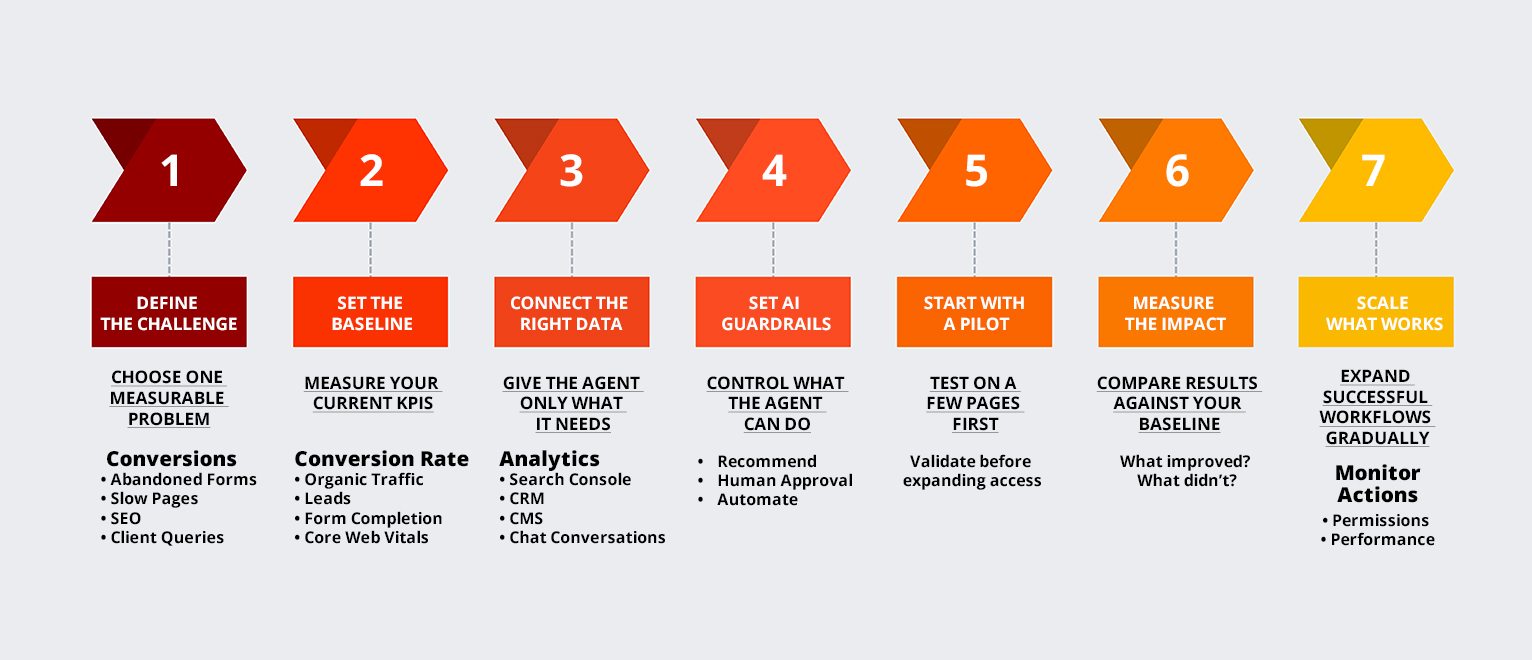
Step 1 – Define one optimization challenge: Begin with one measurable challenge like falling conversions, abandoned forms, slow loading, SEO challenges, or recurring client questions.
Step 2 – Set the baseline: Measure current key performance indicators (KPIs), including conversion rate, organic visits, Core Web Vitals score, qualified leads, or form completion rate.
Step 3 – Gather relevant information: Provide the agent with limited access to only the needed information sources – analytics, Search Console, CRM, CMS, chatbot conversations.
Step 4 – Establish AI guardrails: Divide actions into Recommend → Human Approval → Automate to ensure that no risky changes to the website take place without due process.
Step 5 – Launch a pilot test: Run the experiment on a few pages first before giving the robot access to the whole website.
Step 6 – Evaluate the impact: See how your metrics have improved from the baseline through this approach.
Step 7 – Scale successful workflows: Gradually increase the scale and evaluate agent actions, permissions, and performance.
Advantages of Agent-Ready AI for Website Optimization
This is not about automation per se; it is more about detecting opportunities more quickly and making actions out of website data. Research shows that using artificial intelligence to enhance the experience of agents can bring improvements to many aspects, starting with task completion and ending with conversions and engagement.
- Website Monitoring Can Detect Issues Early: In an experiment on agent-ready websites, 300 test runs were done between a browser and an agent, demonstrating that an optimized version had an 89.3% task completion rate vs. 49.3% for the non-optimized version. Moreover, it cut the average number of steps down from 9.31 to 6.49.
- AI personalization will help you achieve better conversions: The results from the Saks Fifth Avenue case study, where Mastercard personalized the website’s homepage using the purchase intent of visitors, showed an increase in conversion of 9.5%, a 7% uplift in revenue per visitor, and a decrease in bounce rate of 18%. Businesses can see where the opportunity for agentic optimization is.
- Conversational AI will improve the customer experience: The study conducted in 2025 of 552 people with ecommerce experience revealed that the value provided by AI customer service systems is more effective at ensuring long-term satisfaction than usability. This is important to remember when optimizing the website—a chatbot needs to be able not just to provide quick responses but also to actually help visitors.

Challenges and Risks of Agentic Website Optimization
Agentic AI will make optimization quicker and more efficient, but the very act of giving an AI system the ability to read the data, decide on its own, and make changes to your website is also risky.
Controlled autonomy would be the way to go, where AI agents are used to do simple repetitive actions and leave high-level decision-making for humans.
- Restrictions Are Important For Agentic AI Agents: Don’t allow your optimization agent to have unlimited access to your content management, customer relationship, and customer data systems and your production environment. According to a University of Washington study from 2026, seven out of seven agentic AI browsers were found to have methods to bypass browser same-origin security restrictions.
- Agentic SEO Requires Human Approval: The agent could notice a drop in ranking or make suggestions about changing the content, but their reasoning could still be faulty. Studies have identified vulnerabilities within autonomous web agents, including the phenomenon of prompt injection attacks, which are capable of altering agent actions in unintended ways. For high-risk SEO, pricing, legal, or branding alterations, demand human confirmation before going to production.
- Website Optimization Requires Monitoring Post-Deployment: Just because an AI system has done something does not mean it is successful. Monitor its behavior after the action has been performed. As per the recommendations made by the United Kingdom’s National Cyber Security Centre, bounded piloting, visibility, and human oversight are essential during the deployment of agentic AI systems.
The Future of Site Optimization with Agentic AI
Future site optimization would involve not monitoring past activity but reacting to current activity. Agentic AI agents could increasingly integrate analytics, SEO, customer interactions, testing, and website platform operations to achieve continuous optimization cycles.
Action-oriented Agentic AI Website Optimization Would Follow
This shift could be seen even in AI-driven searching and browsing experiences. For instance, a study conducted in 2025 on over 50,000 e-commerce transactions referred by large language model chatbots on 973 websites revealed that the conversions were higher from ChatGPT referrals compared to those from paid social, despite the latter having higher volume.
This means that the future for companies would involve optimizing not only for people who visit the sites but for the AI systems assisting people in researching and purchasing products and services. The best strategy here would be to utilize agents to detect opportunities fast while keeping humans in control when necessary, and measuring whether optimizations have improved customer experience.
Conclusion
Agentic artificial intelligence could allow businesses to spot problems quickly, get insight into customer behavior, and consistently optimize SEO, UX, performance, and conversion rates.
Identify a problem with tangible metrics, link up the appropriate data sources, put proper guardrails in place, and scale what works. The aim is not to turn everything into an automated process; it’s to make sure that your website learns and performs better.
Thinking about making your website more intelligent? Contact SoftProdigy about developing AI-driven optimization solutions.