Real estate professionals make some of the largest financial decisions in any industry. However, most of them still make those decisions on instinct.
But the problem is not a lack of data. Every property transaction, rental agreement, site visit and maintenance request generates data. The problem is that most businesses never connect it, analyze it or act on it. Additionally, according to Grand View Research, the global real estate analytics market is forecast to grow from $4.5 billion in 2023 to $15.8 billion by 2032.
That is the entire industry repricing how decisions get made. The businesses leading that shift are not the largest ones. They are the ones that built the right data infrastructure first. This guide breaks down what real estate data analytics is, how it works across every stage of the property lifecycle, which tools serve which use cases and how your business can build this capability today, regardless of where you are starting from.
Want to learn all about it? Let us begin with understanding real estate data analytics.
What Is Real Estate Data Analytics?
Real estate data analytics is the process of collecting, structuring and analyzing property-related data to guide buying, selling, leasing, pricing and management decisions. It replaces guesswork with evidence and at the same time replaces spreadsheets with systems.
At its core, real estate data analytics pulls information from multiple sources such as
- property records
- transaction histories
- market trends
- tenant behavior
- foot traffic data
- economic indicators and
- demographic shifts
Using advanced data engineering services, businesses can unify these fragmented datasets into a single ecosystem. It connects those sources into a single view. Then it surfaces patterns that a human analyst would take weeks to find manually.
What Does Real Estate Data Analytics Cover?
Real estate data analytics covers every decision point in the property business:
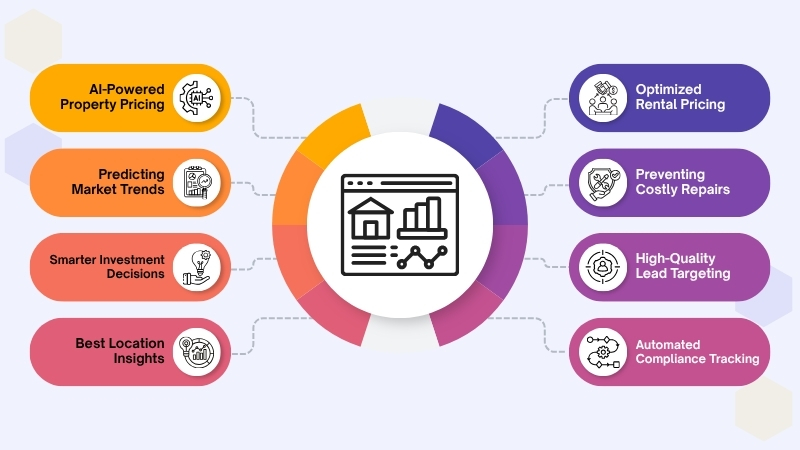
- Property valuation and automated valuation models (AVM)
- Market trend forecasting and neighborhood analysis
- Investment portfolio optimization and risk assessment
- Site selection and location intelligence
- Tenant analytics and rental pricing optimization
- Predictive maintenance and operational cost management
- Real estate marketing analytics and lead scoring
- Compliance monitoring and regulatory reporting
How Is Real Estate Analytics Different from General BI?
General business intelligence tools show you what happened in your business. Real estate analytics does that too, but it also pulls in external market data, geospatial data and alternative data that no internal BI tool can access on its own.
A general BI dashboard shows your occupancy rate. Real estate data analytics tells you why it dropped, which demographic segment is leaving, what your competitors are pricing at and when to expect the next vacancy.
That is not a small distinction. That is the difference between reporting and decision-making.
The 4 Types of Real Estate Analytics
Most real estate businesses operate at base level. The ones gaining ground operate at all four levels simultaneously. Understanding which level your business currently operates at is the fastest way to identify where your competitive gap is.
What Are the 4 Types of Real Estate Analytics?
- Descriptive Analytics: This is the most common starting point. Descriptive analytics summarizes historical data: how many units sold last quarter, what the average rent was, how occupancy trended over 12 months. Most property management platforms provide this by default. It is useful. It is not enough.
- Diagnostic Analytics: Diagnostic analytics finds the cause behind the numbers. Why did occupancy drop in Q3? Which tenant segments left first? Was it pricing, location, maintenance response time or a competitor’s new listing? This level requires connected data across multiple sources, not just a single platform.
- Predictive Analytics: This is where predictive analytics transforms decision-making. Predictive models use historical data, market signals and machine learning algorithms to forecast future outcomes. Which properties will underperform next quarter? Which neighborhoods are positioned for price appreciation? When will this HVAC unit fail? Predictive analytics answers these questions before they become expensive problems.
- Prescriptive Analytics: Prescriptive analytics is the most advanced level. It does not just predict outcomes. It recommends specific actions. Adjust this rental price by 8% to optimize occupancy. Acquire this asset before the demographic shift reaches full momentum. Renegotiate this lease before the market moves.According to McKinsey, companies using prescriptive analytics reduce operating costs by 15% to 20% compared to those relying on descriptive reporting alone.
Key Takeaway: Descriptive analytics tells you the score. Prescriptive analytics tells you how to win. Most real estate businesses have not yet moved past reading the scoreboard.
What Data Actually Powers Real Estate Decisions?
The quality of your real estate analytics output depends entirely on the quality of your data inputs. There are three distinct data layers that power modern property intelligence.
Layer 1: Traditional Data
This is the baseline. Most businesses already have access to it but rarely connect it properly.
- Sales transaction records and pricing history
- Lease agreements and rent roll data
- Property characteristics (square footage, age, condition, zoning)
- Vacancy and occupancy rates
- Maintenance and repair logs
Traditional data alone provides roughly 40% predictive accuracy, according to ATTOM Data Solutions research. That means six out of every ten predictions based only on traditional data will be wrong.
Layer 2: Operational and Market Data
This layer adds the market context that transforms a property record into an investment signal.
- Geographic Information Systems (GIS) and geospatial data
- Comparable market analysis from MLS feeds
- Demographic shift data and migration patterns
- Economic indicators: employment rates, income growth, inflation
- Local infrastructure plans and zoning changes
Layer 3: Alternative and Intelligence Data
This is where modern real estate analytics pulls significantly ahead of traditional approaches.
- Foot traffic data and pedestrian volume patterns
- IoT sensor data from smart building systems
- Social media sentiment and online review analysis
- Mobile signal data and behavioral movement patterns
- Satellite imagery for land use and construction progress
- Web search trend data and buyer intent signals
Combining all three layers can push predictive accuracy above 85%, according to research published by the Urban Land Institute in 2024. The challenge is not finding this data. It is building the data engineering infrastructure to connect, clean and analyze it at scale.
How Real Estate Data Analytics Works Across the Property Lifecycle?
Real estate data analytics does not serve a single use case. It operates across every stage of the property lifecycle, from land acquisition to exit.
- Data Analytics Is Reshaping Property Valuation:
Traditional valuation relies on comparable sales, property condition and appraiser judgment. That approach produces estimates with wide variance and limited predictive power.Data-driven automated valuation models (AVMs) pull from dozens of inputs simultaneously: recent transaction data, neighborhood price trends, school district quality scores, proximity to amenities, walkability indices and economic growth indicators.According to HouseCanary, machine learning-based AVMs now achieve rental price forecast accuracy above 90%in major metropolitan markets.The practical impact is significant. A property manager using AVM tools can reprice a portfolio of 200 units in one hour. The same process done manually takes two analysts an entire week.
- Spotting Market Trends Before They’re Visible:
Predictive real estate analytics identifies emerging neighborhoods before price appreciation becomes visible in transaction data.
The signals come earlier: rising foot traffic to local businesses, demographic in-migration of younger households, permit filings for new commercial development, and declining average days-on-market.Zillow’s research division found that neighborhoods showing three or more of these early indicators experienced an average price appreciation of 22% over the following 24 months. That window is where analytics creates investment advantage. - Portfolio Analytics and Risk Reduction:
Real estate investment portfolio optimization combines individual property performance data with macroeconomic indicators to identify concentration risk, underperforming assets and reallocation opportunities.An investor managing 50 properties across three cities without analytics is essentially flying blind on 47 of them at any given moment. A data-driven AI/ML development layer surfacing anomalies in occupancy, maintenance cost ratios and rental yield means every asset stays visible, every risk stays manageable. - Smarter Site Selection Through Location Intelligence:
Site selection is where location intelligence and real estate analytics intersect most powerfully. Retailers, restaurant chains, healthcare providers and logistics operators all use analytics to evaluate locations before signing a lease or purchasing land.The inputs include foot traffic patterns, trade area demographic profiles, cross-shopping behavior data, competitor proximity, labor market accessibility and projected population growth.Companies using data-driven site selection reduce the probability of underperforming locations by 35% to 50%, according to a 2024 report by JLL.
- Predicting Tenant Churn Before It Happens:
Most property managers know their current occupancy rate. Very few know which tenants are likely to leave in the next 90 days.Tenant analytics models identify churn risk by correlating lease length, payment history, maintenance request frequency, and market rent gap against current rent.When the model flags a high-risk tenant, the property manager can act proactively: offer a renewal incentive, address a maintenance issue or adjust pricing before the tenant starts searching for alternatives.Increasing tenant retention by 5 percentage points reduces revenue volatility and eliminates the cost of vacancy, marketing and new tenant onboarding, which averages 1.5 to 2 months of lost rent per vacancy event. - From Reactive Repairs to Predictive Maintenance:
IoT sensors embedded in HVAC systems, elevators, plumbing infrastructure and electrical panels generate continuous operational data. Predictive maintenance models analyze that data to forecast component failure before it happens.A reactive maintenance approach waits for something to break. A predictive approach detects the pattern that precedes failure: rising motor temperature, declining airflow efficiency, unusual vibration frequency.Buildings using IoT-powered predictive maintenance programs reduce emergency repair costs by 25% to 40% and extend equipment lifespan by an average of 20%, according to a Deloitte Smart Buildings report. - Connecting Marketing Spend to Lead Quality
Real estate marketing analytics connects campaign spend to lead quality, not just lead volume. It tracks which channels generate buyers with the highest conversion rate, what content moves prospects from interest to inquiry and which audience segments respond to specific property types.The output is not just better marketing. It is a lead scoring model that tells your sales team exactly which inquiries to prioritize today.

How AI and Machine Learning Are Changing Property Analytics?
Artificial intelligence is not replacing real estate analytics. It is accelerating everything it can do.
How Do Machine Learning Models Improve Valuation Accuracy?
Traditional statistical models use fixed variables to estimate property value. Machine learning models learn from every new transaction. They identify non-obvious relationships in the data: how the proximity of a specific coffee chain correlates with neighborhood price appreciation or how school rating changes impact rental demand within specific radius thresholds.
The result is a valuation model that gets more accurate over time, not less.
What Is Agentic AI and Why Does Real Estate Need It?
Agentic AI systems do not wait for instructions. They monitor inputs continuously, detect conditions that require action and execute defined workflows autonomously. In real estate, this means an AI agent can monitor a portfolio of 500 leases, flag every renewal approaching within 90 days, pull comparable market rents, generate a recommended reprice range and notify the responsible manager, without a single manual trigger.
SoftProdigy agentic AI solutions make this kind of continuous portfolio intelligence accessible for real estate businesses at any scale.
How Does Computer Vision Support Property Analytics?
Computer vision models process visual data from property photographs, drone footage and satellite imagery. They can assess property conditions, detect unauthorized construction, monitor site progress on development projects and identify landscape or structural degradation before it is reported.
A property management company using computer vision for inspection workflows eliminates the subjectivity of manual inspection reports and builds a standardized condition dataset across its entire portfolio.
What Is the Gap Between AI Hype and What Businesses Actually Need?
Most real estate businesses do not need to start with AI. They need to start with connected, clean data.
AI models built on top of fragmented, inconsistent data produce unreliable outputs. The sequence matters. Build your data infrastructure first. Connect your sources. Establish quality standards. Then layer AI capabilities on top of a foundation that can actually support them.
That is exactly the sequence SoftProdigy follows with every analytics engagement.
Designed & built from the ground up — a cross-platform mobile app and full admin panel
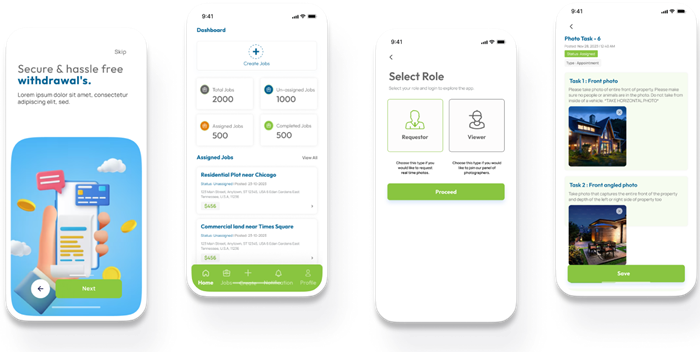
A real estate business needed a platform that served two completely different audiences at once, property inspection requesters and freelance field inspectors. The core challenge was designing an intuitive experience for both: one side needed to post jobs and receive detailed reports, while the other needed a smooth flow to accept jobs, complete inspections, and get paid. Layered on top was the need for secure payments, real-time updates, and a quality control system the admin team could actually manage.
The Solution
Our software development team engineered a complete real estate valuation platform — handling everything from property data ingestion and AVM modelling to agent workflows and investor-facing dashboards, across both iOS and Android. Here are the solutions that we have provided;
- Freelancer Workflow: Inspectors could browse nearby jobs, verify bank accounts, upload photos, answer standardized questions and submit tasks, all from their phone.
- Real-Time Job Tracking: Firebase-powered notifications kept requesters and inspectors aligned at every stage.
- Quality Control Panel: Admins could review, approve, or flag submissions before delivery.
- Secure Payments: Stripe integration ensured inspectors were paid without delays or disputes.
The Results
Within three months of launch:
- 1,000+ users registered on the platform
- 90% of posted jobs completed and admin-approved
- 99.9% payment success rate with zero reported delays
- 30% increase in positive user feedback
The Takeaway
When a platform is built around the people actually using it, quality improves and operations scale naturally. The right custom software solution doesn’t just digitize a process. It makes everyone in the chain more effective.
Conclusion
Most real estate businesses are not losing to competitors with better properties. They are competing on how effectively they use data. Real estate analytics brings together property records, market trends, operational data and customer insights to support faster, smarter decisions across pricing, leasing, maintenance and investment planning.
Instead of relying on fragmented spreadsheets or assumptions, businesses can use structured analytics systems to identify opportunities, reduce risks and improve operational efficiency.
SoftProdigy helps real estate businesses build scalable data engineering pipelines, predictive analytics solutions and custom PropTech platforms tailored to their workflows and long-term goals.
Ready to turn real estate data into a competitive advantage? Connect now!