Artificial intelligence is moving into a new phase.
For the past few years, businesses have focused heavily on generative AI assistants that can answer questions, summarize documents, create content and help employees complete individual tasks.
Now, the conversation is changing. Businesses are asking a more practical question: Can AI actually complete work for us?
That question is driving growing interest in Agentic AI, AI agents, workflow automation and enterprise AI architecture.
But it also creates confusion. What is the difference between Retrieval-Augmented Generation and Agentic AI? Is one better than the other? Does a business need to replace its existing Retrieval-Augmented Generation application with an AI agent? Or can the two technologies work together?
The answer is important because these technologies solve different problems.
Retrieval-Augmented Generation helps AI access the right information. Agentic AI helps AI use information to pursue a goal and take action.
For many organizations, the strongest architecture may combine both. This is becoming increasingly relevant in 2026. Microsoft Research published research in May 2026 on Agentic Retrieval-Augmented Generation, showing how an agentic approach can allow AI systems to iteratively search, navigate documents and analyze evidence rather than relying on a single retrieval step. In its reported benchmarks, the approach achieved 92% answer correctness on FinanceBench and improved factuality on another benchmark.
At the same time, enterprise technology leaders are facing a broader architecture challenge. IBM’s 2026 research describes infrastructure adaptability, governance, and portfolio discipline as important requirements for moving Agentic AI from pilots into production.
So the real question is not simply: RAG vs Agentic AI — which technology wins? It is: What does your business need AI to know, decide, and do?
This guide explains the difference, where each technology fits, when they should be combined and what businesses should consider before investing.
What Is Retrieval-Augmented Generation?
Retrieval-Augmented Generation, commonly abbreviated as RAG, is an approach that allows an AI application to retrieve relevant information from external sources before generating a response.
The simplest way to understand it is to imagine giving an AI assistant access to your company’s private library. A general-purpose AI model may already know a great deal about the world.
However, it does not automatically know your latest product documentation, internal policies, customer records, pricing rules, support procedures or proprietary research.
A Retrieval-Augmented Generation system can connect the AI application to those sources. When a user asks a question, the system searches the relevant knowledge sources, retrieves useful information and provides that context to the language model.
The basic process looks like this:
User question → Information retrieval → Relevant context → AI-generated response
For example, an employee at a software company could ask: “What is our enterprise support policy for customers with premium contracts?”
Instead of relying only on a language model’s general knowledge, a Retrieval-Augmented Generation application can retrieve the organization’s approved support documentation and use it to generate the response.
This makes the technology particularly valuable when accuracy depends on access to current, proprietary, or domain-specific information.
Where Retrieval-Augmented Generation works well
Common business applications include:
- Enterprise knowledge assistants
- Customer support applications
- Internal search
- Product documentation assistants
- Policy and compliance search
- Technical support
- Contract analysis
- Employee onboarding
- Document question-answering
- Research assistants
For example, a customer support representative may need to search through hundreds of product documents before answering a technical question.
A Retrieval-Augmented Generation application can bring that information into a conversational interface. The employee can ask a question in natural language instead of searching through multiple systems manually.
That can improve access to information and reduce time spent looking for answers. However, this is where an important distinction begins.
Retrieving information is not the same as executing a business process.

What Are the Limitations of Retrieval-Augmented Generation?
Retrieval-Augmented Generation is powerful, but businesses sometimes expect it to do more than it was designed to do.
Imagine a customer asks: “Am I eligible for a product return?”
A Retrieval-Augmented Generation system can retrieve the company’s return policy and explain the eligibility requirements.
But suppose the desired business process is:
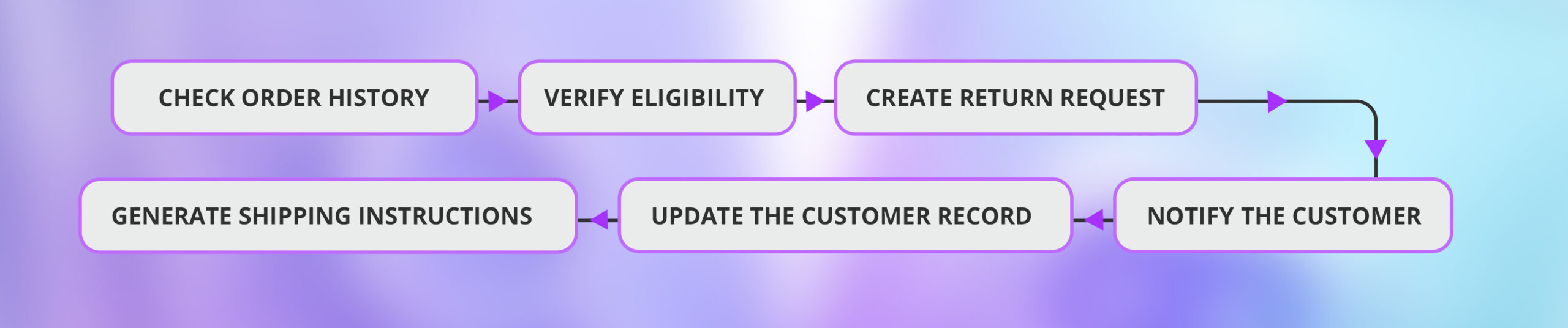
RAG may provide the knowledge required for the first part of the workflow. It does not automatically mean the system can independently coordinate every subsequent action. That distinction becomes even more important when workflows involve:
- Multiple applications
- Multiple decision points
- External APIs
- Business rules
- Human approvals
- Changing context
- Long-running processes
- Exceptions
In these situations, businesses may need an architecture that goes beyond information retrieval.
This is where Agentic AI enters the picture.
What Is Agentic AI?
Agentic AI refers to AI systems designed to work toward a defined objective rather than simply respond to individual prompts. The exact capabilities vary depending on the system design. However, an agentic application can typically combine capabilities such as:
- Understanding a goal
- Planning a sequence of tasks
- Retrieving information
- Reasoning over available information
- Using tools and APIs
- Making decisions within defined boundaries
- Executing actions
- Evaluating results
- Continuing a workflow
- Escalating to a human when required
The simplest distinction is:
Retrieval-Augmented Generation helps AI answer with the right context.
Agentic AI helps AI work toward an outcome.
Consider a sales example.
A conventional AI assistant might analyze a lead and tell a salesperson: “This appears to be a high-value prospect.” An agentic system could potentially go much further.
It could:
- Capture the incoming lead.
- Research the company.
- Retrieve the organization’s qualification criteria.
- Analyze the prospect’s requirements.
- Check previous interactions in the customer relationship management system.
- Score the opportunity.
- Assign the lead to the appropriate salesperson.
- Draft a personalized follow-up.
- Update the customer relationship management system.
- Escalate unusual cases to a human.
The AI is no longer just providing information. It is participating in the workflow. That is the fundamental shift behind Agentic AI.
What Is Agentic AI Orchestration?
A simple AI agent may be enough for a relatively straightforward task. Enterprise workflows are rarely that simple. A real business process may involve several systems, departments, data sources, rules and stakeholders.
This creates a need for Agentic AI orchestration.
Agentic AI orchestration coordinates the different components required to complete a workflow. For example, an enterprise process could involve:
- A research agent gathering information
- A Retrieval-Augmented Generation system finding internal knowledge
- A decision agent evaluating the information
- A compliance agent checking requirements
- A workflow agent updating enterprise applications
- A communication agent preparing customer notifications
The orchestration layer helps determine:

This is especially important because enterprise AI is increasingly moving beyond isolated assistants. Google Cloud’s 2026 coverage of enterprise AI describes organizations moving beyond basic assistants toward proactive AI agents that can operate across business functions.
At the same time, Google Cloud has highlighted a major constraint: AI agents need reliable access to business context and semantic meaning in enterprise data if organizations want to scale agentic systems effectively. That creates an important relationship:
Retrieval provides context.
Agents provide action.
Orchestration connects the two.
RAG vs Agentic AI: What Is the Difference?
The easiest way to compare the two is to look at the problem each one solves.
The important point is that this not necessarily a choice between two competing technologies. A business can use RAG inside an Agentic AI system. In fact, that combination can be extremely powerful.
RAG and Agentic AI Can Work Together
Imagine a financial services company building an AI system for processing customer requests.
The AI needs access to:
- Customer information
- Financial policies
- Product rules
- Compliance requirements
- Internal procedures
- Previous interactions
RAG can help the system retrieve the relevant information. But the workflow may also require the system to:
- Review the request
- Determine what information is missing
- Check eligibility
- Select the appropriate workflow
- Update enterprise systems
- Request additional documentation
- Escalate exceptions
- Notify the customer
This is where Agentic AI can sit on top of the knowledge layer. A simplified architecture becomes:
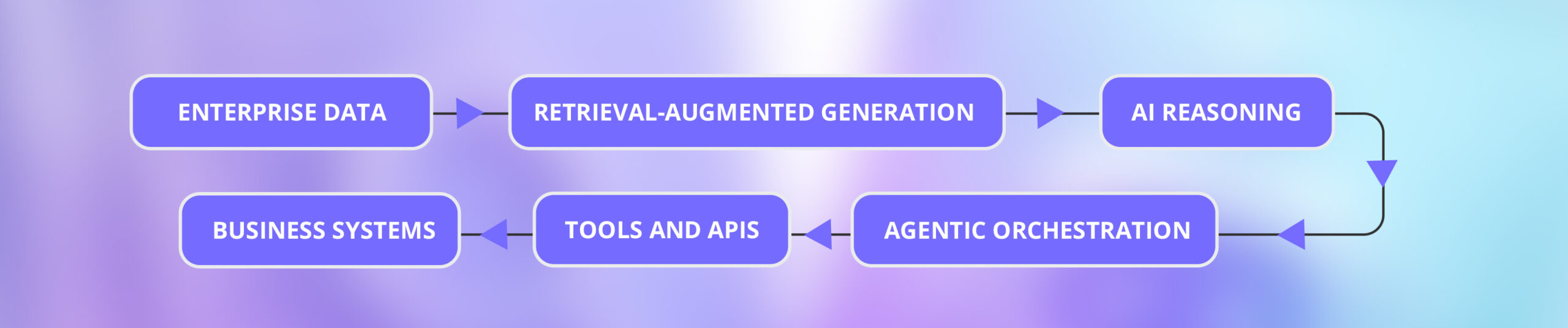
This approach is increasingly reflected in current research. Microsoft Research’s 2026 Agentic Retrieval-Augmented Generation work describes an agentic retrieval approach where a reasoning model can use search, find, open, and summarization tools to iteratively retrieve and analyze enterprise information. The researchers reported improvements over conventional retrieval approaches across multiple benchmarks.
Where RAG Fits in Enterprise AI Architecture
RAG is best understood as one layer within a larger enterprise AI architecture. A simplified architecture might look like this:
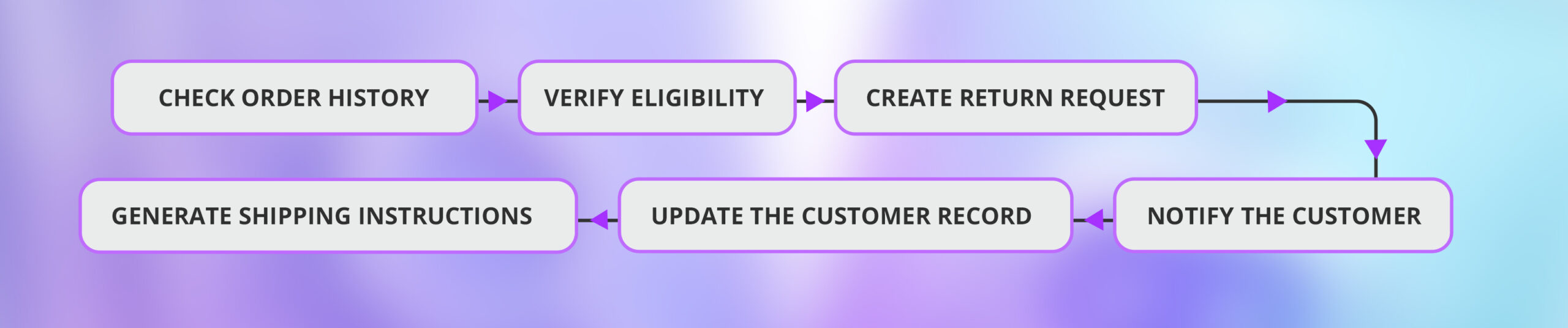
The underlying data could come from:
- Customer relationship management systems
- Enterprise resource planning platforms
- Document repositories
- Databases
- Knowledge bases
- Data warehouses
- Product catalogs
- Support systems
- Internal applications
However, enterprise AI architecture is about more than connecting data to a language model. Security, access control, observability, governance, evaluation and reliability also matter.
IBM’s 2026 research specifically emphasizes that as AI agents move toward production, enterprise architecture becomes increasingly important because AI systems can make decisions and execute actions at a scale that traditional human governance cannot easily supervise manually.
That means businesses should ask more than: “Can this AI produce a good answer?”
They should ask:
- Can it access the right data?
- Can it access only the data it is authorized to use?
- Can its actions be monitored?
- Can decisions be evaluated?
- Can errors be detected?
- Can high-risk actions require approval?
- Can the system scale?
- Can the business measure its impact?
These questions are fundamental to production AI.
A Real-World Example: Agentic AI Transforming Property Buying in New York
To understand where Agentic AI can create real business value, consider a New York, U.S.-based real estate project developed by SoftProdigy.
The challenge was not simply helping buyers search for properties. The traditional buying journey involved too many listings, disconnected communication channels, manual follow-ups, difficulty comparing options, documentation management, and limited visibility into buyer progress.
Sales teams faced similar friction. They had to manually track buyers, coordinate multiple stakeholders, follow up on opportunities, and manage information across disconnected systems. The result was a slower, less personalized buying experience and more administrative work for sales teams.
From Property Search to Guided Buying
SoftProdigy developed an Agentic AI-powered real estate platform designed to support the buyer throughout the journey.
Rather than functioning as a conventional property chatbot, the platform was designed to understand buyer intent, monitor journey progress, identify decision blockers, recommend next actions, and coordinate stakeholders.
Its key capabilities included:
- AI Concierge: Understands buyer preferences and intent, recommends relevant properties, tracks progress, and provides proactive guidance.
- Journey Intelligence: Identifies engagement levels, buying readiness, decision blockers, and recommended next actions.
- Agentic Deal Coordination: Coordinates activities involving buyers, family members, sales consultants, channel partners, and documentation teams.
- Smart Documentation: Organizes documentation and tracks completion status while reducing manual coordination.
- Sales Intelligence: Helps sales teams prioritize high-intent buyers, identify stalled journeys, monitor engagement, and improve response times.
- Post-Purchase Engagement: Extends the relationship beyond the transaction through a connected customer experience.
The difference can be summarized simply:
|
|
The project demonstrates an important point about RAG vs Agentic AI. A RAG-based system could help a buyer retrieve property information, policies, or documentation requirements.
But the broader business challenge required more than information retrieval. The platform needed to understand buyer intent, identify where the buyer was in the journey, coordinate multiple stakeholders, and recommend what should happen next.
That is where Agentic AI becomes valuable. The case study describes the platform as moving AI from a reactive question-answering tool toward an active decision-making assistant.
The Final Takeaway
The difference is easier to understand when you stop looking at the technologies as competitors.
RAG gives AI access to knowledge.Agentic AI gives AI the ability to reason and act. Agentic AI orchestration connects those capabilities into workflows.
For a company that simply needs a smarter knowledge assistant, RAG may be enough. For a company trying to automate a complex process across multiple systems, Agentic AI may be the better fit. And for businesses that need AI to understand proprietary information and then take action based on it, RAG and Agentic AI can work together.
That is where the real opportunity lies. Instead of asking: “Which AI technology should we use?”
Start with: “What do we want AI to know, what do we want it to do, and where should humans remain in control?”
That question leads to a much stronger AI strategy.
Ready to Move From AI Assistance to AI Automation?
If your business is still relying on people to search through information, move data between systems, follow up manually, or coordinate repetitive workflows, there may be an opportunity to redesign the process with AI.
SoftProdigy helps businesses explore and build Agentic AI solutions, AI-powered workflows, enterprise AI architectures, and intelligent digital products around real business requirements. Your AI journey does not need to start with a massive transformation.
It can start with one workflow worth automating. Have a workflow you want to automate? Talk to a SoftProdigy AI Expert