
78% of buyers opt for the first agent they converse with in real estate. A missed call is an opportunity missed in real estate. Wondering why? People expect immediate responses for any inquiries relating to property valuations, leasing questions or maintenance updates outside normal business hours.
Thus, many property management companies and brokerages are looking at voice automation to help reduce their operational costs and enhance their customer service by providing immediate responses.
It provides immediate responses to inquiries, qualifies potential customers, schedule appointments and keeps conversations moving. Furthermore, it does not need the addition of new staff.
In this guide, we will cover some practical use case examples, key features of voice automation solutions, price considerations and tips for choosing the best solution for your business.
What Is an AI Voice Agent for Real Estate?
An AI voice agent for real estate is an automated conversational system that answers incoming calls, qualifies potential customers and arranges property viewings. It captures requests for valuations, assists in leasing and automatically updates your CRM.
It is available 24/7 so that you can respond promptly to inquiries while your team is working to close deals and provide excellent client service. Studies show that businesses that respond to a new lead in under 5 minutes are much more likely to engage and qualify the lead.
If your real estate firm receives hundreds of inquiries each month, automating your initial conversations with potential customers will save you many valuable hours.

Why Real Estate Businesses Are Adopting AI Voice Agents
Conversing is how the real estate industry works. Such as buyer inquiries, seller consultations, calls to lease, requests for property valuations and for maintenance each one of these things begins with conversation.
The problem is not producing leads now. It is how you respond to them. 79% percent of homebuyers expect to work with an agent online, according to the National Association of Realtors.
They are frequently contacting numerous agencies before selecting one. The first to respond in a brokerage will nearly always have first pair of dices in driving the conversation. Below are examples of common scenarios where voice agents are having an impact.
Here are some of the most common situations where voice agents are making a measurable difference.
Buyer and Seller Inquiries:
A buyer wants to know whether a property is still available. A homeowner is looking for a property valuation before listing their house. Instead of sending both callers to voicemail, a voice agent answers instantly, collects key details, schedules appointments, and syncs the information with your CRM so agents can focus on closing deals instead of answering repetitive calls.
Leasing Conversations:
Leasing teams spend a significant part of their day answering repetitive questions. A voice agent can answer these questions naturally, pre-qualify applicants based on your leasing criteria, and schedule a property tour without involving your leasing team.
Typical questions include:
- Is the apartment still available?
- What’s the monthly rent?
- Are pets allowed?
- When can I move in?
- Is parking included?
- What documents are required?
Property Valuation Requests:
A property valuation is usually the first step in selling to a seller. As opposed to obtaining just contacts, a voice agent can obtain information regarding the following:
- Property Location
- Property Type
- Bedroom and Bathroom count
- Size
- Any recent renovations
- Preferred date of valuation
Your valuation specialist gets a fully detailed lead and does not have to use the first call for obtaining basic information.
Property Management and Maintenance:
Maintenance requests are not limited to office hours. Be it a leakage of water pipes, an issue with the air conditioning system, or anything related to security issues, tenants would always want an immediate response.
Voice agents can help determine emergencies, create maintenance tickets, notify the appropriate team, and update tenants regarding the process without waiting for office hours.
Lead Follow-Ups That Never Get Missed:
Many brokerages miss many opportunities just because they lack someone who could take care of constant follow-ups.
The voice agents can reach out to the buyer after a property viewing, remind prospects about appointments, ask for documentation from them, and even connect with inactive leads. All conversations will be recorded and you will get a full-fledged history when reaching out to that prospect
How an AI Voice Agent Works in Real Estate
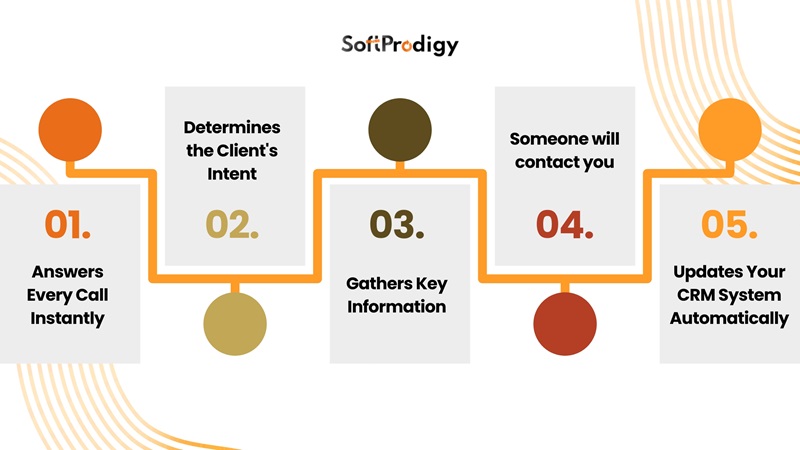
Unlike any other voice agent, an AI voice agent does not only answer calls. It always tries to guide the conversation to the desired outcome, such as scheduling a property visit, qualifying the client, generating a maintenance request, or booking a property valuation. Thus, instead of involving agents to perform all routine inquiries, the first stage of interaction with clients is automated yet sounds very natural.
The workflow typically consists of the following steps.
Step 1: Answers Every Call Instantly
Upon dialing your number, the voice agent picks up the call immediately and not after waiting in a queue or leaving a voicemail. The voice agent says hello, determines the purpose of the call, and starts a dialogue with the caller. So, for instance, when the buyer says, “Is the three-bedroom apartment at Maple Street available?” the voice agent answers and continues the dialogue accordingly.
Step 2: Determines the Client’s Intent
Each caller has his or her own purpose for the call. While some buyers seek a property purchase, others need leasing services, and current tenants may report on some maintenance services or other issues.
Thus, the voice agent detects the intent of the client’s call. It means that the transfer becomes unnecessary, and the callers receive help that is really relevant from the first seconds of the conversation.
Step 3: Gathers Key Information
When it realizes what the request is, the voice agent starts asking the necessary questions.
In the case of property valuation, it may gather such information as:
- Location of the property
- Type of the property
- The number of rooms and bathrooms
- Size
- Date of the valuation
In the case of the leasing inquiry, it may ask about move-in dates, budget, number of tenants, and the days that are suitable for showing the property.
At the end of the conversation, your team already knows all the necessary information.
Step 4: Makes the Next Step
Instead of saying, “Someone will contact you” at the end of the conversation, the voice agent makes another step in the conversation.
Depending on the nature of the inquiry, it can:
- Organize viewing of the property
- Organize the valuation
- Create the maintenance ticket
- Send application forms
- Organize leasing appointment
- Transfer urgent calls to an available agent
Every conversation ends with a clear action.
Step 5: Updates Your CRM System Automatically
Once the conversation ends, the voice agent logs call notes, updates customer records, creates tasks, and informs the relevant team. Your agents get full context before making follow-ups, thereby saving you from having to enter the information manually.
Whatever your CRM is—whether it is Salesforce, HubSpot, Zoho CRM, or any customized real estate CRM integration helps keep your sales and property management teams on the same page.

AI Voice Agent vs Chatbot vs Virtual Receptionist
If your goal is to automate conversations, qualify leads, schedule viewings, and support leasing without increasing headcount, an AI voice agent offers far more flexibility than a chatbot or a traditional virtual receptionist.
Important Features to Look Out for in an AI Voice Agent
Before making a choice, it is important to find a solution that does not merely deal with inbound phone calls but offers additional features that enhance both CX and efficiency.
- Natural-sounding dialogue
- Handling calls round the clock
- Lead routing and qualification
- Viewing appointments and meetings scheduling
- Property appraisal requests gathering
- Leasing and tenant assistance
- Integration with CRM and calendar
- Multilingual communication
- Call reporting and analysis
- Passing the call to a live agent instantly

Final Thoughts
In real estate, timing is everything. Every call that goes unanswered, every follow up that gets put off, and every lead inquiry that gets overlooked is one missed chance at getting a client. Using an AI voice agent will enable brokerage firms, leasing companies, and property management firms to be always available while making sure automated dialogue makes your team more efficient in handling everyday tasks.
Learn more about SoftProdigy’s AI and real estate software development services.