AI testing services evaluate and validate artificial intelligence models to ensure they deliver accurate, secure and reliable outcomes. They assess data quality, model performance, fairness, explainability and resilience, helping organizations identify risks before deployment while improving trust, compliance and long-term AI performance.
An algorithmic mistake caused a loss of $440 million in 45 minutes. There was no safety check in place for Knight Capital’s trading system. Just one missed test cost the company its reputation and almost its bankruptcy.
Sadly, this is a common example now. According to studies, more than 80% of AI projects don’t produce any business value. And the underlying principle of those projects’ failure stays the same. Developers work fast and skip proper testing. And then the AI fails when being used by real clients.
But what is the solution to such mishaps then? Quality Engineering or we can say directly AI testing. All models get tested on accuracy, bias and security. And regular software gets tested much faster using AI tools.
What Are AI Testing Services?
AI testing services evaluate artificial intelligence systems to ensure they remain accurate, secure, fair and reliable throughout their lifecycle. They validate AI models, data quality and decision-making processes before and after deployment, helping businesses reduce risk while building trustworthy AI applications.
Artificial intelligence evolves as it learns from data. That makes testing far more complex than traditional software validation.
Why AI Testing Is Different
Traditional software follows predefined rules and expected outputs. AI models learn from data, adapt to new patterns and generate predictions based on experience. This learning capability introduces uncertainties that conventional testing cannot identify.
As AI evaluation and testing services requirements continue to evolve, organizations need comprehensive validation approaches that assess model accuracy, reliability, fairness and robustness under changing conditions, rather than simply checking whether features work.
What Do AI Testing Services Evaluate?
Comprehensive AI testing examines every layer influencing model performance and business outcomes.
- Data quality to verify accurate and representative training datasets.
- Model accuracy to measure prediction reliability across different scenarios.
- Bias and fairness to identify unintended discrimination before deployment.
- Security and robustness to protect models from adversarial attacks.
- Explain ability to understand how AI models generate decisions.
- Performance to validate consistent results under real-world workloads.

Why AI Testing Matters
AI testing matters because it helps organizations detect inaccuracies, security risks and model failures before they impact customers. Continuous evaluation improves AI reliability, strengthens compliance and protects business outcomes as models evolve over time.
Building an AI model is only half the challenge. Ensuring it performs reliably after deployment is what determines long-term success.
Protects Customer Trust:
Customers expect AI systems to deliver consistent and accurate results every time. Even a single incorrect recommendation or biased response can damage confidence and reduce user adoption.
According to PwC, 73% of consumers say customer experience influences their purchasing decisions. Reliable AI plays a direct role in delivering those positive experiences.
Reduces Business Risks:
Poorly tested AI can generate inaccurate predictions, automate incorrect decisions and create unexpected operational disruptions. Early validation helps organizations identify these issues before they become expensive production failures.
For example, an AI-powered fraud detection system that misses suspicious transactions can expose financial institutions to significant losses and compliance concerns.
Supports Responsible AI:
Governments and industry regulators increasingly expect organizations to develop transparent and trustworthy AI systems. Comprehensive testing helps verify fairness, explain ability, and accountability before AI solutions reach end users.
This proactive approach reduces regulatory risks while strengthening confidence among customers and stakeholders.
Improves Long-Term Model Performance:
AI models naturally evolve as business data changes. Without continuous evaluation, prediction accuracy gradually declines because of model drift.
Regular testing identifies these performance shifts early, allowing teams to retrain models before they affect business outcomes.
According to the Stanford AI Index Report, organizations are placing greater emphasis on responsible AI practices as enterprise adoption continues accelerating. Continuous testing has become a critical part of maintaining reliable AI performance at scale.
Traditional QA vs AI Testing Services
The differences are not always obvious from the outside. Here is a direct comparison to make the gap clear.
| What we compare | Traditional QA | AI Testing Services |
|---|---|---|
| Test creation | Manually written by QA engineers | Generated automatically from user behavior |
| Script maintenance | Breaks with every UI change | Self heals without manual fixes |
| Coverage of AI models | Not designed for this | Built specifically for bias and accuracy checks |
| Security scope | Standard vulnerability scanning | Includes prompt injection and data leakage checks |
| Speed of feedback | Hours to days per cycle | Minutes in most automated pipelines |
| Regulatory readiness | Generic compliance checklists | Built for evolving AI specific regulations |

Core Capabilities Covered by AI Testing Services
AI testing services evaluate multiple components of an AI system, including data quality, model accuracy, security, fairness, explainability and performance. Testing each component ensures AI applications remain reliable, compliant and effective throughout their lifecycle.
A successful AI strategy depends on more than a well-trained model. Every layer of the AI ecosystem must be validated to deliver accurate and trustworthy outcomes.
- Self-healing test automation repairs broken scripts the moment your interface changes. Teams no longer lose hours chasing failed tests after a routine update.
- AI evaluation testing measures your model against real world accuracy benchmarks. It also checks for bias across different user groups and demographics. Regulators increasingly expect documented proof that models behave fairly and consistently.
- AI penetration testing protects your model from manipulation attempts and data leaks. Attackers can trick AI systems into revealing private training data. A dedicated security test finds these weaknesses before criminals ever do.
- LLM and GenAI testing checks for hallucinations, prompt injection risks and inconsistent outputs. This has become essential as more products ship with conversational AI features.
Types of AI Applications That Need Testing
AI is no longer limited to one industry or business function. From customer support to predictive analytics, every AI application requires tailored testing to ensure reliable performance under real-world conditions.
- Generative AI Applications: Generative AI powers chatbots, coding assistants, content creation tools, and enterprise search solutions. Because these models generate new content instead of retrieving predefined answers, they require continuous validation to ensure outputs remain accurate, relevant and safe.
- Machine Learning Models: Machine learning models help businesses predict customer behavior, detect fraud and automate decision-making. As these models learn from evolving datasets, their accuracy can decline without regular evaluation.
- Conversational AI and Chatbots: AI chatbots have become the first point of contact for customer support, sales and internal help desks. Users expect quick, natural and context-aware conversations regardless of how they ask a question.
- Computer Vision Systems: Computer vision enables AI to interpret images and videos for applications such as quality inspections, medical diagnostics, and facial recognition. Even small recognition errors can impact operational efficiency and business outcomes.
- Recommendation Engines: Recommendation engines personalize shopping experiences, streaming platforms, and digital services using customer behavior and historical interactions. Their effectiveness depends on continuously adapting to changing user preferences.
- Predictive Analytics Solutions: Predictive AI helps organizations forecast demand, identify risks, and optimize business operations. Reliable forecasting depends on models performing consistently as market conditions evolve.
The AI-Generated Code Problem Nobody Talks About
There is a second reason testing cannot wait anymore. Your own developers are writing code differently now.
Katalon’s research found developers now submit 76% more code per month than two years ago. Teams of six to fifteen developers saw output rise by 89% in the same period. AI coding tools made this possible.
The testing side has not caught up with that speed. The same research found incidents per pull request rose by 23.5%. Change failure rates climbed by roughly 30% across the same period.
DeviQA surveyed 300 QA engineers working directly with this shift. 65% said their development teams now actively use AI to generate code. 52% said bug volume increased since that shift began.
More code is shipping faster than ever before. Fewer of those changes are getting properly tested before release. AI testing services exist to close exactly this widening gap.
How Do We Approach AI Testing Services?
A strong testing engagement follows a repeatable structure, not guesswork. Here is how this typically comes together.
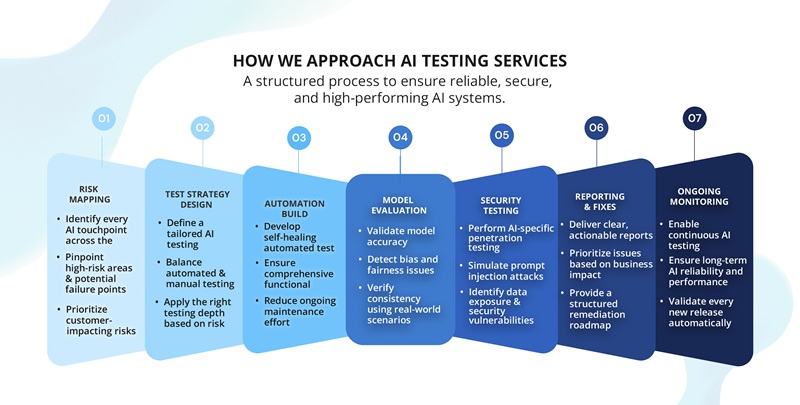
- Risk mapping. We identify every AI touchpoint across your product. This shows exactly where failure would hurt the customer most.
- Test strategy design. We decide which layers need automation and which need manual evaluation. Not every risk needs the same testing depth.
- Automation build. We build self-healing automated test suites for functional coverage. This removes the maintenance burden most in-house teams struggle with.
- Model evaluation. We run accuracy, bias and consistency checks against real usage patterns. This step catches issues that basic functional testing simply misses.
- Security testing. We run structured penetration tests against your AI system specifically. This includes prompt injection attempts and data exposure checks.
- Reporting and fixes. We deliver a clear report with prioritized fixes, not raw data dumps. Your team knows exactly what to fix first.
- Ongoing monitoring. We set up continuous testing so new releases stay protected automatically. Testing becomes a system, not a one-time project.
Common Mistakes Businesses Make With AI Testing
Most testing failures come from a small set of repeated decisions. Here are the ones we see most often.
Treating AI features like regular features. A chatbot is not a button. It behaves differently every time a user phrases something slightly differently.
Skipping bias checks until launch is close. Fixing a biased model after launch costs far more than catching it early. Retraining is expensive and slow compared to early evaluation.
Relying only on automated healing. Self healing automation fixes broken locators well. It cannot judge whether a model’s output is actually correct or fair.
Cutting QA budget right when AI features ship. Applause found 44.1% of companies deactivated a live AI feature last year. Operational costs outweighed the value the feature delivered.
Assuming one test cycle is enough. AI models drift as real user data changes their behavior over time. Testing needs to continue well after launch day.
AI Testing Patterns Across Industries
The mechanics of AI testing stay consistent across sectors. What changes is where the real risk concentrates.
- E-commerce. Recommendation engines that misfire cost real revenue every single day. Testing focuses heavily on personalization accuracy and checkout reliability under load.
- Healthcare. Diagnostic and triage models carry direct patient safety implications. Bias testing and explain ability checks are treated as non negotiable requirements here.
- FinTech. Fraud detection models must stay accurate without blocking genuine customers. Penetration testing focuses on data exposure and manipulation resistance specifically.
- SaaS. Chatbots and AI assistants are the most visible failure point for users. LLM testing catches hallucinations before they reach a paying customer.
- Retail and hospitality. Demand forecasting errors create either stockouts or wasted inventory. Accuracy testing against seasonal and behavioral data patterns matters most here.
The Compliance Landscape Shaping AI Testing
Regulation is no longer a future concern for AI products. It is an active deadline businesses are working against right now.
The EU AI Act’s high risk obligations take effect on August 2, 2026. Non compliant businesses face penalties up to 35 million euros. That figure or 7% of global turnover applies, whichever is higher.
A May 2026 proposed amendment may push some obligations to December 2027 instead. Nothing is finalized yet, so businesses should plan for the earlier date. Waiting on regulatory clarity is a riskier bet than preparing early.
Evaluation testing plays a direct role in meeting these requirements. Documented bias checks and accuracy benchmarks form the evidence regulators expect to see. Businesses without this documentation face real exposure once enforcement begins.
This is not only a European concern despite the headline regulation. US states and other regions are moving toward similar frameworks steadily. Building evaluation testing into your process now avoids a costly retrofit later.
Wrapping Up
Growth should never come at the cost of reliability or customer trust. Every AI feature you ship carries real risk if it goes untested.
At SoftProdigy, we help businesses validate and optimize AI systems with comprehensive testing strategies designed for real-world performance. From functional validation and security testing to bias detection and model evaluation, our experts ensure your Agentic AI solutions are reliable, compliant and ready for production.
The businesses that invest in AI testing early are often the ones that innovate with greater confidence later. Start by testing one AI-powered workflow, refine your approach, and expand coverage as your platform evolves. Your customers may never see the testing behind the scenes, but they’ll experience the reliability, consistency, and trust it creates.