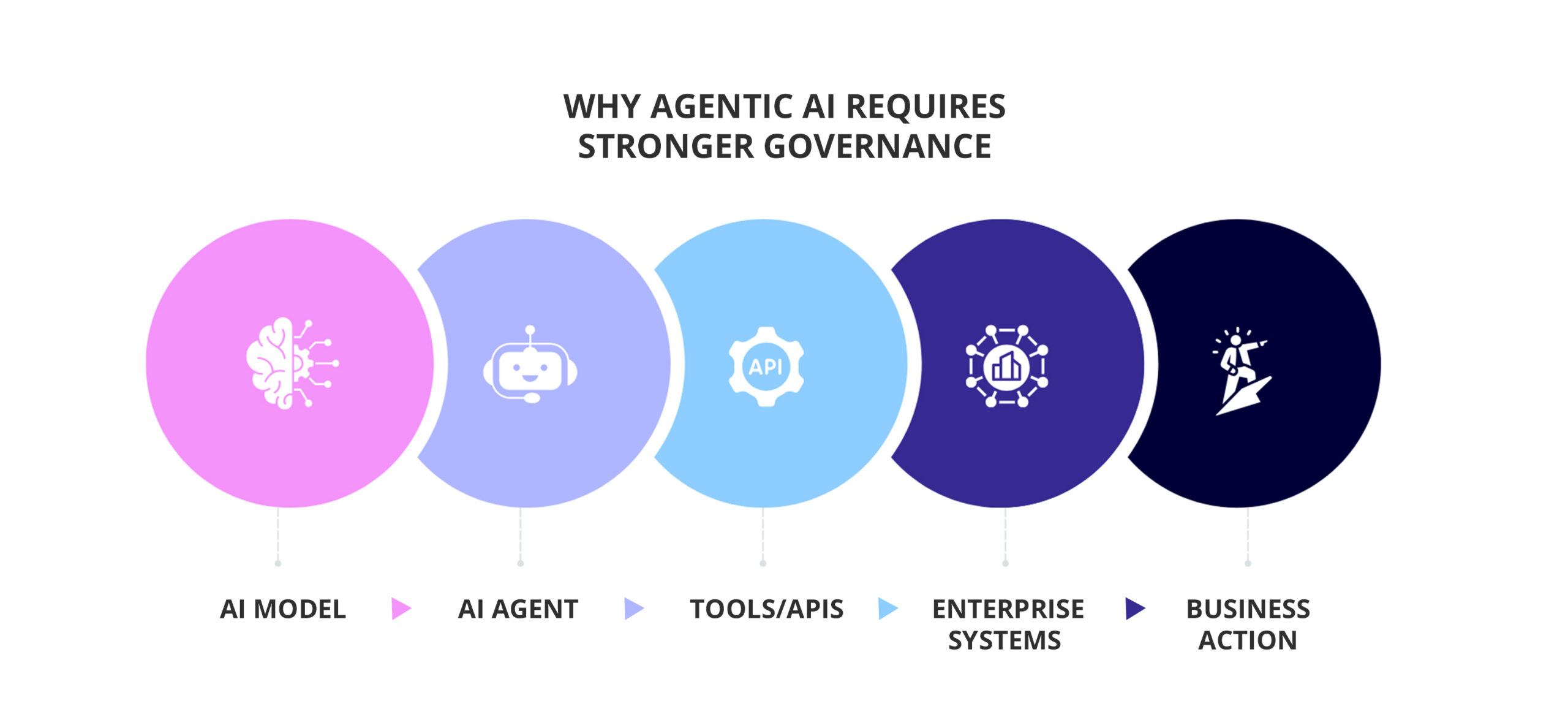
An AI agent is more than a chatbot with better capabilities. It can understand a task and determine how to approach it. It can use connected tools and access enterprise systems to complete the work. In some cases, it can also take action without waiting for a human to approve every step.
This shift from generating text to executing work changes the risk involved. It is also why agentic AI governance has become a strategic concern for enterprise leaders rather than a compliance issue that can be addressed later.
Traditional AI governance often focuses on the model itself. It looks at the data used for training and how accurate the model’s outputs are. It also considers whether the model produces biased or unfair results.
Agentic systems introduce a much bigger challenge. An AI agent can log into a CRM, approve a refund or trigger a workflow across multiple business systems. When those actions happen automatically, accountability becomes a critical question. Who is responsible if the agent makes the wrong decision or causes operational damage?
This is where agentic AI governance becomes essential. It goes beyond managing AI models and focuses on controlling autonomous actions inside enterprise environments.
In this article, you will learn what agentic AI governance really means, how it differs from traditional AI governance.
What Is Agentic AI Governance?
Agentic AI governance is the set of policies, controls and oversight mechanisms that determine how autonomous AI agents are permitted to act inside an organization: what systems they can touch, what decisions they can make unsupervised and how their behavior is monitored, logged and corrected. It extends AI governance beyond the model itself to cover the agent’s identity and the outcomes of what it does.
That distinction matters because agentic systems behave differently from the AI tools most governance programs were designed around. A generative AI model produces text, code or an image and a person decides what to do with it. An agentic system can reason through a multi-step task. It can plan a sequence of actions and call external tools or APIs. It can also retrieve and modify enterprise data.
In some architectures, multiple agents can work together to complete a workflow from start to finish. Governance has to follow the agent through that entire lifecycle and its runtime behavior, not just review the model that powers it.

Why Does Agentic AI Governance Matter?
Autonomy changes the risk profile. A model that only generates a recommendation can be wrong, but a human is still the one who acts on it. An agent that can execute the action removes that checkpoint. This also removes a layer of accidental protection that many organizations may have relied on without realizing it.
Consider the difference directly. In a recommendation scenario, an AI system suggests approving a customer refund and a support agent reviews and confirms it. In an agentic scenario, the AI agent has permission to process the refund itself through a connected billing system. The first case has a human in the loop by default. The second approach requires the organization to define its rules in advance. This includes deciding what dollar threshold is safe to automate and what conditions should trigger an escalation. It should also define what happens if the agent misunderstands the situation.
That gap shows up in several concrete risks:
- Unauthorized or excessive actions taken by an agent operating outside its intended scope
- Excessive permissions granted to agents because it was easier than scoping access precisely
- Data exposure through tool calls or retrieval steps that pull more than the task requires
- Hallucinated or incorrect decisions executed as real actions rather than caught in review
- Prompt injection, where malicious content embedded in a document, email, or webpage manipulates agent behavior
- Tool misuse, where an agent uses a legitimate integration in an unintended or harmful way
- Agent-to-agent risk, where errors or manipulated outputs propagate between coordinating agents
- Lack of traceability, making it difficult to reconstruct why an agent did what it did
- Regulatory exposure, particularly in financial services, healthcare, and other regulated sectors
- Third-party and dependency risk, when an underlying model or connected tool changes behavior without notice
None of this means agentic AI is too risky to deploy. It means the governance model has to be designed for a system that acts, not just one that answers.
Key Risks of Poorly Governed AI Agents
Security and Access Risks
An agent typically authenticates with internal systems in much the same way as an employee or service account. If it has broad or long-lived credentials, the risks increase significantly. A manipulated prompt or compromised tool integration could then turn that access into a security incident rather than simply producing an incorrect answer.
Data Privacy and Confidentiality
Agents often access multiple internal data sources to complete a task. Without clear boundaries, an agent may query or transmit information it should not access. Sensitive data could then appear in a tool call, system log, or output where it was never intended to be shared.
Autonomous Decision Risks
An agent operating in an incomplete or ambiguous context can still act confidently. In a supervised workflow, a person catches that before it matters. In an autonomous one, the action has already happened by the time anyone notices.
Compliance and Regulatory Risks
Regulators increasingly expect organizations to demonstrate accountability and human oversight over automated decisions, particularly where they affect consumers’ employment or health outcomes. Governance gaps here are not just operational, they are legal exposure.
Prompt Injection and Tool Abuse
Agents often interact with content from outside the organization. This can include emails, documents or web pages. Such content may contain hidden instructions that try to change how an agent behaves. Guardrails should therefore protect against manipulated content and not only malicious users.
Lack of Observability
Without clear visibility into an agent’s behavior, troubleshooting becomes difficult. Teams need to know what the agent accessed and how it reached a decision. They also need to see where the agent failed or required human intervention. This level of visibility helps organizations investigate incidents, demonstrate compliance, and improve the system over time.
What Should an Agentic AI Governance Framework Include?
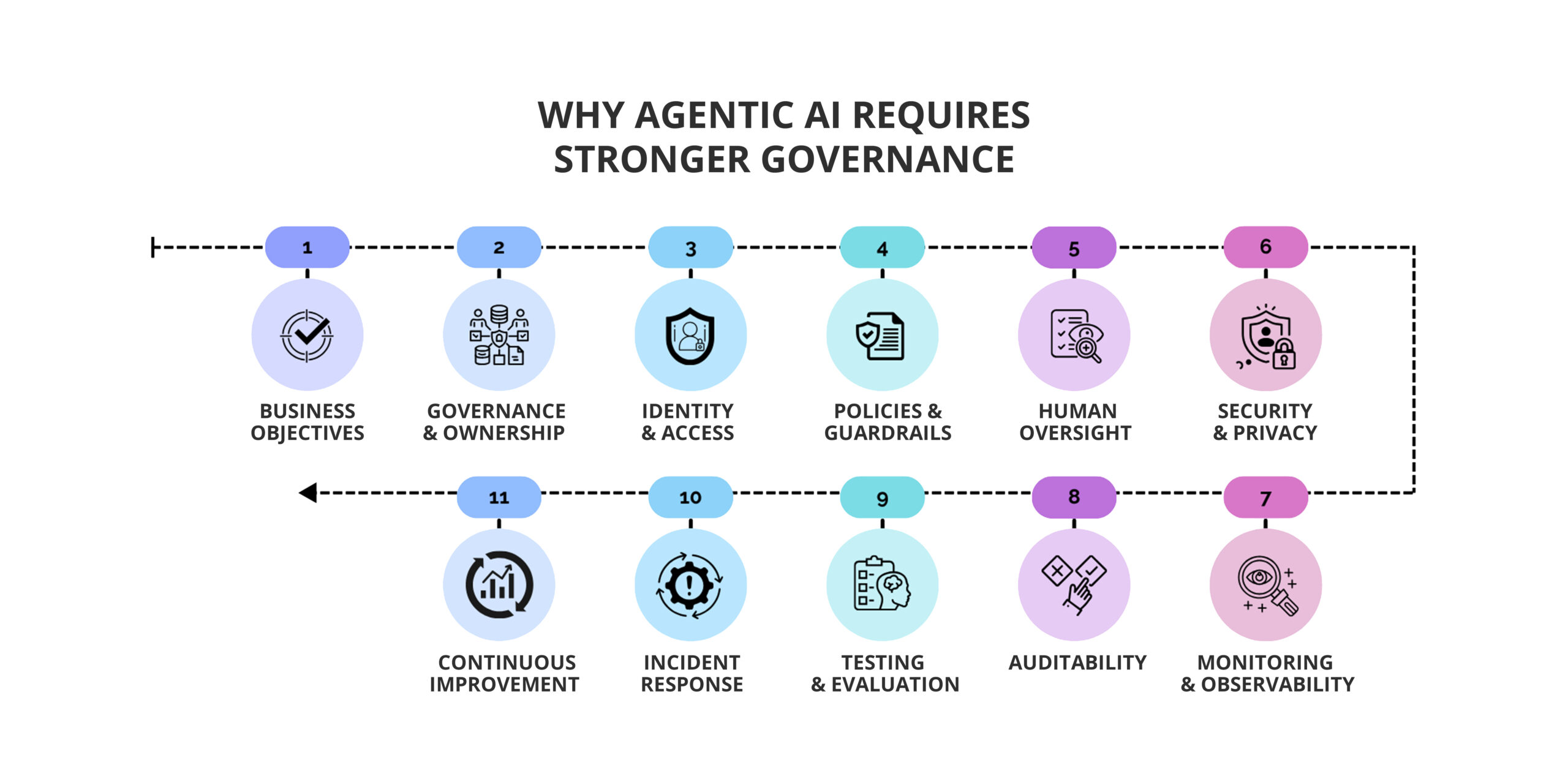
A working agentic AI governance framework is not a single policy document. It is a set of control layers that operate together across the agent’s lifecycle, from design through retirement.
1. Clear Ownership and Accountability
Every agent should have a clearly assigned owner. This person approves its deployment and takes responsibility when something goes wrong. They should also review the agent’s risk profile regularly. The owner must have the authority to disable the agent when necessary. Without clear ownership, incident response can quickly become unclear.
2. Agent Identity and Access Management
Each agent should have its own identity. It should not rely on a person’s credentials or a shared service account. Access should be limited to what the agent actually needs. Short-lived credentials can add another layer of protection where they are practical. Permissions should also be defined for each tool the agent can access. Development and production environments should remain separate to reduce the impact of mistakes or compromised access.
3. Risk-Based Autonomy Levels
Not every agent needs or should have, the same degree of independence. A practical model:
- Level 1 — Assist: the agent recommends, a human acts
- Level 2 — Approve: the agent prepares an action, a human approves before it executes
- Level 3 — Limited autonomy: the agent executes predefined, low-risk actions independently
- Level 4 — High autonomy: the agent runs complex, multi-step workflows under strict guardrails
The right level depends on business impact, data sensitivity, whether the action is reversible, financial exposure, regulatory requirements, and potential for harm.
4. Policy and Guardrails
This layer defines what the agent is allowed and prohibited from doing: data boundaries, tool restrictions, spending limits, escalation triggers, geographic restrictions and compliance rules. These policies matter far more when they are enforced at runtime than when they only exist as documentation nobody checks.
5. Human Oversight
Human review should be required where the stakes justify it: high-impact or irreversible decisions, sensitive data access, financial transactions and compliance- or security-relevant actions. Oversight that applies uniformly to every action, regardless of risk, tends to get bypassed or ignored in practice.
6. Monitoring and Observability
Ongoing visibility into agent behavior, tool usage, decision patterns, errors, latency, cost, policy violations, and escalations turns governance from a one-time approval into a living control.
7. Auditability and Traceability
Enterprises should be able to trace an agent’s activity from start to finish. They should know who initiated it and what task it was given. The record should also show which tools the agent used and what actions it took. It should capture the policies that were applied and any approvals that were required. This level of traceability makes governance practical and defensible, rather than simply documented.
8. Testing and Continuous Evaluation
Pre-production testing, adversarial and red-team testing, scenario and failure testing, and regression testing after model or tool updates all reduce the chance that an agent behaves acceptably in a demo and unpredictably in production.
9. Incident Response and Kill Switches
Organizations need a defined process for unexpected behavior, security incidents, data leakage, runaway tool calls or compromised credentials, including the ability to disable an agent immediately and roll back what it changed.
10. Third-Party and Model Governance
Agentic systems typically depend on foundation model providers, external APIs, plugins, and open-source components. A model or API update outside the organization’s control can change agent behavior overnight, so vendor and dependency risk belongs inside the governance framework, not outside it.
If your organization is evaluating autonomous AI workflows, governance should be designed alongside the agent architecture and not bolted on after deployment. SoftProdigy works with enterprise teams on agentic AI development, building the identity, permissioning and oversight structures into the system from the start.
Best Practices for Building Trusted AI Agents
- Start with a clearly defined business use case. Agents built around a vague mandate tend to accumulate scope and permissions nobody explicitly approved.
- Define the agent’s scope before deployment. What it can and cannot touch should be a design decision, not something discovered in production.
- Assign every agent a clear owner. Accountability that is not assigned in advance does not materialize during an incident.
- Apply least-privilege access. An agent should hold only the permissions its task requires, not the permissions that were convenient to grant.
- Separate low-risk and high-risk actions. Bundling them under one policy usually means the low-risk actions get over-governed or the high-risk ones get under-governed.
- Use risk-based human approval. Reserve mandatory review for the actions where being wrong actually costs something.
- Log important actions and tool calls. Logs are what turn an incident review from guesswork into an answer.
- Test agents against realistic failure scenarios, not just the happy path they were designed for.
- Monitor agents continuously after deployment. Behavior that was safe at launch can drift as models, tools, or data change.
- Build rollback and emergency shutdown capabilities before you need them, not while an incident is active.
- Review model, tool, and policy changes on a schedule, since agent behavior can shift even when nobody touched the agent itself.
- Treat governance as part of engineering, not only compliance. Controls that live only in a policy document rarely constrain what the system actually does at runtime.
Agentic AI Governance vs Traditional AI Governance
How to Implement Agentic AI Governance in an Enterprise
Step 1: Inventory AI agents. List what’s already running and what’s planned, including agents built by individual teams outside a formal AI program.
Step 2: Classify risk. Assess each agent’s autonomy level, data sensitivity, and potential business impact.
Step 3: Define policies. Set explicit rules for access, permitted actions, data boundaries and escalation conditions.
Step 4: Build technical controls. Implement identity management, access control, runtime guardrails, logging, monitoring, and approval workflows.
Step 5: Test before production. Validate normal operation and failure scenarios, including adversarial inputs.
Step 6: Deploy with continuous monitoring. Track behavior and outcomes from day one rather than waiting for a problem to surface.
Step 7: Review and improve. Update governance as agent capabilities, tools, business requirements, and regulations evolve.
Governance built this way sits inside the development lifecycle, not as a separate approval gate added after the system is already built.
Building a governed AI agent requires more than selecting a large language model. Architecture, integrations, permissions, observability and human oversight all have to work together, which is where AI/ML development and governance design typically need to happen in the same conversation.

Agentic AI Governance and the NIST AI Risk Management Framework
Organizations don’t need to invent AI risk management principles from scratch. The NIST AI Risk Management Framework, published in January 2023, is voluntary US government guidance built around four functions: Govern, Map, Measure and Manage. Govern is cross-cutting: it establishes the organizational policies, accountability structures and culture that make the other three functions possible. Map, Measure and Manage then run as an iterative loop layered on top of that foundation.
NIST did not design the AI RMF specifically for autonomous agents, but its structure maps onto agentic governance well. Govern corresponds to ownership, policy and accountability. Map corresponds to identifying an agent’s scope, its access and its potential impact before deployment.
Measure corresponds to testing, monitoring and observability. Manage corresponds to incident response, kill switches and the ongoing adjustment of permissions and guardrails as risk changes. Enterprises building agentic AI governance programs can use the AI RMF as a starting vocabulary rather than a rigid checklist, adapting its categories to the specific realities of systems that act rather than only predict or generate.
Common Mistakes to Avoid
- Treating governance as a one-time approval. Agent behavior changes as models, tools, and data change; governance has to be continuous.
- Giving agents excessive permissions “to be safe.” Broad access intended to avoid future friction is usually the first thing an incident review flags.
- Using the same governance controls for every agent. A low-risk internal scheduling agent and a customer-facing financial agent do not belong under identical rules.
- Ignoring tool and API access. Governance that reviews the model but not what the model can call through tools misses most of the actual risk surface.
- Failing to log agent actions. Without a record of tool calls and decisions, incident response becomes reconstruction from memory.
- Relying entirely on human review. Manual review that scales linearly with agent volume eventually gets skipped under pressure.
- Deploying without rollback mechanisms. Every autonomous action needs a defined way to undo it before it needs one in practice.
- Ignoring third-party model changes. A model or API update outside the organization’s control can silently change how an agent behaves.
- Focusing only on model accuracy. An accurate model with excessive permissions and no oversight is still a governance failure waiting to happen.
- Treating compliance documentation as governance itself. A policy that is not enforced at runtime is a description of intent, not a control.
Conclusion
The value of an AI agent is not only what it can do. It’s whether an organization can control, observe, audit and ultimately trust what it does once it’s operating on its own. That’s the real substance behind agentic AI governance: not a compliance exercise layered on top of the technology, but the operating discipline that makes autonomous systems safe enough to actually rely on.
Done well, governance does not slow innovation down. It’s what lets an organization extend more autonomy to its agents over time, because the identity, permission, monitoring and rollback structures are already in place to catch what goes wrong. As agent capabilities expand, as business requirements shift, and as regulations catch up to autonomous systems, the governance framework needs to evolve with them rather than stay fixed at the point of first deployment.
Enterprises that are building, scaling or trying to safely operationalize AI agents need governance and architecture designed together, not one bolted onto the other after the fact.