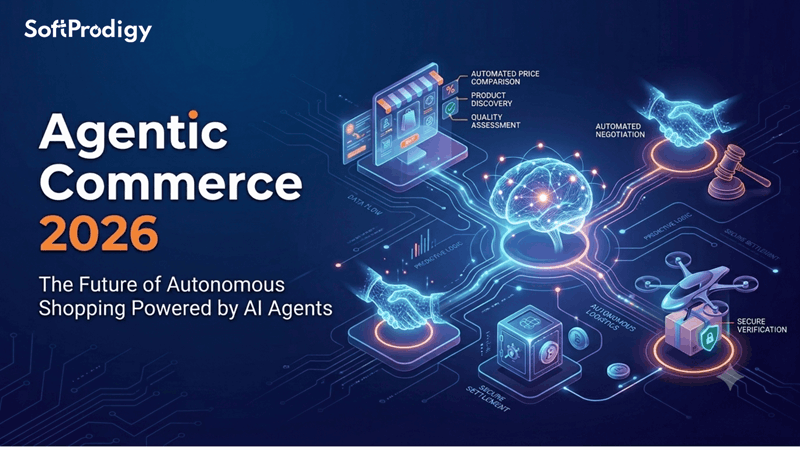
Agentic Commerce is a model of digital commerce in which autonomous AI agents act on behalf of buyers to handle the entire purchase lifecycle. It works without Requiring a human in loop for product discovery and price comparison to checkout and post-purchase support.
In a typical agentic commerce scenario, a user states a goal: “Order running shoes under $120 that arrive by Friday.” The AI agent searches product catalogs, evaluates specifications, cross-references reviews, confirms inventory and completes the purchase. No browser tabs. No checkout forms.
This is not science fiction. It is infrastructure being built right now at scale.
In Q1 2026, AI-driven traffic to Shopify stores grew eight times year over year. While orders from AI-powered searches increased nearly 13 times. Agentic commerce could generate up to $1 trillion in US B2C retail revenue by 2030. Also, the global projections reach $3 trillion to $5 trillion (McKinsey).
For CTOs, CIOs and product leaders, the question is no longer whether agentic commerce matters. It is how fast your organization can build the infrastructure to compete inside it.
This article provides a comprehensive guide to agentic commerce in 2026. It covers architecture, use cases, compliance, platforms, challenges, and what forward-thinking enterprises should do next.
What Is Agentic Commerce and Why Does It Matter Now?
The shift from traditional e-commerce to agentic commerce is arguably the most significant structural change in retail since mobile overtook desktop browsing. But it is happening faster and it rewards different capabilities.
AI-sourced retail traffic surged 1,200% year-over-year, while traditional search traffic declined 10% YoY. This is the most significant traffic shift in retail since mobile overtook desktop.
A common misconception is that agentic commerce is simply a smarter version of the existing recommendation engine or chatbot. It is not. The defining characteristic is autonomy with transaction authority. An AI agent that can discover, evaluate, negotiate and execute a purchase with or without a human in the loop at each step.
What makes this moment different from earlier AI-in-retail hype cycles:
- Protocol infrastructure has arrived. Six major protocols govern agentic commerce as of 2026: ACP (Agentic Commerce Protocol) from OpenAI and Stripe, UCP (Universal Commerce Protocol) from Google and Shopify, AP2 (Agent Payments Protocol) from Google, MCP (Model Context Protocol) from Anthropic, A2A (Agent-to-Agent) from Google, and Visa TAP (Trusted Agent Protocol).
- Major payment networks are live. Visa, Mastercard and American Express all launched agentic commerce products in the first half of 2026.
- Consumer intent is shifting measurably. By 2030, nearly 50% of online shoppers are expected to use AI agents, accounting for approximately 25% of their spending. Adding $115 billion to the US e-commerce sector.
The strategic implication for enterprises is stark. Brands that optimize for human shoppers are building assets that will depreciate faster than they expect.
Agentic Commerce vs. Traditional E-Commerce: A Clear Comparison
The core insight: The winners will not be the merchants with the biggest marketing budgets or the most recognizable brands. They will be the merchants with the cleanest data and the most responsive APIs that makes agents prefer them over competitors.

Agentic Commerce Architecture Explained
Understanding how agentic commerce actually works requires mapping the full technical stack. Below are the seven layers that make autonomous purchasing possible.
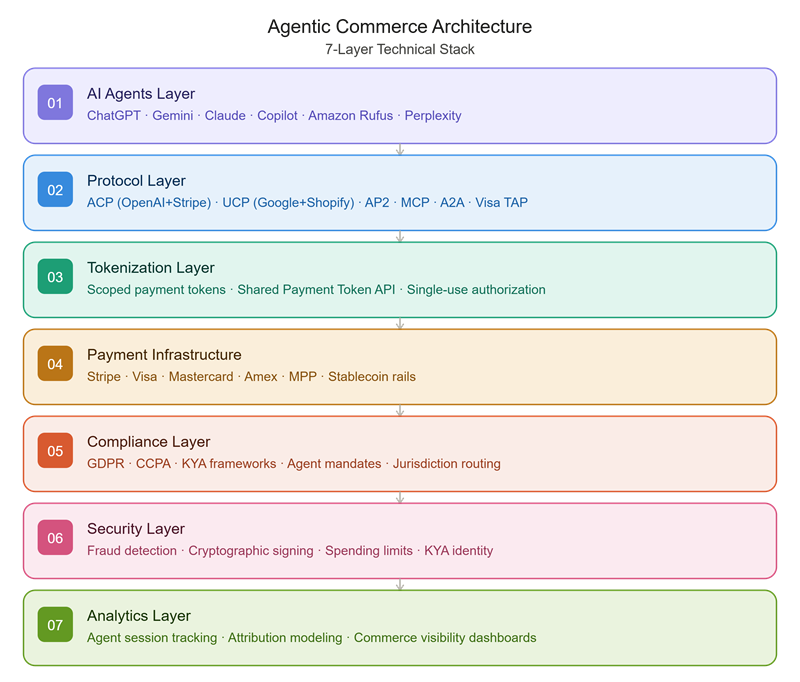
- AI Agents Layer The intelligence layer. Large language models (LLMs) which include ChatGPT, Gemini, Claude, Microsoft Copilot, Amazon Rufus and Perplexity Comet. It serves as the consumer-facing interface.These agents receive natural language intent (“find the best standing desk under $800”). The agent’s ability to recommend your product depends heavily on how accessible and structured your product data is.
- Agentic Operating System / Protocol Layer: The communication standard. Six protocols define the agentic commerce stack as of April 2026. Most production deployments use two or three together. ACP enables checkout transactions inside ChatGPT.UCP, co-developed by Google and Shopify and covers the full journey from discovery through fulfillment. MCP (Anthropic’s Model Context Protocol, donated to the Linux Foundation) provides foundational agent infrastructure. A2A enables multi-agent coordination. Visa TAP verifies agent identity using cryptographic signing. Each protocol serves a different function and most retailers will need to support multiple.
- Tokenization Layer: The security primitive. Rather than exposing a buyer’s payment credentials to an AI agent, the tokenization layer issues single-use and scoped payment tokens. It is authorized only for a specific merchant, amount and time window.Payment is secure: encrypted payment tokens are only authorized for specific amounts and specific merchants with the user’s permission. Also the data sharing is minimal which means only the information required to complete the order is shared with the merchant.
- Payment Infrastructure Layer: This is called the transaction execution layer. The Machine Payments Protocol (MPP) which is co-developed by Stripe and Tempo and launched on March 18, 2026 with over 100 integrated services.The partners include Stripe, Visa, Mastercard, Anthropic, OpenAI and Shopify. MPP supports sessions, streaming micropayments, subscriptions and fiat/stablecoin flexibility. All three major US card networks like Visa, Mastercard and American Express have live agentic payment infrastructure as of mid-2026.
- Compliance Layer: This layer is the regulatory guardrail. One challenge often overlooked is that agentic transactions create new jurisdictional complexity as an agent may execute transactions across multiple countries in a single session which may trigger different tax, consumer protection and data privacy regulations.Organizations should consider embedding policy-aware routing and compliance logic directly into agent workflows, so that identity checks and transaction authorization rules adapt to jurisdiction automatically.
- Security Layer: This is a fraud prevention and trust layer. Verifying that an agent is legitimate and defining responsibility when an agent makes an unauthorized or harmful decision are critical challenges. Industry experts propose implementing Know Your Agent (KYA) identity frameworks, cryptographic signing, Web Bot Auth standards, graded permissions, spending limits, human-in-the-loop checks for high-risk actions and enhanced dispute and recovery flows.
- Analytics Layer: The analytics layer is the visibility layer. This is where the current infrastructure gap is most acute. In agent-mediated commerce, the behavioral data stream starts at the add-to-cart moment.The discovery, browse and the consideration and the refined preferences all live inside ChatGPT or Gemini. Attribution collapses. Personalization breaks. Retail media goes dark. Enterprises need new analytics frameworks designed for machine-mediated shopping.
Top Agentic Commerce Use Cases in 2026
Retail and Direct-to-Consumer
A shopper tells their AI agent: “Find me a birthday gift for a 10-year-old who loves science, under $50, ships in two days.” The agent queries connected product catalogs across multiple retailers, applies preference and logistics filters and presents curated options with one-tap checkout.
Brands like Walmart, Target, Home Depot and Lowe’s are partnering with tech providers to create agentic AI solutions. Early retailers report 7x sales growth versus those without AI agent integrations.
Grocery and Consumables
This is arguably the most mature near-term use case. Instacart launched as ChatGPT’s first grocery partner in December 2025 through the ChatGPT Apps integration. The model is compelling that a user shares a recipe and the AI agent assembles the shopping cart from available inventory which applies loyalty discounts and schedules delivery with no manual browsing required. Subscription-based reordering of household staples (detergent, pet food, vitamins) is an early proving ground for fully autonomous transactions.
Travel and Hospitality
Travel planning is uniquely well-suited to agentic commerce because it involves high complexity and multiple vendors. An agent handling a family vacation can simultaneously query flights, hotels, car rentals and activity providers. It also can optimize across price, timing and stated preferences. The agent can also monitor for price drops post-booking and proactively rebook when better options emerge.
Healthcare and Pharmaceuticals
Agentic commerce introduces significant efficiency gains in prescription refill management, medical supply procurement and wellness product reordering. The compliance considerations are heightened — agents must navigate HIPAA, prescription verification requirements, and controlled substance restrictions. However, for over-the-counter categories and non-prescription health products, autonomous reordering based on consumption patterns is already technically feasible.
Manufacturing Procurement
B2B procurement is one of the highest-value applications. An inventory management agent that monitors stock levels and autonomously initiates purchase orders with supplier systems. It compares price, lead time and quality specs. The result is, it eliminates significant manual labor while reducing stockout risk.
Agent-to-agent commerce is developing: B2B procurement agents will begin negotiating directly with supplier agents. A retailer’s inventory management agent might automatically reorder stock from a manufacturer’s sales agent when levels drop.
B2B Commerce and Enterprise Procurement
The enterprise procurement case is perhaps the most underappreciated opportunity. Multi-step RFP processes, vendor comparisons, contract negotiation and purchase order issuance are all candidates for agent-led automation. Gartner predicts that by the end of 2026, 25% of enterprise software purchases will involve some form of AI agent mediation. Organizations should consider piloting agent-assisted procurement for indirect spend categories first, where compliance complexity is lower and speed-to-value is highest.
Agentic Commerce Startups and Platforms to Watch
The agentic commerce infrastructure landscape is consolidating rapidly. Here are the key players defining the category.
Consumer AI Platforms (Where Shopping Journeys Begin)
- ChatGPT (OpenAI): Launched Instant Checkout via ACP in September 2025. Deprecated native checkout in March 2026 in favor of retailer app integrations (Walmart, Target, Instacart), but remains the highest-volume AI commerce discovery surface with an estimated 50 million shopping-related queries per day.
- Google AI Mode / Gemini: In-chat checkout via Google Pay is already live on Gemini. Gap became the first major fashion retailer to allow shoppers to complete a purchase entirely inside the Gemini chat interface in March 2026, followed by Ulta Beauty in April.
- Microsoft Copilot: Adopted UCP in Merchant Center with Shopify Catalog integration.
- Amazon Rufus / Buy for Me: Amazon’s proprietary agentic shopping agent, operating inside Amazon’s walled garden. On a reported $12 billion incremental annualized revenue run-rate as of Q4 2025.
Commerce Infrastructure Platforms
- Shopify: Shopify co-developed the Universal Commerce Protocol (UCP) with Google and introduced Agentic Storefronts, granting millions of merchants access to AI channels like ChatGPT, Microsoft Copilot and AI Mode in Google Search — managed directly from the Shopify Admin.
- Stripe: Co-developed ACP with OpenAI. Launched the Agentic Commerce Suite in December 2025, with partners including URBN, Etsy, Coach, Kate Spade, Ashley Furniture and Revolve.
- Commercetools and BigCommerce: Merchant enablement layer integrations enabling multi-protocol compliance through single API connections.
Payments and Security Startups
- Nekuda: Raised a $5 million seed round (Madrona, Amex Ventures, Visa Ventures). Builds agentic payments SDK with Secure Agent Wallet and Agentic Mandates components. Launch partner for Visa Intelligent Commerce.
- Skyfire: Agentic payments infrastructure focused on machine-to-machine transaction authorization.
- Basis Theory: Token vault infrastructure for securing payment credentials in agentic flows.
- Very Good Security (VGS): Closing the data gap between consumers, agents, merchants, and payment processors.
Protocol and Identity Infrastructure
- Visa Intelligent Commerce / TAP: Cryptographic agent identity verification, live with partners including Adyen, Stripe, Shopify, Microsoft, and Worldpay.
- Mastercard Agent Pay: Live in Singapore, South Korea and other Asia-Pacific markets as of February 2026.
- American Express ACE Developer Kit: Debuted in April 2026 with industry-first purchase protection for registered AI agent purchases.
Benefits of Agentic Commerce for Enterprises
For Merchants and Retailers
- Access to high-intent buyers who have already decided to purchase before reaching your product listing
- Elimination of browse abandonment as a metric (agents convert at the goal-seeking stage, not the impulse stage)
- McKinsey data shows 4.4x higher conversion rates for AI-generated product recommendations versus traditional search
- Reduced customer acquisition cost for repeat categories (subscription-like behavior without subscription mechanics)
For B2B Organizations
- Significant reduction in procurement cycle time
- Elimination of manual RFQ and PO issuance for routine spend
- Real-time supplier comparison against live pricing and availability
- Auditability and compliance logging built into agent workflows
For Consumers
- Goal-based shopping instead of browsing-based shopping
- Elimination of decision fatigue for routine purchases
- Price and availability optimization across merchants without manual comparison
- Consistent preferences applied across every purchase session
Agentic Commerce Compliance: What Organizations Need to Know
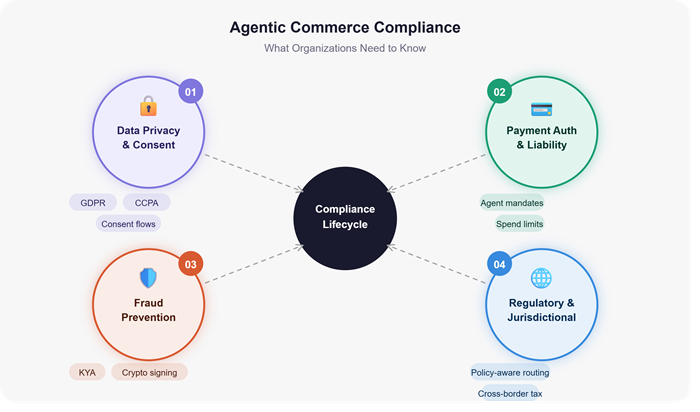
Compliance is the layer most enterprises underestimate when planning agentic commerce deployments. The challenges fall into four categories.
Data Privacy and Consent Agentic systems access purchase history, behavioral data and personal preferences to function effectively. GDPR (Europe), CCPA (California), and similar frameworks create consent requirements that most agentic architectures have not yet built to natively.
Payment Authorization and Liability When an AI agent completes a transaction that the user disputes, who is liable, the merchant, the AI platform or the payment processor? Current frameworks are evolving. Organizations should consider establishing clear agent mandate documentation that defines spending limits, authorized categories and revocation mechanisms before deploying production agentic commerce capabilities.
Fraud Prevention With cybercrime and online fraud resulting in over $4 billion in losses and counting, businesses face growing pressure to protect both their customers and their bottom line. Agentic transactions introduce new fraud vectors i.e compromised agent credentials, injection attacks via product data and unauthorized agent impersonation. The KYA (Know Your Agent) framework is emerging as the industry standard for agent identity verification.
Regulatory and Jurisdictional Complexity An AI agent executing a cross-border transaction triggers tax, import consumer protection rules from multiple jurisdictions simultaneously. Policy-aware routing where compliance rules are embedded in agent decision logic rather than applied post-hoc is the most scalable mitigation strategy.
Challenges and Mitigation Strategies
The Agentic Commerce Maturity Model
Organizations adopting agentic commerce typically move through four stages. Knowing where you are determines where to invest first.
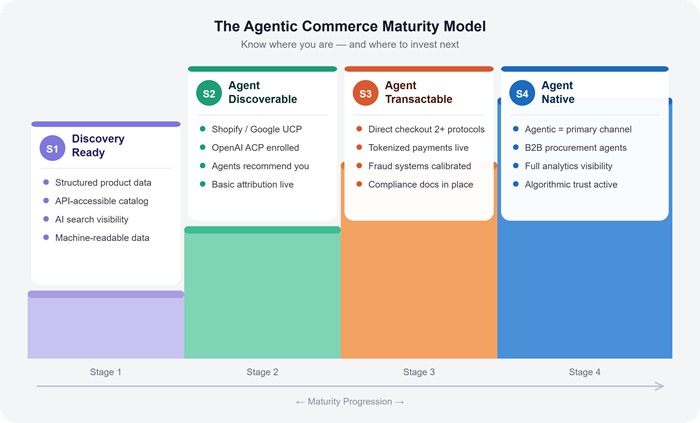
Stage 1 — Discovery Ready
Your product data is structured, complete and accessible via API. Your catalog is machine-readable. You appear in AI-generated search results. Most organizations should target this stage as the immediate priority. It is a prerequisite for every subsequent stage.
Stage 2 — Agent Discoverable
You are enrolled in one or more agentic storefronts (Shopify Catalog, Google UCP, OpenAI ACP). Agents can recommend your products. Transactions route through established payment infrastructure. You have basic attribution instrumentation for agent-sourced orders.
Stage 3 — Agent Transactable
You have implemented direct checkout via two or more protocols. You have a tokenized payment infrastructure in place. Your fraud prevention systems are calibrated for machine-initiated transactions. You have compliance documentation for agent mandate authorization.
Stage 4 — Agent Native
Agentic commerce is a primary channel not an experiment. You have internal AI agents handling B2B procurement, inventory replenishment and supplier negotiation. Your analytics stack provides full visibility into agent-mediated commerce performance. You actively maintain your “algorithmic trust”. The preference AI agents show your products when comparing alternatives.
Future Trends in Agentic Commerce
Agent-to-Agent Commerce Scaling
The next frontier is not human-to-agent commerce but agent-to-agent. Enterprise procurement agents negotiating in real time with supplier agents. Without a human approving each step it will become standard for routine spend categories by 2027-2028.
Stablecoin and Programmable Payment Rails
Autonomous agents favor speed, low fees and 24/7 settlement that is exactly what stablecoins deliver. The x402 protocol, led by Coinbase, processed roughly 165 million agent transactions in its first months. As agents execute cross-border micro-transactions at machine speed, stablecoin rails will increasingly compete with card networks for agent-initiated payment volume.
Voice Commerce Agents
Voice-Commerce Agents are forecast to register the strongest 36.25% CAGR among all technology segments through 2031. As voice interfaces become more capable of managing complex, multi-step commerce interactions, the “shop by speaking to your AI” model will move from novelty to normalized behavior.
Subscription-Like Autonomous Reordering
The most frictionless commerce outcome is a purchase that happens without the consumer needing to initiate it. Agents that monitor consumption, predict reorder timing and execute purchases within pre-authorized parameters will create a new category of “continuous commerce”.
Answer Engine Optimization (AEO) Replacing SEO
Brands and businesses that previously obsessed about search engine optimization (SEO) now must become experts in answer engine optimization (AEO), as consumers are turning away from standard searches and using more complex and conversational AI-driven searches.
How SoftProdigy Can Help Build Agentic Commerce Solutions
SoftProdigy sits at the precise intersection of capabilities that agentic commerce demands: Agentic AI architecture, Data Engineering, Product Engineering, Quality Engineering, and Digital Transformation. We are not a commerce platform reseller. We are a technology partner that builds the infrastructure layer enterprises need to compete inside agent-mediated markets.
Agentic AI Agent Development We design and build purpose-built AI agents for commerce use cases like shopping agents, procurement agents, inventory agents and customer support agents by using the latest LLM frameworks and fine-tuning approaches.
Data Engineering for Agent Readiness
The single biggest predictor of agentic commerce performance is data quality. SoftProdigy’s data engineering teams build machine-readable product catalog infrastructure, real-time inventory APIs, and structured data pipelines that ensure your products are visible, accurate and recommended by AI agents.
Protocol Integration and Commerce API Development
We build and maintain integrations with ACP, UCP, AP2, MCP and emerging protocols, so your organization can participate across multiple agent platforms through a managed, maintainable architecture rather than brittle one-off integrations.
Agentic Commerce Security and Compliance Frameworks
Our engineering teams implement tokenization layers, KYA identity verification, fraud detection models tuned for machine-initiated transactions and jurisdiction-aware compliance routing which cover the security and regulatory requirements that most agentic commerce deployments underestimate.
Analytics and Attribution Infrastructure
We build the analytics stack that makes agent-mediated commerce measurable by replacing human-browse attribution models with agent-session-aware instrumentation that gives your team actionable visibility into how AI agents are interacting with your catalog.
B2B Agent-to-Agent Commerce Systems
For manufacturing, distribution and enterprise clients, SoftProdigy designs and implements agent-to-agent procurement workflows which connect your internal inventory and purchasing systems to supplier APIs through autonomous agent orchestration.

Conclusion
Agentic Commerce is not a distant technology scenario. There is a structural market shift happening now, shaped by six live protocols, three major payment networks and hundreds of millions of shopping queries running through AI models every day.
The enterprises that will capture disproportionate value from this shift share one characteristic: they treat agent-readiness as infrastructure investment and not a marketing experiment. Clean product data, responsive APIs, multi-protocol compliance and agent-aware security are the foundations. Everything else like higher conversion rates, lower acquisition costs and new B2B procurement efficiency are built on top of them.
A common misconception is that agentic commerce primarily benefits large enterprises with dedicated AI teams. The reality is more nuanced. Clean data, open API architecture and protocol compliance are achievable at any scale. The competitive divide will not be drawn between large and small organizations. It will be drawn between those who build for the agent economy now and those who wait until the infrastructure advantage of early movers compounds beyond their reach.
SoftProdigy helps organizations at every stage of this journey. From initial data infrastructure assessment to full agentic commerce platform deployment, the agent economy is open. The question is whether your organization is ready to compete inside it.