Many years ago, grocery apps were considered an advantage. However these days they are a business necessity.
Consumers hate to wait in line when they purchase groceries. They expect shopping needs to be digitally available with actual time visibility to stock and multiple delivery options. This forces grocery retailers, supermarkets and new brands to pace up their online presence.
Industry reports estimate that the global online grocery market could exceed $2 trillion by 2030. Do you know why? The growing smartphone adoption, customer expectations and increased demand for comfort.
Planning to take your grocery business online or start a grocery delivery venture? There are various factors to consider before investing in grocery app development company. This guide will help you make better decisions and avoid mistakes.
What Does a Grocery App Development Company Actually Do?
A grocery app may seem like a simple platform where customers browse products, add items to a cart and schedule deliveries. But modern grocery apps do more than just let customers place orders.
They connect shoppers, store operations, inventory, deliveries, payments, and business data on a single platform. It is responsible for designing and building this entire ecosystem. Not just the mobile application customers interact with.
Think about what happens when a customer places an order through a grocery app. Once a customer places an order. The system quickly checks inventory, confirms payment, schedules delivery and sends an order confirmation.
While customers see a seamless shopping experience, dozens of backend processes are working simultaneously behind the scenes. This level of coordination is what separates grocery app development from standard app development.
Why Businesses Need Grocery Delivery Apps in 2026
Convenience, speed and flexibility now influence how people buy everything, including groceries.
Several factors are driving this transformation:
- More than 7 billion smartphone connections worldwide are making mobile commerce more accessible.
- Digital wallets now account for over half of global e-commerce transactions, simplifying online purchases.
- Same-day and scheduled deliveries have become a standard expectation rather than a premium service.
- Quick-commerce platforms are reshaping consumer expectations around delivery speed.
- Personalized offers and recommendations continue to improve customer retention and repeat purchases.
Key Business Benefits of Grocery Delivery Apps
What CEOs and Retail Leaders Are Thinking About?
When evaluating grocery app development company, decision-makers are no longer asking whether they need a digital platform. Instead, they’re focused on questions such as the following:
- How quickly can we launch and scale?
- Can the platform support multiple stores and locations?
- How can we improve customer retention and repeat purchases?
- What role can AI play in personalization and forecasting?
- How can we reduce operational costs through automation?
- Will the platform integrate with our existing POS, ERP, and inventory systems?
The answers to these questions often determine the long-term success of a grocery delivery initiative.
The Competitive Reality
Leading brands such as Instacart, Walmart Grocery, BigBasket, Blinkit and Zepto have raised customer expectations significantly.
Consumers now expect features like real-time order tracking, personalized recommendations, flexible delivery windows and seamless checkout experiences as standard.
For businesses entering or expanding within the online grocery space, investing in a scalable grocery delivery platform is no longer about keeping up with trends. It’s about meeting evolving customer expectations while building a foundation for sustainable growth.
Types of Grocery Delivery Apps
All grocery delivery apps operate differently. The business model you choose impacts everything from development costs and operational complexity to revenue generation.
Therefore, before investing in grocery app development businesses should understand the different types of grocery delivery platforms available and determine which model aligns best with them.
Here are the major types of grocery apps:
1. Inventory-Based Grocery App:
This is the model where the business manages and owns its inventory. Customers place orders and the products are delivered directly from the physical store or warehouse.It provides complete control of the product quality, pricing, inventory and user experience. According to research, retailers with strong inventory visibility and fulfillment processes can reduce stockouts.
Best for:
Supermarket chains
Retail brands
Large grocery stores
2. Multi-Vendor Grocery Marketplace:
A multi-vendor grocery marketplace connects customers with multiple grocery stores through a single platform. The platform owner does not maintain inventory but earns revenue through commissions, subscriptions, or listing fees.This model scales faster because new vendors can be added without increasing inventory costs. Marketplace businesses continue to drive a major share of global e-commerce growth. This makes the model best for businesses looking to expand without much investment.
Best for:
Startups
Aggregator platforms
Regional grocery marketplaces
3. Hyperlocal Grocery Delivery App:
Hyperlocal grocery apps focus on serving customers within a specific geographic radius. Orders are fulfilled from nearby stores, enabling faster deliveries and reduced logistics costs.This model has gained popularity due to the growing demand for convenience and same-day deliveries. Studies suggest delivery speed is a major influence on the customer purchase decision.
Best for:
Local grocery chains
Regional retailers
Urban delivery businesses
4. Quick Commerce Grocery App:
The focus of the quick-commerce grocery app is on ultra-fast deliveries. Often within a time span of 10-30 minutes. These operate through microfulfillment centers. These centers are located near customers.
Its popularity continues to rise. According to a Reuters report citing Bain & Company, quick commerce accounted for more than two-thirds of e-grocery orders in 2024. Furthermore, it is expected to grow at over 40% annually through 2030.
Comparison of Grocery App Business Models
Grocery App Development Process
Building a successful grocery delivery platform requires more than just working on the code. It involves careful planning, user-centric design, scalable architecture, seamless integrations and continuous optimization.
A structured development process helps businesses reduce risks, control costs, and accelerate time-to-market.
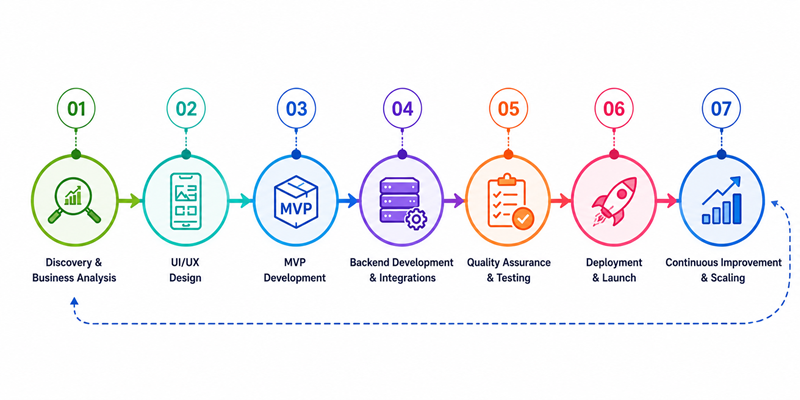
1. Discovery and Business Analysis:
The first step to building a successful grocery app starts with understanding the business model, target audience, competitive landscape and operational requirements. This stage lays the foundation for the entire project and helps prevent costly changes later.
During this phase, development teams define the following:
- Business objectives
- Revenue model
- Target market
- User personas
- Core features
- Technical requirements
- Integration needs
2. UI/UX Design:
The next step is creating a simple and likeable user experience. Designers make sure customers can find products, place orders, and check out easily.
A well-designed interface directly impacts conversion rates and customer retention.
Key focus areas include:
- Easy navigation
- Fast product discovery
- Simplified checkout
- Mobile responsiveness
- Accessibility
3. MVP Development:
Rather than launching with every possible feature, many businesses begin with a Minimum Viable Product (MVP).
An MVP includes only the essential features required to validate the concept and attract early users. This approach reduces initial investment while providing valuable user feedback.
Typical MVP features include:
4. Backend Development and Integrations:
The backend powers every operation behind the scenes. A strong backend ensures accuracy, and smooth performance during peak demand periods.
This stage includes:
- Database development
- API creation
- Payment gateway integration
- Inventory synchronization
- POS integration
- ERP integration
- Delivery management systems
- Notification services
5. Quality Assurance and Testing:
Before launch, every component undergoes testing to identify and eliminate issues. The goal is to ensure a seamless experience across all devices and user scenarios.
Testing typically covers:
- Functional testing
- Security testing
- Performance testing
- Usability testing
- Device compatibility testing
- Payment workflow testing
6. Deployment and Launch:
Once testing is complete, the application is deployed to production environments and published on app stores. A successful launch requires careful planning to avoid disruptions and ensure platform stability.
This phase includes:
- Cloud deployment
- Security configuration
- Performance monitoring
- App Store submission
- Google Play Store submission
- Go-live support
7. Continuous Improvement and Scaling:
Launch is only the beginning. Successful grocery platforms continuously evolve based on customer feedback and changing market demands.
Businesses that treat their grocery platform as an evolving digital product often achieve stronger customer retention.
Post-launch activities often include:
- Feature enhancements
- Security updates
- Performance optimization
- Customer behavior analysis
- AI implementation
- Expansion into new markets
Typical Grocery App Development Timeline
The exact timeline depends on feature complexity, integrations, business model and customization requirements.
Grocery App Development Cost Breakdown
One of the first questions businesses ask is, “How much does a grocery delivery app cost?” It depends on several factors such as the number of features, integrations and development approach.
A simple MVP will cost less than an enterprise-grade grocery ecosystem that supports multiple stores, advanced analytics and AI-powered capabilities.
Average Grocery App Development Cost
These estimates can vary based on project scope, customization, third-party integrations and long-term scalability goals.
Right Technology Stack for Grocery App Development
The technology stack behind a grocery delivery platform directly impacts performance, scalability, security and long-term maintenance costs. Choosing the wrong architecture can lead to slow response times, integration challenges and expensive redevelopment as the business grows.
This is why successful grocery platforms are built with future scalability in mind rather than focusing solely on launch requirements.
What Makes a Technology Stack Suitable for Grocery Apps?
Unlike traditional eCommerce applications, grocery delivery platforms process thousands of real-time actions simultaneously, including inventory updates, order placements, payment transactions, delivery tracking and customer notifications.
To support these operations, the technology foundation must deliver:
- Fast application performance
- Real-time data synchronization
- Secure payment processing
- High system availability
- Seamless third-party integrations
- Scalability during peak demand
- Data security and compliance
Core Layers of a Modern Grocery Delivery Platform
Rather than operating independently, these layers work together to create a seamless shopping experience.
Future-Ready Grocery Platforms
The right technology stack creates the foundation for adopting these innovations without requiring major platform redesigns.
As customer expectations evolve, grocery businesses are increasingly investing in advanced capabilities such as the following:
- Personalized shopping experiences
- Demand forecasting
- Predictive inventory management
- Customer behavior analytics
- Automated promotions
- Intelligent product recommendations
How Is AI Transforming Grocery App Development?
Artificial intelligence is no longer a future trend in grocery retail. It is becoming a core component of how businesses improve customer experiences, optimize operations and increase profitability.
As competition grows and customer expectations evolve, grocery businesses are increasingly adopting intelligent solutions that help them make faster, data-driven decisions.
From personalized shopping experiences to demand forecasting, AI is helping grocery platforms become more efficient, responsive and customer-centric.
Business Impact of AI in Grocery Apps
Personalized Product Recommendations
Every customer shops differently. AI analyzes browsing patterns, purchase history, preferences, and buying behavior to recommend relevant products.
For example, if a customer frequently purchases organic products, the platform can automatically recommend similar items during future shopping sessions.
This creates a more personalized shopping experience while increasing:
- Average order value
- Cross-selling opportunities
- Customer engagement
- Repeat purchases
Security and Compliance Requirements for Grocery Apps
Security is a business requirement. Grocery apps handle sensitive customer information, payment details, addresses and transaction data daily. A single security breach can damage customer trust, lead to financial losses and result in regulatory penalties.
This is why security and compliance should be built into the platform from day one rather than added later.
Key Security Measures Every Grocery App Needs
- Secure Payment Processing: Customers expect fast and secure transactions. Grocery apps must use encrypted payment gateways and follow industry standards to protect payment information.
- Data Encryption: Sensitive customer data should be encrypted both during transmission and storage to prevent unauthorized access.
- Multi-Factor Authentication (MFA): Adding an extra layer of authentication helps protect customer and admin accounts from unauthorized logins.
- Role-Based Access Control: Different users require different levels of access. Store managers, delivery partners and administrators should only have access to the information necessary for their roles.
- Regular Security Audits: Routine testing and vulnerability assessments help identify and resolve security risks before they become major issues.
Why Security Matters for Growth?
As grocery platforms scale, they process larger volumes of customer data and transactions. A secure and compliant platform not only reduces risk but also strengthens brand reputation and customer confidence.
For businesses looking to expand into new markets, strong security practices often become a competitive advantage rather than just a technical requirement.
How to Choose the Right Grocery App Development Company?
You are choosing a technology partner that will influence customer experience, operational efficiency, revenue growth and your ability to scale in the future.
The challenge is that many development companies look similar on the surface. They showcase impressive portfolios, list the latest technologies and promise fast delivery. But once the project begins, the differences become obvious.
So, what should businesses actually look for?
Do They Understand Grocery Retail or Just Software Development?
A grocery app is not just another eCommerce platform.
It involves inventory management, delivery logistics, customer retention, pricing strategies, payment workflows and operational efficiency.
A development partner that understands grocery operations can identify challenges before they become expensive problems.
For example, they should already be thinking about:
- What happens when an item goes out of stock?
- How will inventory sync across multiple stores?
- Can delivery slots be managed efficiently during peak hours?
- How will the platform handle seasonal demand spikes?
These questions often matter more than the programming language being used.
1. Are They Building for Today or Planning for Tomorrow?
Many businesses launch with a small customer base and limited geographic coverage. Six months later, they’re adding new locations, increasing order volumes, and introducing new services.
2. Can They Connect With Your Existing Business Systems?
Most grocery businesses already use tools for inventory, accounting, customer management, or point-of-sale operations. The real value comes from making these systems work together.
If inventory updates in one system but not another, customer experience suffers. If orders need to be entered manually across multiple platforms, operational costs increase. The best grocery app development company focus on creating a connected ecosystem rather than a standalone application.
3. Are They Asking the Right Questions?
One of the easiest ways to evaluate a development partner is to pay attention to the questions they ask. If the conversation revolves entirely around features, that’s a concern.
The best partners usually ask questions like:
What are your growth goals?
How do customers currently place orders?
What challenges are slowing operations today?
Which metrics define success for your business?
What systems are already in place?
These discussions often reveal opportunities that businesses have not considered yet.
What Happens After Launch?
Many businesses focus heavily on development and overlook what comes next. But launch day is not the finish line.Customer expectations change. New competitors enter the market. Security requirements evolve. Technology advances.A strong development partner stays involved after launch to help optimize performance, improve user experiences, and support future growth.
Common Challenges in Grocery App Development
In reality, grocery platforms are among the most operationally complex digital products to build and manage.
Unlike traditional eCommerce apps, grocery businesses deal with rapidly changing inventory, delivery logistics, customer expectations and real-time transactions. Even small inefficiencies can directly impact revenue and customer satisfaction.
Understanding these challenges early can help businesses avoid costly mistakes and build a more resilient platform.
Managing Real-Time Inventory: One of the most common frustrations for customers is placing an order only to discover that products are unavailable. Inventory changes constantly throughout the day, especially for fresh produce, dairy products and fast-moving consumer goods.
The solution: Implement real-time inventory synchronization between stores, warehouses and the customer-facing application to ensure accurate product availability.
Delivering a Consistent Customer Experience: Customers expect a seamless experience across every touchpoint, from product discovery and checkout to delivery and support. Slow-loading pages, inaccurate product information, and complicated checkout processes can quickly lead to abandoned carts.
The solution: Focus on intuitive user experiences, simplified navigation, fast search functionality, and frictionless checkout flows.
Scaling During Peak Demand: Holiday seasons, promotional campaigns, and weekend shopping spikes can place significant pressure on a grocery platform. Without proper infrastructure, businesses may experience slow performance, failed transactions, and service disruptions.
The solution: Build on scalable cloud infrastructure capable of handling traffic fluctuations without affecting performance.
Coordinating Delivery Operations: Fast and reliable delivery remains one of the biggest operational challenges for grocery businesses. Factors such as route planning, traffic conditions, delivery zones and driver availability directly impact customer satisfaction.
The solution: Leverage route optimization tools, delivery management systems and real-time tracking capabilities to improve efficiency.
Maintaining Data Security: As grocery platforms process customer information and payment data, security becomes a critical business priority. A single breach can damage customer trust and expose businesses to financial and regulatory risks.
The solution: Implement strong encryption, secure payment gateways, access controls and regular security assessments.
Integrating Multiple Business Systems: Most grocery businesses rely on several systems to manage operations, including inventory software, ERP platforms, POS systems, accounting tools and customer databases. Disconnected systems often create operational bottlenecks and inconsistent data.
The solution: Build a connected ecosystem where information flows seamlessly across all business functions.
Keeping Customers Engaged: Acquiring customers is expensive. Retaining them is where long-term profitability is built. Many grocery apps struggle with low repeat purchase rates and declining customer engagement.
The solution: Use personalized recommendations, loyalty programs, targeted promotions, and customer insights to encourage repeat purchases.
Conclusion
Success in digital grocery commerce is no longer defined by simply having an app. It comes from creating experiences that make shopping effortless, operations more efficient and business growth more predictable.
Whether you are launching a new venture or expanding an existing retail business, partnering with an experienced technology provider can make all the difference.
With expertise in building scalable digital solutions, SoftProdigy helps businesses turn ambitious ideas into impactful customer experiences.