
Your front desk phone rings all day, and most calls ask the same questions. Your clinicians finish notes at night instead of resting. Claims bounce back because of one small coding error, and cash flow slows down again.
Sound familiar? Many founders and practice owners hit this wall as their clinics grow. Hiring more staff feels like the only fix, yet payroll keeps climbing.
There is a smarter path, and it is easier to start than you think. Global Newswire valued the healthcare automation market at $35.92 billion in 2023. Forecasts say it will reach $80.28 billion by 2032. That growth shows where smart operators are placing their bets.
In this guide, you will learn what to automate first and how to avoid costly mistakes.
What Is AI Automation in Healthcare?
AI automation in healthcare uses intelligent technology to handle repetitive tasks, analyze information, and support faster decisions.
It allows for decreasing workloads for healthcare organizations and gives professionals more time to interact with patients. For organizations exploring tailored solutions, agentic ai solutions offer a starting point for understanding relevant capabilities.
Imagine a clinic where employees perform administrative tasks like scheduling appointments, verifying insurance, and updating patient records. AI tools may automate some procedures, detect gaps in information, and send tasks to appropriate departments.
Tools such as NLP, predictive analytics, and robotic process automation (RPA) have their roles. Natural language processing helps computers understand medical texts, while predictive analytics detects patterns in patient data. Robotic process automation performs repetitive digital tasks according to specified rules.
What really matters is the combination of these tools with existing health systems. The goal of automation is to assist healthcare professionals rather than substitute clinical reasoning.

How AI Automation Is Implemented in Healthcare
AI automation merges patient data, technology, and healthcare systems to facilitate healthcare operations. It is able to collect information, identify patterns, and react accordingly, doing very little work manually.
The typical process of AI automation in healthcare goes as follows:
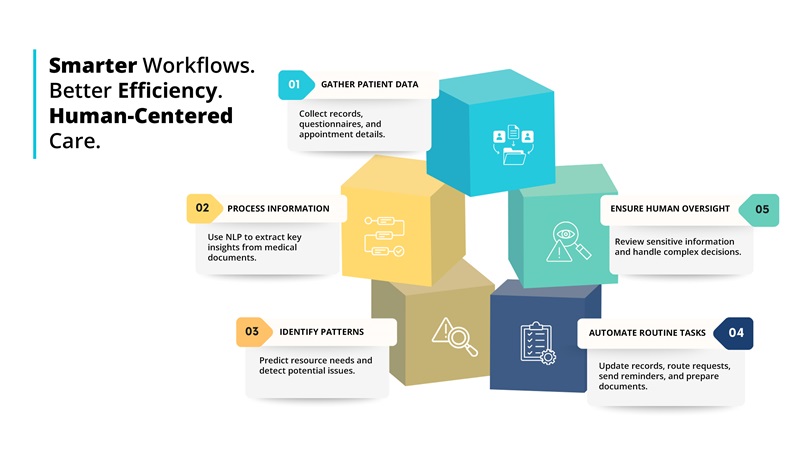
- Gather patient information: Systems gather data from patient medical records, questionnaires, scheduling systems, and other reliable sources.
- Process information: Natural language processing is used to extract valuable information from the documents.
- Recognize patterns: Predictive analytics can help detect patterns, predict resource needs, and recognize problems.
- Automate routine processes: AI updates medical records, routes requests, sends reminders, and prepares documents.
- Provide human review: Human beings will check sensitive information and take care of more complicated decisions.
Nevertheless, integration is optimal when the systems have accurate data exchange. The use of electronic health records, billing systems, and scheduling systems may help avoid disconnects in operations. It is possible to utilize ai solutions to find out more about integrated solutions.
Key Use Cases of Automation in Healthcare
Some healthcare institutions can automate some processes in their routine operation without loss of human involvement.
- Intake of Patients and Appointments: Handling patient inquiries, booking new appointments, rescheduling existing ones, and processing forms leads to many administrative tasks. Automated virtual assistants can handle standard requests, collect information, and book appointments during available slots.In a busy clinic, for instance, appointment scheduling and cancellations can be automated to allow staff to concentrate on the patients who require human attention.
- Clinical Documentation and Medical Records: The doctors and other medical personnel have to spend a lot of time collecting information and filling out the patient’s record. Natural language processing can help to collect the necessary information and document the patient’s data. In a simple example, the software can create a consultation note for review by the doctor.
- Medical Billing and Claim Submission: Billing staff have to do similar activities related to claim forms, patient eligibility, and payment history. RPA software can facilitate the exchange of information between different platforms and notify of incomplete applications.AI solutions can also spot abnormal billing trends and lack of necessary documents. Then, people can examine such cases prior to submission of claims or payment.
- Patient Engagement and Follow-up: Lack of adherence and overdue follow-ups may disrupt coordination of care. Virtual assistants can inform patients about their appointments, provide them with guidelines, and answer typical questions.For instance, a healthcare facility may automatically notify patients about future visits. All questions regarding symptoms and emergencies should be addressed to healthcare professionals.
- Hospital Resource and Process Coordination Hospital resource management requires coordination of people, beds, devices, and patients’ admission processes. With predictive analytics, it is possible to determine the demand trends and schedule resources efficiently. For instance, past admission statistics may help predict periods of intensive activity in the hospital and enable managers to assess staffing requirements and allocate relevant resources.
- Imaging in Hospitals and Clinics: AI technologies can analyze the data received from the images and point out any patterns that should be considered by the specialist. For instance, an imaging technology in a hospital may point to suspicious areas and allow for further review by a qualified specialist.
How to Implement AI Automation in Healthcare?
Healthcare entrepreneurs do not have to automate all processes at once. Instead, this process will help them manage expenses and show success before scaling up.
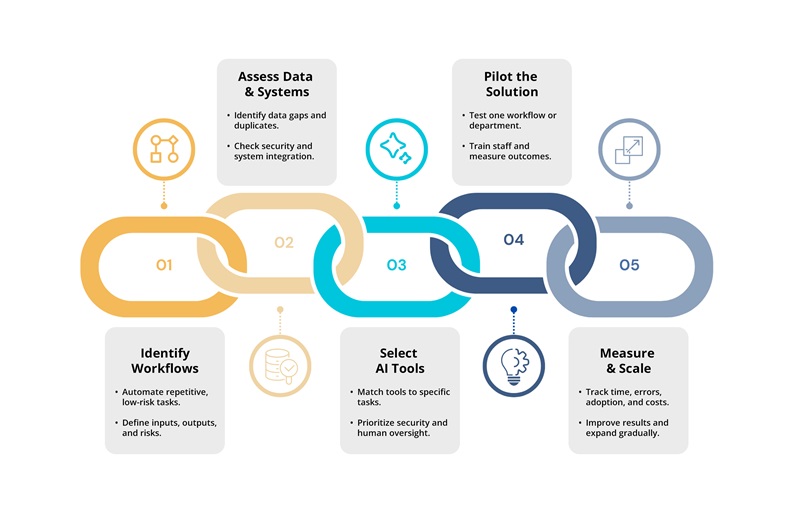
Step 1: Pick the Appropriate Workflow:
First, find processes that take up the time of staff members or create delays on a regular basis. Scheduling appointments, processing claims, and managing documents can be good starting points. It is important to choose workflows that have specific inputs, outputs, and risks. It is better not to start with high-risk clinical decisions.
Step 2: Evaluate the Readiness of Your Data and Systems:
Find out how your organization gathers, organizes, and shares patient data. See what problems there are: disconnected platforms, duplicate records, and security issues. See whether there is an opportunity to integrate AI tools with your current health systems.
Step 3: Select Relevant AI Tools
Select the tools according to the suitability for the job rather than choosing them based on their popularity. RPA will be useful in tasks where there are rules involved, while NLP will help in understanding unstructured documents. Forecasting can be done using predictive analytics, while virtual assistants take care of routine interactions. Consider factors such as security, integration needs, scalability, and human review while selecting the tool.
Step 4: Implement Controlled Pilot Testing
Test the solution in one of the departments or in one of the workflows rather than rolling out the solution to all areas at once. Train the employees and create guidelines for reviewing the results of automation. For instance, automate appointment reminders in just one clinic location first. Compare missed appointments, burden of work on staff, and feedback from patients compared to the previous scenario.
Step 5: Evaluate Results and Roll Out to Similar Workflows
Monitor the performance based on the baseline established prior to implementation. Keep track of processing time, error rate, adoption by staff members, and cost of operations.
How to Quantify ROI for Healthcare Automation
It is imperative for healthcare businesses to be able to prove that automation is adding real value to their businesses. Measuring certain metrics will allow you to analyze your savings, pinpoint any issues, and plan new investments.
The first thing to do is to compare performance metrics before and after implementing automation. Consider the following five metrics:
- Hours saved from performing routine tasks;
- Processing cost before and after implementing automation;
- Errors made during data entry, incomplete records, and claim rejections;
- Productivity of staff members who now have more time for productive tasks;
- Patient experience—appointment delays, missed appointments, and patient feedback.
For instance, clinics could implement an automated appointment reminder system and measure the number of missed appointments for several months to see if the new solution is actually helpful. Do not forget about such expenses as installation, integration, training, and maintenance costs. The full picture of ROI includes all costs and not just the cost of software.
Future of AI Automation in Healthcare
The future of AI automation in healthcare will be characterized by connection, streamlining of processes, and better decision-making. Many healthcare institutions are now looking for intelligent AI agents to enable them to perform tasks through various applications.
For instance, an intelligent agent can detect a lack of some information within the patient’s records, collect the missing data, and alert the concerned staff. However, this requires having quality data as well as safe connections.
Those institutions that develop these fundamentals can then easily embrace the future innovations of AI technology when the need arises. The key here is to allow automation of repetitive tasks so that healthcare staff can concentrate on people.

Risks, Compliance, and Limits of Automation AI in Healthcare
AI automation can benefit healthcare processes; however, successful implementation involves careful planning. Health entrepreneurs can overcome any issues related to implementation through proper prioritization and safeguard measures.
- Securing Patients’ Information and Privacy: In health care settings, patient information, including their medical history and diagnostics, is very sensitive. Insecure access controls and lack of proper integration can put such information at risk.
- Integrating Existing Health Care Platforms: Many health care facilities use outdated systems that have limited capacity for information exchange. This can lead to duplicated records and other problems with processes in place.
- Managing Issues of Accuracy and Bias: Incorrect outputs or bias can arise with the use of AI, which can be an issue, especially in cases where the tool is used to make clinical decisions.
- Managing Issues of Cost and Staff Adoption: Cost concerns arise with implementation that extend beyond mere acquisition of the software. Training and maintenance can add to cost and require workflow changes.
Conclusion
Utilizing AI automation in the healthcare industry presents an effective means by which businesses can address operational issues while improving efficiency and enhancing the experience of patients. It all comes down to selecting the right workflow processes that have a problem to be solved.
Go big by starting small, measure the outcomes, and scale up. With the availability of patient information, security of integration, and adequate human intervention, the healthcare industry can become more efficient without forgetting patient care.
Ready to explore what’s possible for your organization? Connect with SoftProdigy to explore AI-powered solutions that align with your healthcare workflows, business goals, and long-term growth.