Real estate businesses today are not struggling with demand; they are struggling with response. Teams handle constant inquiries across websites, WhatsApp and listing platforms every day. The real problem is not volume but slow response times and missed opportunities.
A potential buyer expects answers in seconds, not hours or days anymore. When responses lag, website visitors drop off and move to faster competitors instantly. This creates a silent gap where high-intent leads disappear without any trace.
Industry reports suggest generative AI could unlock billions in real estate value. However, the real advantage comes from using conversational AI for real estate operations. Businesses that respond faster consistently see higher conversion rates and better engagement.
This is where a real estate AI chatbot becomes more than just a tool. It acts like an assistant that captures lead opportunities in real time. It qualifies potential clients, shares property information and reduces manual workload.
In this blog, we will explore examples of AI chatbots for real estate that actually generate leads. You would also learn how to turn everyday inquiries into automated lead generation systems.
Understanding Custom Real Estate Chatbots
A real estate chatbot is an AI assistant that interacts with website visitors instantly. It answers queries, shares property information, and captures lead data automatically.
You just listed a property. Inquiries start coming in at 11 PM. Your phone buzzes, but you are already asleep. By morning, four potential clients have moved on to a competitor who responded instantly. That single night cost you four deals.
This is a rare scenario. It is the daily reality for real estate agents, brokers and property managers across the industry. Buyers do not wait. Sellers expect instant answers and the market never really sleeps.
A real estate chatbot is an AI-powered virtual assistant built specifically for property businesses. It engages website visitors, answers property questions, qualifies leads and schedules site visits, all without any human involvement. Think of it as your smartest team member who never takes a day off.
AI vs. Rule-Based Chatbots in Real Estate
Rule-based bots follow fixed scripts and predefined conversation paths. They handle basic tasks like sharing details or scheduling property visits.
AI-driven chatbots adapt based on user behavior and conversation context. They personalize responses and qualify leads more accurately over time. This makes them more effective for improving conversion rates and engagement.
Where Real Estate Chatbots Fit in the Sales Funnel
At the top, they engage website visitors and initiate conversations instantly. In the middle, they qualify leads by asking relevant and targeted questions. At the bottom, they trigger actions like scheduling property visits or callbacks.
This continuous interaction ensures no inquiry goes unnoticed or unanswered. It also helps property managers track data and improve lead generation strategies.

Why Real Estate Businesses Needs a Custom AI Chatbot
A real estate AI chatbot helps businesses respond instantly and capture more qualified leads. It reduces manual effort while improving response times and overall conversion rates.
Most real estate businesses lose leads due to delayed or missed responses daily. Manual handling of inquiries creates gaps that directly impact lead generation performance.
A real estate AI chatbot solves these issues by responding in real time consistently. It acts as an AI assistant that engages potential clients across multiple channels.
From websites to social media, it ensures every inquiry gets immediate attention. This consistency builds trust and keeps users engaged throughout their journey.
Higher conversion rates in real estate directly correlate with faster response times. Studies show replying within minutes increases chances of qualifying serious buyers significantly. An AI-driven system ensures no delay, even during peak hours or weekends.
It also helps businesses scale without increasing hiring or operational complexity. Instead of adding more agents, you automate repetitive conversations and lead capture.
1. The Cost of Missed Property Inquiries:
Every missed inquiry represents a lost opportunity with real financial impact. Buyers rarely wait for responses when multiple options are available instantly.
Without automation, many leads drop off before any meaningful interaction begins. This results in inconsistent pipelines and reduced overall business growth potential.
2. Speed, Availability, and Lead Expectations:
Modern buyers expect quick responses across websites and social media platforms. Delayed replies create frustration and reduce confidence in your service quality.
Chatbots for real estate provide 24/7 availability without operational pressure on teams. They handle multiple conversations simultaneously while maintaining consistent response quality.
How a Chatbot for Real Estate Agents Improves Lead Conversion
A chatbot for real estate agents improves lead conversion by handling conversations instantly. It captures, qualifies and moves potential clients toward action without delays.
Most agents spend hours answering repetitive and low-intent property inquiries. This delays responses to serious buyers who are ready to take action quickly. Manual follow-ups create gaps where high-intent leads lose interest and drop off.
By the time agents respond, the buyer has already moved to another option.
What Changes When You Add a Custom Chatbot for Your Real Estate Business
A custom chatbot is built around your business workflows, not generic templates. It aligns with your sales process, target audience, and specific property offerings.
Unlike basic tools, it adapts to how your team captures and converts leads. This creates a more personalized experience that resonates with potential clients instantly. A tailored chatbot engages website visitors based on real user intent and behavior. It asks relevant questions, qualifies leads and guides them toward meaningful actions.
It also integrates with your existing systems to streamline communication and tracking. From inquiries to scheduling property visits, everything flows within one structured system.
The result is not just automation, but a smarter and more efficient sales process.
A chatbot engages website visitors the moment they show interest in listings. Instead of passive browsing, users enter guided conversations that drive intent.
Every interaction becomes structured, trackable, and easy to manage for teams. This turns scattered inquiries into consistent and automated lead generation flows.

Custom Real Estate Chatbot Example: From Inquiry to Deal
Talking about chatbots in theory is easy. Seeing exactly how they work in practice is what actually builds confidence. Here are real-world workflows that demonstrate a chatbot handling the most challenging tasks right from the initial message.
1. SoftProdigy Conversational Real Estate Chatbot:
A growing real estate firm struggled with delayed responses and scattered lead tracking. Their team managed inquiries across websites, WhatsApp and listing platforms manually. High-intent leads were dropping off due to slow follow-ups and inconsistent communication. They needed a system that could respond instantly and structure their lead pipeline.
What We Built
We developed a custom chatbot aligned with their exact sales workflow. It was not a generic tool, but a tailored solution designed for their audience.
The chatbot:
- Engaged website visitors instantly with contextual property prompts
- Asked targeted questions to qualify buyer intent within seconds
- Recommended properties based on preferences and budget range
- Captured lead data and synced it directly into their CRM
- Enabled instant scheduling for site visits without manual coordination
What Changed for Their Business
Response times dropped from hours to real-time engagement across all channels. Their team stopped chasing unqualified leads and focused on serious buyers only.
The chatbot handled repetitive queries while agents focused on closing deals. This improved operational efficiency without increasing team size or workload.
Measurable Results
- 40% increase in qualified lead capture within the first few weeks
- 30% improvement in site visit bookings through automated scheduling
- Significant reduction in missed inquiries across platforms
This was not just automation; it was a structured and scalable growth system.
2. AI Chatbot Real Estate Example:
A property listing platform implemented a chatbot to engage website visitors instantly. It focused on answering FAQs and guiding users toward relevant property options. The result was better engagement and improved time spent on property pages. It also helped capture more leads without increasing marketing spend significantly.
3. Responsive AI for Real Estate in Rental Management
A rental management company used conversational AI to handle tenant inquiries efficiently. The chatbot managed queries related to availability, pricing and basic documentation. This reduced manual workload for property managers and improved response consistency. It also ensured that potential clients received quick and accurate information every time.
What Are the Most Effective Uses of AI Chatbots in Real Estate?
Most real estate businesses underestimate what a chatbot can actually do. It is not just a pop-up that says “Hi, how can I help?” It is a full-time, AI-driven revenue engine working across multiple channels simultaneously.
Here are the use cases that are delivering real results right now.
1. Website Chatbots for Property Listings:
Your website gets visitors every single day. Most of them leave without leaving any contact details. That is not a traffic problem. That is a conversion problem. A strategically placed chatbot on your property listings page completely changes that dynamic.
Here is what it does the moment a website visitor lands:
- Greets instantly: No delay, no form, no friction. The conversation starts in seconds.
- Filters properties: Asks for budget, location, and type to show only relevant listings.
- Shares property information: Sends photos, floor plans, pricing, and amenities on demand.
- Captures lead details: Collects name, number, and email naturally within the chat.
- Book viewings: Schedule site visits without any back-and-forth communication.
- Updates CRM: Pushes all data into your system in real time automatically.
2. WhatsApp and Messenger Automation
Here is a truth most real estate businesses overlook completely. Your potential clients are not sitting on your website all day. They are on WhatsApp. They are on Instagram. They are scrolling Facebook while commuting to work.
Meeting them on those platforms is no longer optional. It is essential.
WhatsApp chatbot capabilities for real estate:
Facebook Messenger adds another layer:
Chatbots for real estate running on Messenger can retarget visitors who clicked your social media ads. Someone saw your property ad, clicked, but did not fill a form. The Messenger bot follows up automatically, re-engages them, and brings them back into your funnel.
This is conversational AI in real estate working at its smartest. It does not wait for leads to come to you. It goes where your audience already is and starts the conversation there.
How Conversational AI for Real Estate Enhances Experience
Buying or selling a property is one of the biggest financial decisions a person makes. It is emotional. It is stressful. And it demands a level of trust that generic, transactional interactions simply cannot build.
This is where conversational AI in real estate does something no ordinary chatbot can. It does not just answer questions. It creates experiences that make potential clients feel heard, understood, and confident in their next step.
1. Personalized Property Recommendations
Nobody wants to scroll through 200 listings to find one that fits. That experience is exhausting and drives buyers straight to a competitor who makes things easier. An AI assistant changes this completely by acting like a personal property consultant available 24 hours a day.
Here is how personalization works in practice:
Buyer says: “I am looking for a 2BHK under 60 lakhs near good schools.”
Chatbot does:
- Filters listings by budget, size, and location instantly
- Cross-references school proximity from integrated data
- Presents top 3 matching properties with photos
- Highlights features that match stated priorities
- Asks a follow-up question to refine further
This is not a search filter. This is a conversation. And conversations build relationships far faster than search bars ever will.
What makes AI-powered personalization powerful?
- Preference Tracking: Remembers what each buyer liked or rejected in previous chats
- Dynamic Suggestions: Updates recommendations as new listings match buyer criteria
- Location Intelligence: Factors in commute, amenities, and neighbourhood data automatically
- Tone Matching: Adjusts communication style based on how the buyer types and responds
- Multilingual Support: Communicates in the buyer’s preferred language without friction
The outcome?
Buyers spend more time engaging with your listings. They feel like the platform understands them. That sense of understanding transforms a browser into a buyer. Research confirms this clearly. Personalized property experiences increase engagement by up to 60% and reduce the average time to conversion by nearly 35%.
2. Natural Conversations That Build Trust
There is a reason people still prefer talking to a human agent over filling out a form. Conversations feel personal. Forms feel like data collection. And nobody likes feeling like a data point. Today’s best real estate AI solutions are designed to create a genuinely conversational experience.
Here is what separates a trust-building chatbot from a frustrating one:
Real trust is built through three things:
1. Consistency: The chatbot gives accurate, consistent property information every single time. No outdated pricing. No incorrect availability. No contradicting answers. Buyers trust what is reliable.
2. Empathy in Language: Phrases like “That is a great area to consider” or “I understand budget is important; let me help you find the best option” make the experience feel human even when it is automated.
3. Seamless Handoff: When a conversation needs a human agent, the bot transitions smoothly. The agent receives full context. The buyer never has to repeat themselves. That seamless experience builds enormous trust instantly.
The bottom line:
People buy from businesses they trust. Conversational ai for real estate creates that trust at scale, across hundreds of simultaneous conversations, without ever having a bad day or an off moment. That is something no human team, regardless of how talented, can consistently replicate at volume.
Chatbot Ai Implementation Strategy: Getting Started Without Complexity
You can implement a real estate chatbot without disrupting your existing workflow. Start small, focus on high-impact areas, and scale based on results.
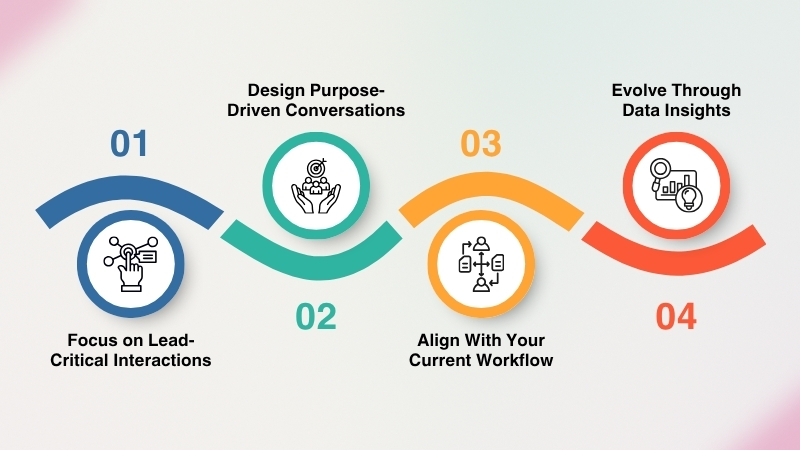
Step 1: Identify High-Impact Use Cases:
Start with areas where delays are costing you the most leads. Focus on website inquiries, property queries, and initial lead qualification first. This ensures quick wins and immediate improvement in response times.
Step 2: Define Your Conversation Flow Clearly
Map out how you want conversations to guide potential clients. Please consider incorporating questions about budget, location, and property preferences early on. Keep it simple, relevant, and aligned with your sales process.
Step 3: Integrate With Your Existing Systems
Connect your chatbot with CRM tools to capture and manage leads properly. This ensures every interaction is tracked and followed up without manual effort. It also helps your team stay organized and respond faster.
Step 4: Test, Optimize, and Improve Continuously
Monitor how users interact and where drop offs are happening. Refine responses, questions, and flows based on real user behavior. Small improvements over time can significantly increase conversion rates.
The Future of Real Estate Chatbots in a Competitive Market
The businesses winning in real estate today are not always the ones with the best properties. They are the ones with the fastest, smartest client engagement systems. That gap is only going to grow wider.
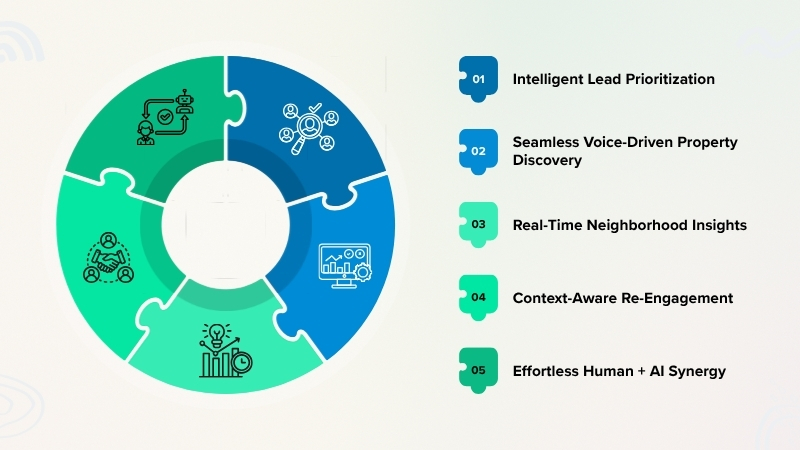
Five trends are shaping real estate AI right now:
1. Predictive Lead Scoring AI analyzes browsing behavior and engagement patterns to identify hot leads before any conversation begins. Your bot prioritizes them automatically.
2. Voice-Enabled Property Search Buyers will soon search listings, ask questions, and book site visits entirely through voice commands on phones and smart speakers.
3. Hyperlocal Market Intelligence Chatbots will deliver real-time neighborhood insights conversationally. School ratings, infrastructure projects, and rental yield trends, all within the chat itself.
4. Hyper-Personalized Follow-Ups: A lead who went cold six months ago receives perfectly timed, contextually relevant outreach based on market changes matching their original preferences exactly.
5. Smarter Human-AI Collaboration Chatbots handle everything until trust-building and negotiation. Then they hand off to human agents with complete context, perfect timing, and zero friction.
Conclusion
Real estate never sleeps. Neither should your lead generation system. Buyers are searching at midnight. Sellers want instant answers on weekends. Every unanswered inquiry is a deal walking straight to your competitor.
A real estate chatbot fixes this completely. It captures leads, qualifies prospects, books site visits, and builds trust around the clock without adding a single person to your payroll. The technology is ready. The market is moving. The only question is whether you move with it or watch competitors pull ahead.
At SoftProdigy, we build custom real estate chatbot solutions tailored around your market, your process, and your growth goals. Your next qualified lead is already searching right now. Make sure your business is the first to respond.