
Quality issues in manufacturing rarely appear all at once. They build quietly over time. A minor defect ignored today can become a costly recall tomorrow. A skipped process check can lead to rework, delayed deliveries, and frustrated customers.
Manufacturing quality assurance exists to prevent these problems before they reach the production floor or the customer. This guide is written for operations leaders and decision-makers who want clarity.
It focuses on real manufacturing challenges and practical solutions. You will understand what quality assurance actually means, how it differs from inspection-based quality control, how to implement it step by step, and how modern manufacturers use technology to make quality predictable instead of reactive.
Want to learn all about it? Let us walk you through it.
What is manufacturing quality assurance and why does it matter?
Manufacturing quality assurance is a structured approach that ensures products are built correctly by design, not corrected after failure. It focuses on strengthening processes so defects do not occur in the first place.
At its core, quality assurance answers one critical question. Can your manufacturing system consistently meet customer and regulatory expectations?
Unlike inspection-heavy models, quality assurance works upstream. It looks at how raw materials are sourced, how machines are calibrated, how operators follow procedures and how risks are identified before production begins.
This matters because most quality problems are not caused by people. They are caused by weak systems.
When manufacturers rely only on final inspections, defects are already embedded in the product. That leads to scrap, rework, delivery delays and rising costs. Quality assurance shifts attention to prevention, which is where long-term savings come from.
Well-implemented QA systems help manufacturers:
- Reduce defect rates and variability
- Improve first-pass yield
- Maintain compliance with industry standards
- Build customer trust through consistent output
Industry data shows that manufacturers with mature quality assurance programs reduce the cost of poor quality by up to 30%. The biggest impact comes from avoiding rework, warranty claims and customer dissatisfaction.
In simple terms, manufacturing quality assurance turns quality from a reaction into a system. It gives teams control, predictability, and confidence as production scales.

How is quality assurance different from quality control in manufacturing?
Quality assurance prevents defects by strengthening processes. Quality control detects defects after production has already occurred. That single distinction explains why many manufacturers struggle with recurring quality issues.
Quality assurance focuses on how work is done. Quality control focuses on what the final product looks like.
How quality assurance works in real manufacturing environments?
Quality assurance is proactive. It evaluates systems before production begins.
It answers questions like:
- Are machines calibrated correctly?
- Are operators trained consistently?
- Are materials verified before use?
- Are risks documented and controlled?
According to industry benchmarking data, nearly 85% of manufacturing defects originate from process weaknesses, not from operator error. This is why QA delivers long-term impact.
How does quality control fit into the picture?
Quality control is reactive. It inspects products during or after production.
It includes:
- Visual inspections
- Dimensional checks
- Functional testing
- Final audits
Quality control is important. But when it becomes the only line of defense, defects are already embedded. Fixing them costs more.
Cost comparison: QA vs QC impact
Manufacturing cost studies show a clear pattern:
- Fixing a defect during design or planning costs 1x
- Fixing it during production costs 5 to 7x
- Fixing it after shipment costs 10 to 30x
This cost curve explains why companies that rely heavily on inspection spend more on rework, scrap and customer support.
Why high-performing manufacturers use both?
The strongest manufacturers do not choose between QA and QC. They use QA to stabilize processes and QC to validate outcomes.
Quality assurance reduces variation. Quality control confirms consistency. When integrated with production systems and analytics, as seen in digitally mature plants, this combination reduces defect rates by 20 to 35 percent within the first year.
This is where structured QA systems integrated with operational platforms make a measurable difference.
How is quality assurance different from quality control in manufacturing?
Quality assurance prevents defects before they happen. Quality control identifies defects after production. That single difference decides whether a plant runs proactively or keeps firefighting quality issues.
Manufacturing Quality Assurance vs Quality Control
| Aspect | Manufacturing Quality Assurance (QA) | Manufacturing Quality Control (QC) |
|---|---|---|
| Core purpose | Prevent defects by strengthening processes | Detect defects in finished or in-process products |
| Focus area | How work is designed and executed | What the final product looks like |
| Timing | Before and during production | During or after production |
| Approach | Proactive and system-driven | Reactive and inspection-driven |
| Key activities | Process design, risk analysis, SOPs, training, calibration | Visual checks, dimensional checks, functional testing |
| Main question answered | Can this process consistently produce quality output? | Does this product meet specifications right now? |
| Root cause visibility | High. Identifies why defects occur | Low. Identifies defects but not always the cause |
| Impact on recurring defects | Reduces repetition | Often allows repeat issues |
| Cost efficiency | Lower long-term cost | Higher long-term cost due to rework and scrap |
Cost impact comparison that decision-makers should know
| Stage where defect is fixed | Relative cost |
|---|---|
| During planning or process design | 1x |
| During production | 5x to 7x |
| After shipment to customer | 10x to 30x |
Why do high-performing manufacturers use both QA and QC?
Top manufacturers do not choose between quality assurance and quality control.
They use:
- Quality assurance to stabilize and improve processes
- Quality control to verify outputs and catch exceptions
Plants that integrate QA with production systems and data analytics report 20 to 35 percent lower defect rates within the first year, along with faster audits and fewer customer escalations. This is where digital quality systems make a difference. When quality data connects with ERP, MES, and analytics platforms, teams act earlier instead of reacting later.
What problems does manufacturing quality assurance actually solve?
Manufacturing quality assurance reduces defects, lowers rework costs, improves compliance and creates consistent production output. Most quality challenges manufacturers face are symptoms, not root causes. QA addresses the system gaps behind those symptoms.
Below are the real problems manufacturers struggle with and how quality assurance fixes them.
Problem 1: Recurring defects that never fully disappear
Many plants fix the same defect repeatedly. The reason is simple. The process causing the defect never changed.
How QA solves this: Quality assurance uses structured tools like root cause analysis, process mapping and corrective actions to eliminate the source of the defect. Instead of temporary fixes, processes are redesigned for stability.
Impact: Manufacturers using structured QA programs report 25 to 40 percent fewer repeat defects within the first year.
Problem 2: High scrap, rework and hidden quality costs
Scrap and rework often feel like a normal cost of doing business. In reality, they silently drain margins.
How QA solves this: Quality assurance focuses on early controls such as incoming material checks, in-process verification, and measurement system validation. This prevents bad material or variation from flowing downstream.
Impact: Reducing the cost of poor quality typically improves operating margins by 5 to 15 percent, depending on production volume and complexity.
Problem 3: Inconsistent output across shifts or locations
Same product. Same equipment. Different results. This usually happens due to inconsistent procedures, training gaps, or undocumented process changes.
How QA solves this: Standard operating procedures, visual work instructions, and structured training programs ensure consistency across shifts and plants.
Impact: Plants with standardized QA processes see 20 to 30 percent improvement in first-pass yield.
Problem 4: Audit stress and compliance pressure
Audits become stressful when documentation is scattered and processes are unclear.
How QA solves this: Quality assurance aligns processes with standards like ISO 9001 and industry-specific frameworks. Documentation becomes part of daily operations instead of a last-minute scramble.
Impact: Organizations with mature QA systems reduce audit preparation time by up to 50 percent.
Problem 5: Customer complaints and declining trust
Customer complaints often signal deeper process instability.
How QA solves this: By improving traceability, monitoring KPIs, and acting early on process variation, QA helps manufacturers deliver consistent quality.
Impact: Manufacturers with strong QA systems report 30 percent fewer customer complaints year over year.
Why these problems matter more as production scales?
As volume increases, small quality gaps multiply. What works at low scale breaks under pressure. Quality assurance ensures systems scale with production, not against it.
This is where technology plays a role. Soft Prodigy helps manufacturers connect quality data with production systems so these problems are detected early and resolved systematically.

Which standards and frameworks guide manufacturing quality assurance today?
Manufacturing quality assurance is guided by global standards that define process control, risk management and continuous improvement.
Standards exist for one reason. To remove ambiguity from quality. They help manufacturers build repeatable systems instead of relying on tribal knowledge or individual experience.
Why quality standards matter in manufacturing
With a framework, quality depends on processes. Therefore, quality standards help manufacturers:
- Define how work should be done
- Reduce variation across teams and shifts
- Prove compliance to customers and regulators
- Build trust with global partners
Manufacturers that follow recognized QA standards experience fewer audit findings and stronger supplier relationships.
The most widely used quality assurance standards in manufacturing
1. ISO 9001: Quality Management Systems:
ISO 9001 is the most commonly adopted QA standard across industries. It focuses on:
- Process consistency
- Risk-based thinking
- Documentation and traceability
- Continuous improvement
Why it matters: Over 1 million organizations worldwide are ISO 9001 certified. Many enterprise buyers require it as a baseline for supplier approval.
2. IATF 16949: Automotive quality assurance:
Designed specifically for automotive manufacturing and suppliers. It emphasizes:
- Defect prevention
- Process capability
- Supplier quality management
- Product safety
Impact: Automotive suppliers using IATF-aligned QA systems report significantly lower defect parts per million and stronger OEM relationships.
3. AS9100: Aerospace and defense manufacturing
This standard builds on ISO 9001 with stricter controls. It focuses on:
- Risk management
- Configuration control
- Product traceability
- Supplier oversight
Aerospace manufacturers rely on AS9100 to ensure safety-critical consistency.
How to choose the right quality framework for your manufacturing plant?
Many manufacturers start with ISO 9001 and expand into industry-specific frameworks as they grow.
The right standard depends on:
- Industry requirements
- Customer expectations
- Regulatory obligations
- Scale and complexity of operations
Common mistake manufacturers make with standards
Treating standards as documentation exercises. Standards work only when embedded into daily workflows.
This leads to:
- Heavy paperwork
- Low adoption on the shop floor
- Minimal operational improvement
How technology strengthens standard-based QA systems
Modern manufacturers integrate standards directly into operational systems. This reduces manual work and improves compliance visibility.
Examples include:
- Digital SOPs linked to production data
- Automated audit trails
- Real-time KPI monitoring
- Risk tracking dashboards
How do you build a manufacturing quality assurance program step by step?
A manufacturing quality assurance program is built by defining quality goals, stabilizing processes, controlling risk, and continuously measuring outcomes. You do not need to build everything at once. Strong QA systems grow in layers.
Below is a practical roadmap manufacturers can realistically follow.
Step 1: Define quality objectives that support business goals
Quality goals should never exist in isolation. They must support cost control, delivery reliability, and customer satisfaction.
Start by answering:
- What quality issues cost us the most today?
- Where do defects slow production or impact customers?
- Which processes create the highest risk?
Examples of effective objectives:
- Reduce defect rate by 20 percent in six months
- Improve first-pass yield on critical lines
- Lower customer complaints quarter over quarter
Plants that align quality goals with operational KPIs are 2 times more likely to sustain improvements long term.
Step 2: Map processes and identify quality risk points
Most defects originate where processes are unclear or uncontrolled.
This step focuses on:
- Mapping each production step
- Identifying variation points
- Assessing failure risks using structured analysis
Tools like process flow diagrams and Failure Mode and Effects Analysis help teams prioritize where controls are needed most. Studies show that early risk identification can reduce downstream defects by up to 30 percent.
Step 3: Establish inspection and control plans
Quality assurance does not remove inspections. It makes them purposeful. Incoming material checks, in-process controls, and final verification should be based on risk, not habit.
A strong control plan defines:
- What to inspect
- Where to inspect
- How often to inspect
- What action to take when results fall outside limits
Step 4: Standardize procedures and train teams
Consistency fails when people interpret processes differently. Plants with standardized work instructions experience 20 to 30 percent higher first-pass yield compared to those relying on informal knowledge.
This step includes:
- Clear standard operating procedures
- Visual work instructions
- Training aligned with real production scenarios
Step 5: Validate measurement and equipment capability
If measurements are inaccurate, decisions will be wrong. This ensures quality data reflects reality, not assumptions.
Quality assurance requires:
- Calibration schedules
- Measurement System Analysis
- Equipment capability checks
Step 6: Monitor performance using meaningful KPIs
Tracking everything creates noise. Tracking the right metrics creates insight. Manufacturers using focused KPI dashboards improve response time to quality issues by 40%.
Focus on:
- Defect rate
- First-pass yield
- Cost of poor quality
- Customer complaints
- Process capability
Step 7: Improve continuously using data, not guesswork
Quality assurance is not a one-time setup. Continuous improvement keeps QA systems relevant as production volumes and complexity grow.
Use structured review cycles to:
- Analyze trends
- Address root causes
- Strengthen controls
- Update procedures
How technology simplifies QA implementation
Manual QA systems become difficult to scale. This is where technology partners like Soft Prodigy support manufacturers by integrating QA workflows with production and analytics platforms.
Digital integration helps by:
- Connecting quality data with ERP and MES systems
- Automating inspections and reporting
- Providing real-time visibility into quality trends

Which tools and techniques strengthen manufacturing quality assurance today?
Manufacturing quality assurance improves when tools detect variation early, validate data accuracy, and prevent defects from recurring.
Key tools manufacturers rely on:
- Statistical Process Control (SPC): Monitors process stability in real time and reduces defect rates by 20–30 percent by catching variation early.
- Failure Mode and Effects Analysis (FMEA): Identifies potential failures before launch, cutting production disruptions by up to 50 percent.
- Measurement System Analysis (MSA): Ensures inspection tools are reliable, reducing false rejections by 15–25 percent.
- Root Cause Analysis (RCA): Eliminates repeat issues, lowering recurring defects by 30–40 percent.
- Quality KPIs and dashboards: Improve response time to quality issues by 40 percent.
- Digital QA tools: Automation, vision systems, and analytics boost operational efficiency by up to 25 percent.
What KPIs should you track to measure manufacturing quality assurance success?
Manufacturing quality assurance success is measured by defect reduction, process stability, and cost control, not inspection volume.
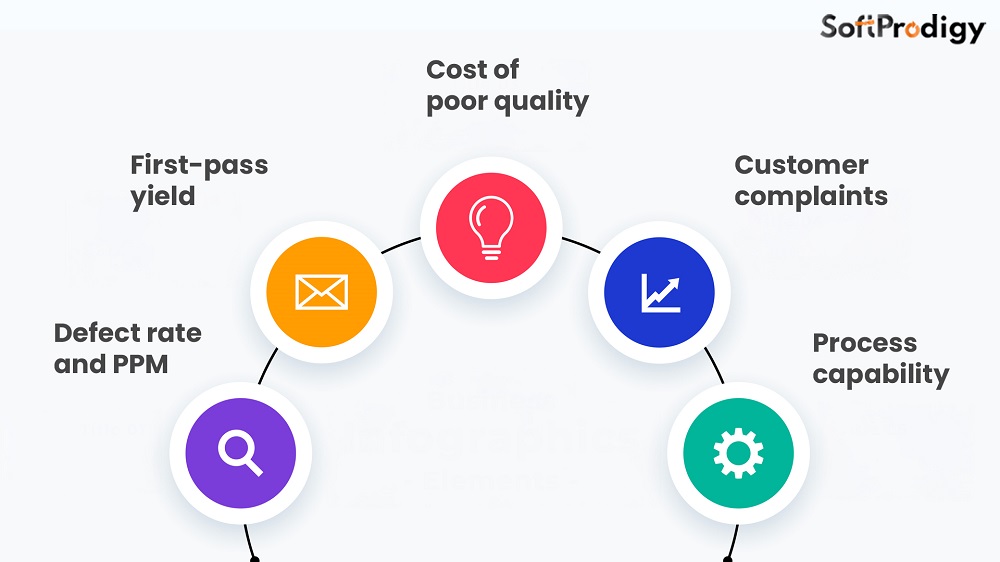
Tracking the right KPIs helps teams act early instead of reacting late.
Key QA metrics manufacturers should monitor:
- Defect rate and PPM: Shows how often processes fail. Mature QA programs reduce defects by 20–35 percent.
- First-pass yield: Measures how many products pass without rework. Higher yield means stable processes.
- Cost of poor quality: Captures scrap, rework, and warranty costs. Reducing COPQ can improve margins by 5–15 percent.
- Customer complaints: Direct signal of quality consistency and trust.
- Process capability: Indicates whether processes can reliably meet specifications.
Manufacturers that track focused QA KPIs respond to quality issues 40 percent faster and scale with confidence.
How does technology modernize manufacturing quality assurance?
Technology modernizes manufacturing quality assurance by enabling real-time monitoring, early defect detection, and data-driven decision-making. Traditional QA relies heavily on manual checks and delayed reports. Technology shifts QA from reactive to predictive.
Here’s how modern manufacturers use technology to strengthen quality:
- Real-time data integration: Quality data connects with ERP and MES systems, allowing teams to detect issues during production, not after shipment.
- Automated inspections: Vision systems and sensors reduce human dependency and improve accuracy, especially in high-volume lines.
- Predictive analytics: Advanced analytics identify quality drift before defects occur, helping prevent failures instead of responding to them.
- Digital quality management systems: Centralize audits, SOPs, corrective actions, and traceability in one place.
- Faster decision-making: Plants using digital QA tools respond to quality issues up to 40 percent faster and reduce defect-related losses by 20–25 percent.
How Soft Prodigy supports manufacturing quality assurance initiatives
Manufacturing quality assurance becomes scalable when quality systems are connected with production, data, and automation.
Many manufacturers already have pieces of QA in place. What’s missing is connection.
Disconnected data, manual reporting, and siloed systems slow decision-making and hide risks.
This is where Soft Prodigy steps in.
Soft Prodigy helps manufacturers strengthen quality assurance by:
- Integrating quality data with ERP and MES systems so issues surface during production, not after
- Designing data-driven QA dashboards that track defects, yield, and process stability in real time
- Automating inspection workflows to reduce manual errors and dependency
- Applying analytics and AI models to detect early quality drift and recurring patterns
- Enabling audit-ready documentation and traceability through digital systems
Instead of adding more checks, the focus is on building systems that prevent defects by design.
Manufacturers working with Soft Prodigy gain better visibility, faster response to quality issues, and the ability to scale production without scaling risk. You can explore relevant manufacturing technology, system integration, and automation capabilities.
When quality data flows seamlessly across operations, quality stops being a bottleneck and starts becoming a competitive advantage.

Conclusion
Manufacturing quality assurance is not about adding more checks or slowing production. It is about building systems that make quality consistent, predictable and repeatable as operations grow.
When quality is designed into processes instead of inspected at the end, defects reduce, costs come down and teams work with confidence. More importantly, customers experience reliability they can trust, not promises that depend on last-minute fixes.
The manufacturers that lead today are not the ones inspecting the hardest. They are the ones preventing issues before they appear. With the right processes, clear KPIs and connected systems, quality stops being a daily struggle and becomes a natural outcome of how work is done.
Whether you are improving an existing setup or building quality from the ground up, the focus should always remain the same. Strong processes. Clear data. Continuous improvement.
That is how quality scales without risk.