Legacy application modernization is urgent! Companies face increased pressure to improve speed, security and scalability. Manual modernization methods are slow and often costly. AI introduces a game-changing way to automate refactoring, testing and migration.
This shift from manual to AI-assisted digital transformation reduces risks and accelerates outcomes. If you want faster modernization with fewer errors, embracing AI is essential.
Ready to modernize smarter? Discover how AI transforms legacy apps with automation.
Why Legacy App Modernization Remains a Critical Business Need
Legacy systems often carry outdated frameworks that limit long-term system growth. These systems rely on older patterns that restrict new technology adoption. They create long cycles for feature development and often increase operational cost.
Many enterprises continue using these systems due to complex business dependencies. These dependencies slow modernization plans and increase long-term risk.
Maintenance for legacy systems grows more expensive each year. Outdated components often create security concerns.
Many organizations struggle to find skilled engineers for older technologies. These skill challenges slow system updates and affect platform stability. Legacy applications also deliver lower performance under new workloads. These performance limits restrict customer experience and business expansion.
Enterprises now view modernization as a strategic requirement. AI helps remove discovery barriers that hinder modernization progress. It supports faster exploration of older systems and reveals areas needing improvement.
Why Does Modernization Still Remain Hard for SV-Level Legacy Systems Today?
AI identifies hidden relationships inside older applications using advanced analysis models. These models highlight logic patterns that guide modernization decisions. Teams use these insights to understand system complexity and prepare better modernization plans.
AI identifies functions that require restructuring to support modernization. It highlights code segments that create performance issues. This information helps engineers focus on sections that deliver real modernization value.
AI generates clear documentation for older systems that lack written details. This documentation helps teams understand logic flows and data paths. Better structure reduces confusion and accelerates modernization tasks. AI creates clarity that normally requires large manual effort.
AI also provides predictive insights for modernization risk. It reveals modules that may break during transformation. These predictions help teams design mitigation plans. This planning reduces deployment risk and improves modernization outcomes.
AI Strengthens Traditional Modernization Pathways
Modernization frameworks often include familiar transformation paths. AI strengthens these paths with detailed analysis and structured guidance. The result creates more predictable modernization outcomes with reduced errors.
6 Rs of Modernization: AI-Enhanced
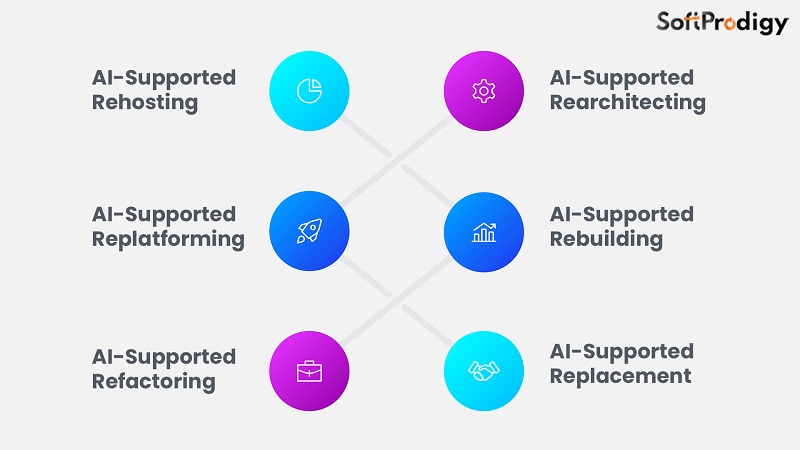
1. AI-Supported Rehosting: Rehosting moves workloads to new infrastructure environments without code changes. AI identifies operational blockers that affect rehosting success. This helps teams plan smoother transitions with higher system reliability.
2. AI-Supported Replatforming: Replatforming updates system infrastructure while retaining function behavior. AI highlights components that gain value from platform improvements. Teams apply these insights to improve performance after migration.
3. AI-Supported Refactoring: Refactoring improves code structure to enhance system quality. AI identifies areas requiring structural adjustment. This results in improved system clarity and better long-term maintainability.
4. AI-Supported Rearchitecting: Rearchitecting introduces new system designs that improve flexibility. AI proposes better architectures for complex workloads. These suggestions help teams plan transformations with fewer errors.
5. AI-Supported Rebuilding: Rebuilding involves creating new applications that replace older systems. AI reveals logic paths needed inside new designs. This reduces guesswork and accelerates development timelines.
6. AI-Supported Replacement: Replacement removes outdated systems and introduces better platforms. AI identifies brittle modules inside older systems. These insights help teams prioritize elements needing replacement.
How Does AI Improve Refactoring for SV Driven Legacy Code Structures?
Refactoring requires a deep understanding of existing code. Teams often struggle with older codebases that lack documentation. These challenges slow refactoring efforts and increase modernization risk. AI reduces these issues by providing insights that support predictable refactoring.
1. Code Analysis Supported by AI:
AI scans code and identifies problem areas that affect performance. It identifies logic blocks that require restructuring. This helps teams review code more effectively.
AI highlights unused elements within the codebase. These elements create confusion during refactoring. Removing these parts improves clarity and reduces complexity.
2. Automated Structure Suggestions
AI recommends new structures that improve modularity. It identifies classes and methods that need separation. This improves maintainability and supports future enhancements.
AI also reviews dependencies across modules. It provides suggestions to reduce tight coupling. This supports long-term scalability and improves system performance.
3. Transforming Monoliths With AI Assistance
Many enterprises aim to shift monolithic applications to modular patterns. AI identifies natural boundaries within the codebase. These boundaries help teams create modular structures with less manual analysis.
AI suggests patterns that support clear separation. These patterns reduce error rates during modernization. Teams gain better control over their codebase with these insights.
4. Improving Maintainability With Refactored Code
Refactored code reduces future maintenance needs. AI ensures that refactored sections follow best practices. This improves code quality and supports long-term stability.
AI-Driven Test Automation for Fast and Reliable Modernization
Testing plays a major role in modernization efforts. Teams need strong test coverage to avoid regression issues. Manual test creation requires time and complex validation cycles. AI simplifies this effort using automated test generation.
1. Automated Test Case Generation
AI identifies code paths and creates suitable test cases. These test cases validate system behavior during modernization. Teams reduce manual test writing with these generated cases.
AI also identifies edge cases that manual reviews may miss. This improves coverage and reduces defect rates. Teams gain confidence during deployment phases.
2. Regression Suite Development
AI identifies similar code paths and creates regression suites. These suites help teams test core functions after changes. They reduce risk associated with migration tasks.
Regressions usually consume a large amount of time during modernization. AI-driven suites help reduce cycle time. This improves quality without increasing effort.
3. Intelligent QA Workflows
AI assigns priorities to tests based on risk levels. High-risk areas receive more attention. Low-risk areas follow smaller execution cycles. This improves efficiency.
AI also identifies areas where test coverage remains low. This supports intelligent planning for future testing needs.
4. Accurate Test Suggestions
AI reviews function behavior and suggests tests for validation. These suggestions help teams build complete test coverage. They reduce manual test planning and support fast releases.
How Does AI Improve SV Based Application Migration With Better Speed and Accuracy?
Migration requires understanding of architecture and data structures. AI reduces complexity by providing structured insights. These insights help teams plan migration paths with better accuracy.
1. Code Conversion Supported by AI
AI converts functions into new formats with high accuracy. It supports language transitions for modernization plans. This accelerates code transformation tasks.
AI identifies outdated patterns within the codebase. It recommends modern alternatives that improve performance. Teams gain reliable results with these conversions.
2. Data Migration Assistance
AI identifies data dependencies across systems. These dependencies often slow migration timelines. AI highlights potential blockers and proposes solutions that reduce delays.
AI also provides mapping suggestions for new structures. These suggestions improve accuracy and reduce data-related risks.
3. Cloud Migration Optimization
AI identifies workloads suitable for cloud environments. It highlights areas where cloud platforms deliver strong performance improvements. These insights help teams plan better cloud migration strategies.
AI predicts resource requirements based on workload patterns. This helps enterprises design optimal cloud architectures.
4. API Extraction Support
AI identifies logic units that can convert into APIs. This helps enterprises create API-first systems. These systems support flexible integrations and improved scalability.

How Does AI Improve SV Based Architecture Modernization Across Evolving System Environments?
Architecture modernization often requires shifting from older patterns to modern ones. Many enterprises aim to adopt microservices or modular patterns. AI helps teams choose the right structures and supports migration tasks.
1. Microservices Extraction Using AI:
AI identifies modules that align with microservices architecture. These modules form the foundation of microservices designs. This clarity reduces manual design effort.
AI also shows how services interact within the system. This supports design planning and reduces integration delays.
2. API-First Transformation
AI identifies logic units that need API layers. This supports new integration pathways. API-first strategies help enterprises deliver services with better consistency.
AI reviews data flow across the system. It highlights areas where APIs provide strong value. This creates optimal API-driven designs.
3. Containerization Support
AI identifies components that align with containerization models. These components shift to container platforms with better consistency. Containerization improves deployment and reduces environment differences.
AI also predicts resource usage for containers. This supports scalable and cost-effective deployments.
4. DevOps Enhancement
AI reviews pipelines for automation opportunities. These opportunities improve deployment cycles and reduce manual work. It also highlights inefficiencies that limit delivery speed.
Choosing the Right AI-Assisted Modernization Strategy
Enterprises need to align system needs with modernization pathways. AI helps identify suitable strategies by analyzing code and architecture. These insights support better decision-making.
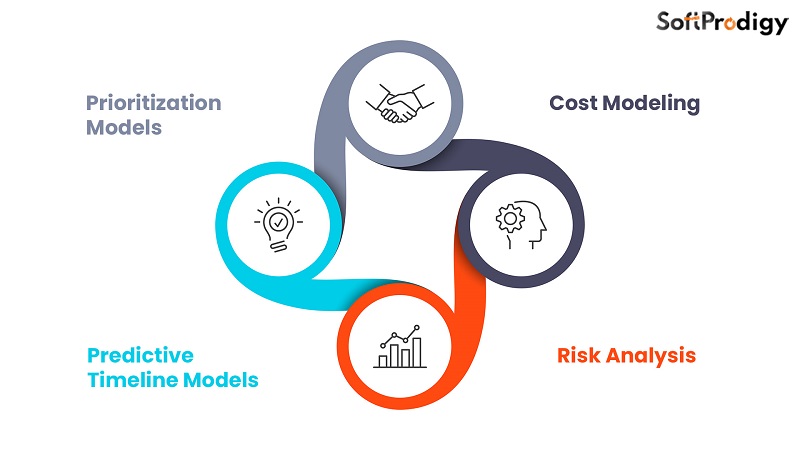
1. Prioritization Models
AI scores each component based on modernization impact. Higher scores represent strong modernization potential. This helps teams select target systems that deliver business value.
2. Predictive Timeline Models
AI predicts modernization timelines based on code complexity. These timelines help teams understand project scope. They also reduce planning uncertainty.
3. Cost Modeling
AI predicts cost ranges for modernization tasks. This supports budget planning and improves financial visibility. These predictions reduce risk for large projects.
4. Risk Analysis
AI identifies areas where modernization creates risk. It highlights susceptible modules and potential outages. This helps teams deploy reliable mitigation plans.
AI-Powered Tools Supporting Modernization Efforts
Many vendors now offer AI-powered platforms for modernization tasks. These platforms support code analysis and automated transformation. They also include features that reduce manual effort across the development lifecycle.
1. Code Assessment Tools
These tools scan codebases and identify improvement areas. AI highlights patterns that limit performance. This helps teams plan effective changes.
2. Migration Tools
These tools convert code into modern formats. AI identifies transformation patterns that preserve functionality. This reduces risk across migration cycles.
3. Testing Tools
AI generates test cases for improved validation. These tools enhance coverage and reduce failure risk.
4. Architecture Tools
These tools highlight architecture issues. AI proposes modern structures that support future growth.
How AI Reduces Modernization Timelines?
AI-driven modernization produces measurable results for enterprises. Many organizations now experience reduced workloads across analysis tasks. AI cuts documentation time and reduces code review complexity. These changes help teams focus on high-value work.
Some enterprises achieve significant reductions in modernization timelines. AI reduces discovery cycles and supports code transformation. These improvements result in faster modernization outcomes.
AI generates test coverage with better efficiency. Teams reduce failure risks during modernization. This supports reliable deployment cycles that improve business continuity.
Risks and Considerations of AI-Enabled Modernization
AI improves modernization but requires careful oversight. Teams must verify AI suggestions before implementation. This ensures that new structures align with system needs. AI outputs sometimes require adjustments based on business logic.
Security remains a strong concern. AI analyzes sensitive codebases and architecture details. Organizations must implement secure environments for AI tools. They should follow strict governance standards during modernization.
AI suggestions vary across systems. Teams must validate each suggestion before deployment. Human oversight ensures quality and reduces risk.
Enterprises should adopt AI in phases. Controlled phases help teams validate capabilities. This structured approach ensures predictable modernization outcomes.
The Future of AI in Application Modernization
AI continues to advance with new engineering capabilities. It now supports a deeper understanding of system logic. These advancements will reduce manual effort even further. Teams will use AI to generate architecture plans and modernization pathways.
Agentic AI systems can automate migration with minimal intervention. These systems identify logic, restructure patterns, and execute migration tasks. They reduce friction and improve modernization accuracy.
Future AI models will support continuous modernization. These models monitor system changes and provide suggestions. This creates a long-term modernization cycle with improved efficiency.
Modernization evolves as AI systems gain stronger capabilities. Enterprises with AI-driven modernization gain competitive advantage. They deliver new features faster and manage risks with more clarity.
Wrapping Up
AI now plays a central role in legacy application modernization across global enterprises. It increases clarity inside older systems and reduces effort across transformation cycles.
AI strengthens modernization outcomes with accurate insights and consistent execution support. Organizations gain faster progress with reduced disruption and improved system reliability.
AI-driven modernization helps enterprises adopt modern architectures with stronger confidence. Companies that adopt AI-driven approaches now gain clear advantage in future modernization programs.