AI is no longer just about generating content. It is starting to take action.
Most businesses today are familiar with tools that write emails, create images or generate code. That is generative AI at work. But a new shift is quietly changing how work gets done. AI is now moving beyond creation into execution.
This is where agentic AI comes in. It does not wait for instructions. It plans, decides and acts toward a goal. Understanding the difference between agentic AI and generative AI is no longer optional. It directly impacts how teams automate workflows, scale operations and make faster decisions.
The real question is not which one is better. It is when to use each.

What exactly is Agentic AI and how does it work in real life?

Most AI tools today wait for instructions. Agentic AI does not. It starts with a goal. Then it figures out the steps needed to reach it.
Think of it less like a tool and more like a digital worker. You assign it an outcome, not a task. From there, it plans, decides and executes.
At its core, agentic AI combines a few key abilities:
- It breaks down complex goals into smaller steps
- It makes decisions based on changing inputs
- It uses tools, APIs or systems to take action
- It learns from past interactions to improve outcomes
This is not about generating responses. It is about getting things done.
Autonomous Decision-Making:
Here is where things get intriguing. Agentic AI does not rely on constant prompts. It evaluates what is happening and adjusts its actions in real time.
For example, instead of asking AI to “send follow-up emails,” you define a goal like improving lead response time. The system then:
- Tracks incoming leads
- Prioritizes them
- Sends responses
- Adjusts timing based on engagement
No step-by-step instructions needed.
Example Use Cases
This is already showing up across industries. Not in theory. In real workflows.
- Customer support: AI agents resolve tickets without human input
- Sales operations: Follow-ups, scheduling and CRM updates happen automatically
- Supply chain: Systems monitor inventory and trigger reorders
- IT workflows: Incident detection and resolution run with minimal oversight
The shift is simple but powerful. Generative AI helps you create. Agentic AI helps you complete.
What is generative AI and why is everyone talking about it?
Before AI started acting, it learned how to create. Generative AI is what most people interact with today. You give it a prompt, and it offers you something back. Text, images, code, even video.
It does not take action on its own. It responds. What makes it powerful is its ability to understand patterns in massive datasets. Then recreate something that feels original, human, and context-aware.
At the center of this process are large language models (LLMs). These models are trained on vast amounts of data to predict what comes next. That is how they generate content that sounds natural.
But here is the catch. It only works when you ask.
Prompt-Based Content Creation
Everything starts with a prompt. The quality of the output depends on the clarity of the input. You guide the AI. It follows. That is why users spend time refining prompts, adjusting tone and regenerating outputs. It is a loop of instruction and response.
This approach makes generative AI incredibly useful for:
- Fast content creation
- Idea generation
- Drafting and editing
- Prototyping concepts
But it still depends on human direction at every step.
Example Use Cases
This is where generative AI shines. Anywhere creativity or content is involved.
- Marketing teams: Writing blogs, ads and social posts
- Developers: Generating code snippets or debugging
- Designers: Creating visuals and mockups
- Content teams: Repurposing long-form into bite-sized content
It speeds up thinking. It reduces effort. But it does not move without you.
What’s the real difference between Agentic AI and Gen AI?
At first glance, both can feel similar. They use advanced models also sound intelligent. They even overlap in some use cases. But the difference becomes obvious when you look at how they operate.
One waits, the other acts. Generative AI responds to prompts. Agentic AI works toward goals.
That shift changes everything from how teams use AI to how businesses scale it.
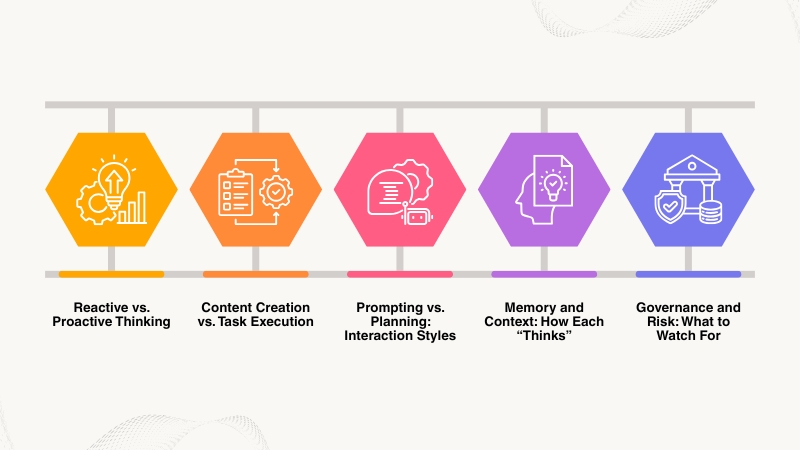
- Reactive vs. Proactive Thinking:
Generative AI is reactive by design. It needs a prompt to start. No input, no output. Agentic AI works differently; it is proactive.
It can monitor situations, make decisions, and take the next step without being told every time. That is the difference between asking for help and having someone handle the work.
- Content Creation vs. Task Execution:
Generative AI focuses on output. It creates:
- Text
- Images
- Code
- Ideas
Agentic AI focuses on outcomes. It executes:
- Workflows
- Processes
- Decisions
- Actions across systems
One helps you produce. The other helps you complete.
- Prompting vs. Planning: Interaction Styles:
With generative AI, interaction is simple. You ask, it answers. With agentic AI, interaction shifts. You define a goal. The system builds a plan to achieve it. Then adjusts as things change. It is less about giving instructions and more about setting direction.
- Memory and Context: How Each “Thinks”
Generative AI works mostly in the present. It uses the context you provide in a prompt. Once the interaction ends, that context fades.
Agentic AI goes further. It can track past actions, remember previous steps, and use that context to improve decisions over time. That makes it better suited for ongoing workflows, not just one-time tasks.
- Governance and Risk: What to Watch For
Both come with risks. Just different ones.
Generative AI can:
- Produce inaccurate information
- Reflect bias in outputs
- Sound confident even when wrong
Agentic AI introduces a different challenge. Because it can act, mistakes can have direct consequences. A wrong decision is not just text. It becomes an action.
That is why guardrails, monitoring, and clear boundaries matter more with agentic systems.
Quick Comparison: Agentic AI vs Generative AI
| Aspect | Generative AI | Agentic AI |
|---|---|---|
| Core Role | Creates content | Executes tasks |
| How it Works | Responds to prompts | Works toward goals |
| Interaction Style | Prompt → Response | Goal → Plan → Action |
| Thinking Model | Reactive | Proactive |
| Output Type | Text, images, code | Actions, decisions, workflows |
| Dependency | Needs constant input | Operates with minimal input |
| Memory Use | Limited to prompt context | Uses short- and long-term memory |
| Best For | Content, creativity, ideation | Automation, operations, execution |
| Risk Type | Hallucinations, bias | Incorrect actions, workflow errors |

When should you use Generative AI or Agentic AI?
Knowing the difference is one thing. Knowing when to use each is where real value shows up. Most businesses do not fail because they lack AI tools. They struggle because they use the wrong type of AI for the job.
Some problems need creativity. Others need execution. And treating them the same leads to wasted time, broken workflows, or overcomplication.
Let’s break it down in a way that actually helps you decide.
Where Generative AI Makes More Sense
If the task starts with a blank page, generative AI is your go-to. It works best when you need to create, explore, or refine ideas quickly. Not execute them.
Use generative AI when your work involves:
- Writing content from scratch
- Brainstorming ideas or campaigns
- Drafting emails, blogs or reports
- Generating code snippets or prototypes
- Designing visuals or creative assets
It reduces effort at the start of the process. But it still depends on you to:
- Review outputs
- Make decisions
- Take the next step
Think of it as a creative partner. Fast and helpful, but still waiting on you.
Where Agentic AI Becomes the Better Choice
Now shift to tasks that are repetitive, multi-step, or time-sensitive. This is where generative AI starts to fall short. Not because it lacks intelligence, but because it lacks initiative.
Agentic AI steps in when the goal is not to create something but to get it done.
Use agentic AI when your work involves:
- Managing workflows across tools or systems
- Automating follow-ups or responses
- Monitoring data and triggering actions
- Handling operational processes end-to-end
- Making decisions based on changing inputs
It removes the need for constant supervision. You define the outcome. The system handles the steps. This stage is where businesses start seeing real efficiency gains. Not in minutes saved, but in processes removed.
The Real Shift: From Assistance to Execution
Here is the simplest way to comprehend it. If your team is still doing the work, you are using generative AI. If your team is completing the work without constant involvement, you are transitioning into agentic AI.
That shift matters. Because as operations grow, manual intervention does not scale. Execution does.
A Practical Way to Decide
If you are unsure which to use, ask one question: Does this task need creativity or completion?
- If it needs ideas, drafts, or content, go with generative AI
- If it needs actions, decisions, or outcomes, go with agentic AI
Simple. But powerful when applied correctly.
Can Agentic AI and Generative AI work better together?
If you are treating these as competing technologies, you are missing the bigger picture. The real advantage shows up when they work together.
Generative AI creates the output. Agentic AI makes sure that output actually gets used. One without the other often leads to gaps. Either great ideas with no execution… or automation with no intelligence behind it.
When combined, they close that loop.
How the Combination Works in Practice
Let’s make this real. Imagine a marketing workflow.
- Generative AI writes email campaigns
- Agentic AI schedules them, segments audiences, and tracks responses
- Based on performance, the agent adjusts timing or triggers follow-ups
No constant manual input. No disconnected steps.Another example in operations:
- Generative AI drafts reports or summaries
- Agentic AI sends them to stakeholders, logs data and triggers next actions
Creation flows directly into execution. That is where the real efficiency lies.
Why This Combination Matters for Businesses
Using only generative AI can create a bottleneck. You generate more content, more ideas, more drafts… but someone still has to manage everything.
Using only agentic AI can limit quality. You automate processes, but without strong inputs, the outcomes may lack depth or context.
Together, they balance each other:
- Speed + Execution
- Creativity + Consistency
- Intelligence + Action
This is how teams move from experimenting with AI to actually scaling it.
Governance and Trust: Getting It Right
Now comes the important part. The more autonomy you introduce, the more control you need. When these systems work together, businesses must define:
- Clear boundaries on what AI can and cannot do
- Approval layers for critical decisions
- Monitoring systems to track actions and outcomes
This initiative is not about limiting AI. It is about making it reliable. Without governance, automation can create as many problems as it solves.
Related Read: Building Responsible AI Governance: A Complete Framework
Measuring Real Impact, Not Just Output
Many teams measure AI success the wrong way. They look at how much content was generated. That is only half the story.
The real value shows up in:
- Time saved across workflows
- Reduction in manual intervention
- Faster decision-making cycles
- Improved consistency in execution
Generative AI improves output. Agentic AI improves outcomes. And businesses need both to see real ROI. This is where AI stops being a tool… And starts becoming part of how work actually gets done.
What does the future look like for Agentic and Generative AI?
AI is not evolving in one direction. It is expanding in layers. What started as content generation is now moving toward decision-making and execution. And this shift is only getting faster.
The future is not about choosing between agentic and generative AI. It is about how deeply they integrate into everyday workflows.
Hybrid AI Systems Are Becoming the New Standard
The distinction between creation and action is already beginning to fade. Modern AI systems are no longer built as single-purpose tools. They are being designed as connected systems, where:
- Generative AI handles thinking and creation
- Agentic AI handles planning and execution
You will see more platforms where:
- AI generates insights
- AI decides next steps
- AI executes actions across tools
All actions are executed within the same flow. This is not a future concept. It is already being tested across enterprise systems.
From Tools to Teammates
Right now, most teams still use AI. In the near future, they will work alongside it. Agentic systems will start behaving less like automation scripts and more like digital teammates that:
- Understand goals
- Adapt to changes
- Handle ongoing responsibilities
At the same time, generative AI will continue improving in depth, accuracy, and contextual understanding. Together, they will reduce the gap between planning and doing.
What Businesses Need to Prepare For
This shift will not just be technical. It will be operational. Businesses that benefit the most will focus on:
- Training teams to work with AI, not around it
- Redesigning workflows to include AI-driven execution
- Setting clear governance and accountability structures
- Starting with small pilots before scaling
The most significant mistake is waiting for “perfect AI.” The advantage will go to those who learn early and adapt faster.
The Bigger Picture
AI is moving from assistance to ownership of tasks. AI is not intended to replace humans, but rather to shift the focus of human attention.
Less time for repetitive execution. More time on strategy, creativity, and decision-making. And that shift is where the real value lies.
This is not just another tech trend. It is a change in how work gets created… and how it gets done.

Wrapping Up,
AI is no longer just supporting work. It is starting to shape how it happens. The difference between agentic AI and generative AI is not just technical. It is operational. It defines whether your team is still managing tasks… or moving toward systems that handle them.
Most businesses today are still experimenting. Testing tools. Generating content. Exploring possibilities. But the real shift begins when AI stops being an assistant and starts becoming part of execution.
That is where clarity matters. Knowing when to create. Knowing when to automate. And more importantly, knowing how to connect both.
The future will not reward businesses that use more AI tools. It will reward those building smarter AI-driven workflows.
This is precisely where teams need the right direction. Not just tools, but a clear approach to implementation, integration, and scale. At Softprodigy, the focus is not on adding AI for the sake of it. It is focused on helping businesses design systems where AI actually drives outcomes. From intelligent automation to real-world execution, the goal is simple: make AI work where it matters most.
And the sooner that shift happens, the faster everything else follows.