Manufacturing is evolving into a connected, data-driven ecosystem. Modern enterprises are investing in IT solutions to improve operational precision and scale with confidence. Instead of reacting to production challenges, leaders now rely on integrated ERP, MES, IoT and analytics platforms to guide decisions.
These systems align operations, supply chains and leadership teams under one intelligent framework. The result is stronger performance, faster response cycles and measurable efficiency gains.
This guide explains how IT solutions for the manufacturing industry create structured growth and sustainable competitive advantage.
What Are IT Solutions for the Manufacturing Industry?
IT solutions for the manufacturing industry are integrated digital systems that connect data and decision-making across production environments.
They unify machines, software, teams and leadership dashboards. Additionally, it creates real-time visibility across plants and processes. They replace fragmented tools with centralized intelligence.
In simple terms, these solutions transform factories into connected ecosystems.

Manufacturing IT typically includes ERP systems, manufacturing execution systems, industrial IoT platforms, cloud infrastructure, analytics engines and cybersecurity frameworks. Each system serves a specific operational purpose. Together, they create structured efficiency.
Unlike traditional software upgrades, modern manufacturing IT is outcome-driven. It focuses on measurable gains such as improved OEE, lower downtime, faster reporting and supply chain synchronization.
These systems also bridge IT and OT environments. Production data flows directly into executive dashboards. Operational bottlenecks become visible immediately. Leadership decisions become data-backed.
At Softprodigy, enterprise implementations focus on integration first. Technology works best when systems communicate seamlessly. Disconnected deployments limit long-term scalability.
The true value of IT solutions lies in orchestration. Not isolated platforms. Not standalone tools.
But a synchronized digital framework.
Modern manufacturing is no longer reactive. It is intelligent by design.
Why Are IT Solutions Important for Manufacturing Companies?
Manufacturing success today depends on visibility and control. IT solutions provide both.
Modern plants generate vast amounts of operational data. Without structured systems, that data remains underutilized. Integrated IT platforms convert raw production information into actionable insight.
This shift improves decision speed across leadership teams. It strengthens coordination between departments. It aligns shop floor operations with strategic goals.
Operational efficiency improves when systems communicate in real time. Production managers can detect performance gaps early. Maintenance teams can act before equipment failure occurs. Supply chain teams gain forecasting clarity.
IT solutions also support scalability. As production expands, digital scales without operational disruption. This flexibility protects long-term growth infrastructure .
Security and compliance become stronger as well. Centralized platforms reduce exposure risks and improve data governance.
Digital transformation initiatives focus on measurable impact. Enterprise manufacturers need structured progress, not fragmented upgrades. When technology aligns with business strategy, performance improves consistently.
In competitive markets, informed decisions create advantage. Connected systems create informed decisions.
That is why IT solutions are not optional upgrades. They are strategic growth enablers.
What Are the Core Types of IT Solutions Used in Manufacturing?
Modern manufacturing runs on interconnected digital systems. Each solution plays a defined operational role. Together, they create a unified production ecosystem.
Below are the core IT solutions shaping intelligent factories.
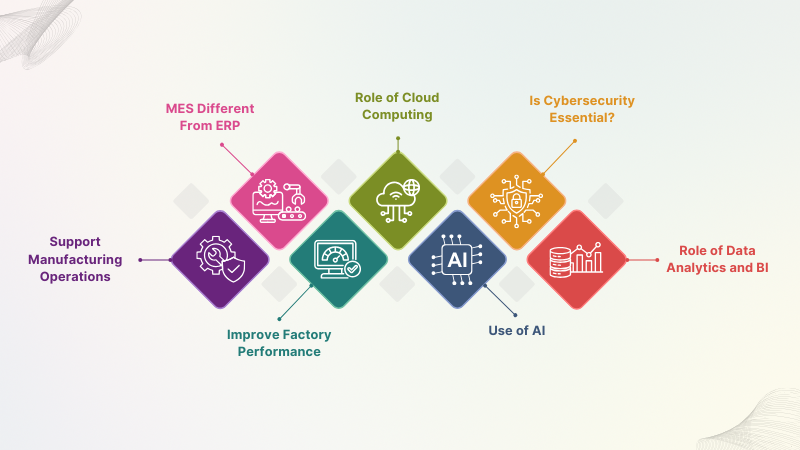
1. What Is ERP and How Does It Support Manufacturing Operations?
Enterprise Resource Planning systems centralize business operations. ERP connects finance, procurement, inventory, production planning and HR.
It creates a single source of operational truth. Manufacturers use ERP to align demand forecasting with production capacity. Inventory levels update in real time. Financial reporting becomes automated and accurate.
ERP ensures leadership sees operational performance holistically. It strengthens cost control and resource allocation.
ERP modernization projects focus on integration depth. ERP must connect seamlessly with plant-level systems.
2. What Is MES and How Is It Different from ERP?
Manufacturing Execution Systems operate at the shop floor level. While ERP manages business processes, MES manages production execution.
It tracks work orders, machine performance and quality control. MES provides real-time visibility into production lines. Supervisors monitor cycle times and defect rates instantly.
ERP answers, “What should we produce?” MES answers, “How is production performing right now?”
When integrated, ERP and MES create end-to-end transparency.
3. How Does Industrial IoT (IIoT) Improve Factory Performance?
Industrial IoT connects machines through smart sensors. Sensors capture temperature, vibration, output rate and usage data. That data flows into centralized analytics platforms.
Manufacturers use IIoT for predictive maintenance. Equipment failures can be anticipated before breakdowns occur.
IIoT reduces downtime and improves asset utilization. It supports energy optimization and process refinement.
4. What Role Does Cloud Computing Play in Manufacturing?
Cloud infrastructure provides scalability and accessibility. Production data becomes available across locations. Leadership teams access dashboards remotely.
Cloud systems reduce on-premise maintenance costs. They support faster deployment of updates and integrations.
Scalable cloud environments future-proof manufacturing growth.
5. How Is Artificial Intelligence Used in Manufacturing?
AI analyzes production data patterns. It detects anomalies and predicts performance trends.
It improves demand forecasting accuracy.
AI enhances quality inspection through vision systems. It optimizes scheduling based on dynamic variables.
Manufacturers move from reactive management to predictive control.
6. Why Is Cybersecurity Essential for Manufacturing IT Systems?
Connected factories require secure infrastructure. Cybersecurity protects intellectual property and production continuity. It safeguards operational technology environments.
Network segmentation, threat detection, and secure access control are essential. Strong cybersecurity frameworks reduce operational risk.
Enterprise transformation must prioritize protection alongside performance.
7. How Do Data Analytics and BI Improve Manufacturing Decisions?
Analytics platforms convert raw data into insights. Executives gain real-time performance dashboards.
KPIs become measurable and transparent. Analytics supports faster corrective action. It strengthens cross-functional coordination.
Data-driven leadership improves long-term strategy.
When these systems operate together, manufacturing becomes synchronized. Operations become measurable. Decisions become structured. Growth becomes sustainable.
How Do IT Solutions Improve Manufacturing Efficiency and Productivity?
Efficiency improves when visibility improves. IT solutions create that visibility. Modern manufacturing systems provide real-time performance data. Leaders no longer wait for end-of-day reports. They act immediately.
Downtime is reduced through predictive maintenance systems. Sensors detect equipment anomalies early. Maintenance becomes proactive, not reactive.
Production scheduling also becomes optimized. AI-driven planning adjusts for demand fluctuations. Capacity utilization improves across shifts.
Quality control becomes more precise with digital monitoring. Defect patterns are identified instantly. Corrective action happens before large-scale waste occurs.
Inventory accuracy strengthens through ERP integration. Overstocking and shortages reduce significantly. Working capital is used more efficiently.
Cross-department coordination improves as well. Supply chain teams access live production data. Procurement aligns with actual demand.
Analytics platforms provide KPI dashboards for leadership. OEE, throughput, scrap rate and cycle time become transparent. Data replaces assumption.
Enterprise deployments focus on measurable performance gains. Technology must improve output, not just infrastructure.
When systems are connected, productivity scales naturally. When insights are immediate, performance stabilizes. Efficiency is no longer incremental. It becomes systemic.
What Are Real-World Use Cases of IT Solutions in Manufacturing?
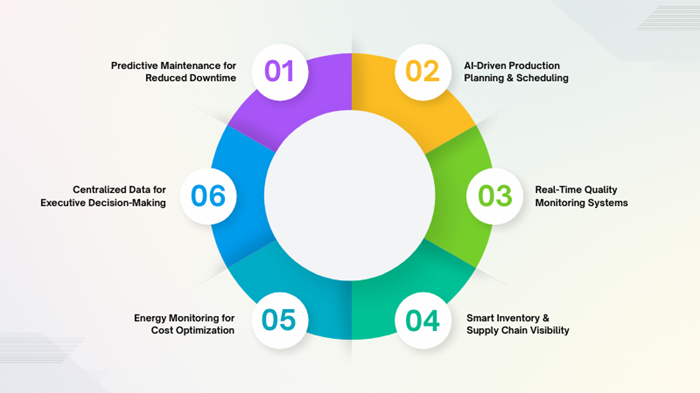
Technology delivers value when applied to real operational scenarios. Below are practical enterprise use cases transforming modern factories.
Technology delivers value when applied to real operational scenarios.
Below are practical enterprise use cases transforming modern factories.
How Does Predictive Maintenance Reduce Equipment Downtime?
Unplanned downtime impacts production schedules and revenue. IIoT sensors continuously monitor machine health indicators.
AI models detect vibration, heat, and performance irregularities. Alerts are generated before failure occurs.
Maintenance becomes scheduled and strategic. Spare parts planning becomes accurate. Production continuity improves significantly.
Manufacturers often see measurable improvements in equipment availability.
How Do IT Solutions Improve Production Planning and Scheduling?
Production variability creates bottlenecks. ERP and AI-driven planning tools analyze demand forecasts. Capacity constraints are identified early. Schedules adjust dynamically.
Supervisors gain better resource allocation control. Overtime costs decrease. Delivery timelines stabilize.
Integrated planning reduces operational friction.
How Does Real-Time Quality Monitoring Improve Product Consistency?
Quality control traditionally relies on post-production inspection. MES systems track production parameters continuously. AI-powered vision systems detect micro-defects instantly.
Non-conforming units are isolated immediately. Scrap rates decline. Customer satisfaction increases. Brand reputation strengthens.
How Do IT Solutions Optimize Inventory and Supply Chain Visibility?
Inventory misalignment affects working capital. ERP platforms synchronize procurement and production demand. Live inventory dashboards reduce stock discrepancies.
Automated reordering improves supply continuity. Supply chain teams respond faster to disruptions. Cash flow efficiency improves.
How Does Energy Monitoring Improve Cost Efficiency?
Energy consumption directly impacts manufacturing margins. IoT sensors monitor energy usage per machine. Analytics platforms highlight inefficiencies. Energy-intensive processes are optimized.
Sustainability goals align with cost reduction strategies. Operational expenses decrease systematically.
How Does Centralized Data Improve Executive Decision-Making?
Disconnected reporting delays strategic action. Integrated analytics dashboards consolidate plant-level data. Executives gain unified performance visibility. Cross-location benchmarking becomes easier.
Decision cycles shorten. Strategy aligns with real operational metrics.
How Much Do IT Solutions Cost for Manufacturing Companies?
The cost of IT solutions depends on scope, scale and integration depth. There is no single fixed number. Enterprise deployments vary based on plant size and complexity.
ERP implementation for mid-sized manufacturers typically ranges from $75,000 to $250,000. Large enterprise rollouts can exceed that significantly. Costs depend on customization, licensing, integration, and user volume.
Manufacturing Execution Systems often range between $50,000 and $150,000. Pricing increases when multi-plant visibility is required.
Industrial IoT deployments may begin around $30,000 for pilot programs. Full-scale sensor integration across facilities increases investment accordingly.
Cloud migration costs depend on infrastructure maturity. Hybrid models often reduce upfront capital expenditure.
Beyond software licensing, manufacturers should consider:
- System integration costs
- Data migration and cleansing
- Workforce training
- Change management planning
- Ongoing support and maintenance
The most important cost factor is integration quality. Disconnected systems increase long-term expenses. Return on investment often becomes visible within 12 to 24 months. Downtime reduction, improved OEE, lower scrap rates, and optimized inventory typically offset implementation costs.
Cost planning begins with operational mapping. Investment decisions align with measurable performance metrics. Phased implementation models also help reduce financial risk.
IT investment should not be evaluated as expense alone. It is an operational infrastructure for scalable growth. When structured properly, digital transformation delivers compounding value.
Biggest Challenges in Manufacturing IT Transformation
Manufacturing IT transformation is a strategic evolution, but it requires structured planning. One of the most common challenges is integration complexity. Many manufacturing environments operate on legacy systems that were not designed for modern interoperability.
Without careful architecture planning, new platforms can unintentionally recreate data silos. An architecture-first approach, supported by APIs and middleware, ensures seamless system communication.
Workforce adoption is another critical factor. Digital systems change workflows and increase performance transparency. Without structured training and leadership alignment, adoption may slow. Successful enterprises prioritize change management programs that build confidence and clarity across teams.
Cybersecurity also becomes more important as factories become connected. Linking operational technology with enterprise networks increases exposure risks. Strong network segmentation, role-based access control, and continuous monitoring are essential for protecting production continuity and intellectual property.
Budget overruns often result from undefined project scope or excessive customization. Phased implementation models with milestone-based governance help maintain financial discipline. Clear KPI alignment further protects ROI by ensuring that technology investments support measurable outcomes such as OEE improvement, downtime reduction, and scrap rate optimization.
Data quality is equally important. Legacy systems may contain inconsistent or outdated information. Structured data validation and cleansing processes should precede migration to avoid operational disruption.
When integration, workforce readiness, cybersecurity, financial governance and data quality are addressed proactively, manufacturing IT transformation becomes structured and sustainable. With proper planning, digital systems strengthen operational resilience while supporting scalable growth.
Choosing the Right IT Solutions Partner for Manufacturing:
1. Industry-Specific Manufacturing Expertise: A technology partner must understand manufacturing workflows, production cycles and plant-level operations. Generic IT knowledge is not enough. The partner should demonstrate experience with ERP, MES, IIoT and industrial integrations within manufacturing environments. Domain familiarity reduces implementation risk and accelerates measurable outcomes.
2. Integration and Architecture Capability: Manufacturing IT ecosystems require seamless system communication. Your partner must prioritize interoperability between legacy systems and enterprise platforms. API architecture, middleware planning and scalable infrastructure design should be core strengths, not afterthoughts.
3. Cybersecurity and Compliance Readiness: Connected factories demand secure infrastructure. A reliable partner implements role-based access control, network segmentation, and continuous monitoring frameworks. Compliance with industry standards must be built into the architecture from day one to protect operational continuity.
4. Structured Implementation and Support Model: Successful transformation depends on disciplined execution. Look for phased deployment strategies, milestone-based governance, and measurable KPI alignment. Ongoing support, system optimization, and long-term scalability planning are equally important for sustained performance.
Connect with Softprodigy to design an IT roadmap that delivers scalable efficiency and long-term competitive advantage.
Conclusion,
Manufacturing is entering a phase of intelligent acceleration. Data is shaping strategy. Integration is shaping performance. Visibility is shaping leadership decisions. IT solutions are no longer operational add-ons. They are foundational infrastructure for growth.
When ERP, MES, IoT, cloud, and analytics work together, manufacturing becomes measurable and scalable. Downtime reduces. Efficiency improves. Decision cycles shorten.
The advantage does not come from tools alone. It comes from structured implementation and aligned strategy. Enterprise manufacturers that invest thoughtfully today position themselves for long-term resilience tomorrow.
At Softprodigy, manufacturing transformation is approached strategically. Every initiative begins with operational clarity. Every deployment aligns with measurable KPIs. If your organization is planning digital modernization, the right time to structure it is now.
Partner with SoftProdigy to build a connected, intelligent manufacturing ecosystem that delivers performance, precision and sustainable growth.